Lone Japanese contender
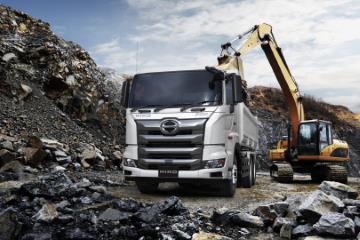
Hino, the sole Japanese participant amidst a predominantly Western and Eastern European truck lineup, is set to join the 2024 Dakar with its Hino 600 diesel-electric hybrid truck. The vehicle was unveiled in 2023.

The upcoming race will feature a prologue on the first day to determine starting positions, followed by 12 days of racing interspersed with a rest day. The total distance covered in timed special stages will span 5,000km, with an additional 3,000km on road sections. Commencing in Alula and concluding in Yanbu, the race will include a rest day in Riyadh.

The 2023 Dakar posed significant challenges for the Hino 600 Hybrid, which encountered fuel system issues initially and later grappled with numerous punctures. Despite the setbacks, the team persevered, ultimately finishing in 22nd place after briefly holding the eighth position.
Major development programme
Over the past year, the race truck has undergone an extensive development programme, primarily focusing on enhancing reliability. The truck is equipped with a straight-six turbo-diesel engine and a hybrid system generating nearly 800hp, which propel all four wheels through a six-speed transmission. The truck's weight is 8,300kg.

Team Hino Sugawara's race truck will be driven by Teruhito Sugawara, the team director, who has been a fixture in the Dakar since 2005. This marks his 24th Dakar participation (it’s his 17th as a driver). Before becoming a driver, Teruhito co-piloted in five events alongside his father, Yoshimasa Sugawara, a veteran of 36 Dakar Rallies who has since retired.

Teruhito achieved his highest ranking in 2001, securing second place overall while co-driving with his father. In 2018, as a driver, he claimed the sixth position overall. With an impressive record in the under 10-litre class, Teruhito has clinched victory 13 times. Joining him for the third consecutive year are co-driver Somemiya Hirokazu and mechanic Mochizuki Yuji.
Synonymous with Dakar
Hino is synonymous with the Dakar. Since 1991, the Japanese truck maker has participated in every Dakar Rally, and without fail, at least one Hino vehicle has successfully completed the event.

The 2024 Dakar Rally is expected to be exceptionally challenging. For instance, it will feature a gruelling 600km timed special stage spread across two days in the renowned Empty Quarter, often referred to as the Desert of Death. This edition will adopt a unique "48-hour marathon" format, prohibiting any external assistance. Competitors will solely rely on mutual support, fostering a spirit of self-sufficiency among participants.

There will be distinct routes for motorcycles and quads, as well as for cars and trucks. This implies that the leading cars each day will lack the advantage of motorcycle tracks to trail, emphasising the critical role of navigation in the competition.
Rally attracts 778 entrants
The 2024 Dakar Rally has attracted a total field of 778 vehicles, including 46 trucks in the main race and a further 14 trucks competing in the category for classics. There are 10 different makes in the main truck field. These are made up of Iveco (18), MAN (13), Tatra (four), DAF (three), Renault and Scania (two each) and Hino, Praga, Ford, and Ginaf (one each). Last year there were 56 trucks in the main field. There are no Russian Kamaz trucks in the field for the second year running due to the Ukrainian war.

“We are very pleased that Hino has decided to continue its participation in the Dakar Rally, which is considered the toughest motorsport event in the world, as it is an ideal proving ground for Hino’s core characteristics of quality, durability and reliability,” comments Anton Falck, Vice President of Hino South Africa.

“Hino has built up an amazing finishing record and this year will be of special interest as Team Hino Sugawara will again campaign the Hino 600 Hybrid that made its debut in this year’s Dakar. Hino South Africa currently has the Hino 300 Hybrid under evaluation for possible introduction to its range, so the racing Hino Hybrid is very relevant to Hino’s plans for new energy vehicles into the future,” concludes Falck.