Europe moves towards electric

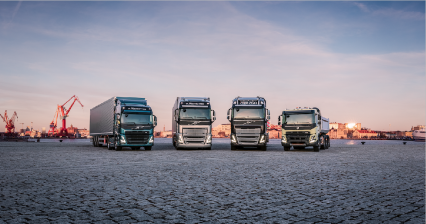
European truck makers and transport operators agree: electric is the future. In this regard, Volvo Trucks will start to sell three new extra heavy all-electric models – the FH, FM and FMX – in Europe this year. Production of these trucks will start in the second half of 2022 and they will complement the Volvo FL Electric, Volvo FE Electric and Volvo VNR Electric.
The FH Electric is suitable for regional and intercity transport and the FM Electric is a versatile truck for heavy local transport and regional distribution. The FMX Electric is a construction truck while the FE Electric is ideal for local and city distribution and waste transport and the FL Electric is suited to local and city distribution.
Range of up to 300 km

The Volvo FH, FM and FMX Electric have a range of up to 300 km and they offer continuous power of 490 kW, maximum torque of 2400 Nm and a battery capacity of up to 540 kWh. They have a gross combination weight (GCW) of up to 44 tons.
The Volvo FE Electric – with its GCW of 27 tons – has a range of up to 200 km. It features continuous power of 330 kW, maximum torque of up to 850 Nm and battery capacity of up to 264 kWh.
Boasting a GCW of 16 tons, the Volvo FL Electric has a range of up to 300 km. Its motor generates continuous power of 165 kW and maximum torque of up to 425 Nm. The battery capacity is up to 396 kWh.
50% of fleet to be electrified

According to the truck maker, almost half of all truck fleets in the European Union could be electrified soon. “More and more transport companies are realising they need to start their electrification journey right now, both with the environment in mind and for competitive reasons to satisfy customer requirements for sustainable shipping. With our wide and deep offering, it is totally feasible for far more transport companies to go electric,” says Roger Alm, President of Volvo Trucks.
“There is huge potential to electrify truck transports in Europe, and also in other parts of the world, in the very near future,” adds Alm. “To prove this, we have set the ambitious goal to have electric trucks account for half of our sales in Europe by 2030. And these three new extra-heavy trucks we are now launching mark a giant step towards reaching this target.”
And what of SA?

That’s the situation in Europe – but what about South Africa? According to Eric Parry, Senior Manager: Product Support for Volvo Trucks South Africa, local transport operators definitely do want electric trucks. “We see bigger blue-chip customers who have global pressure to reduce emissions being the first to actively use this type of driveline locally (companies that are not necessarily dependent on the local grid),” he reveals.
But mum’s the word on when the e-trucks will actually come here. “That timeline – when Volvo Trucks brings electric vehicles to South Africa – will be dependent on outcomes of local testing, so no time span can be communicated at this point in time,” says Parry.
What about price?

When the trucks do come here, the million-dollar question on the lips of all local operators will be this: when will the purchase price of an electric truck mirror that of a diesel-powered vehicle (if ever)? Parry doesn’t have good news in this regard. “This would be driven by economies of scale. For the foreseeable future they will remain at a premium over a diesel,” he warns.
Things could be different with total cost of ownership (TCO). “That is very operation dependent, some are significantly better, others are worse. Currently, we don’t have enough data to give definitive figures,” says Parry.
LNG to the fore

Meanwhile, the local company will continue to run tests on two Liquified Natural Gas (LNG) models. “Testing has had its obstacles,” concedes Parry. “These are mostly related to securing suitable refuellers. We hope to have definitive results by the end of this year.”
In Europe, LNG trucks are already big news. Iveco has been especially successful when it comes to trucks powered by natural gas. It will be fascinating to see if Volvo follows suit in this country.