Current situation
At the time of writing this article, the virus – which originated in Wuhan, Hubei province, China – had killed at least 1 670 people and infected some 69 000. Only three people outside China had died (one in the Philippines, one in Japan and another in France). Not surprisingly, the World Health Organization (WHO) declared that the coronavirus was a global health emergency.
The outbreak has had a massive impact on Chinese people – with some 60 million people facing travel restrictions. On February 16, the government of Hubei province banned vehicle traffic across the region in an attempt to curb the spread of the virus.
Impact on Chinese commercial vehicle industry
The disease has had a massive impact on the Chinese economy (as factories have closed, and employees have remained at home). But what is the effect on the Chinese commercial vehicle industry?
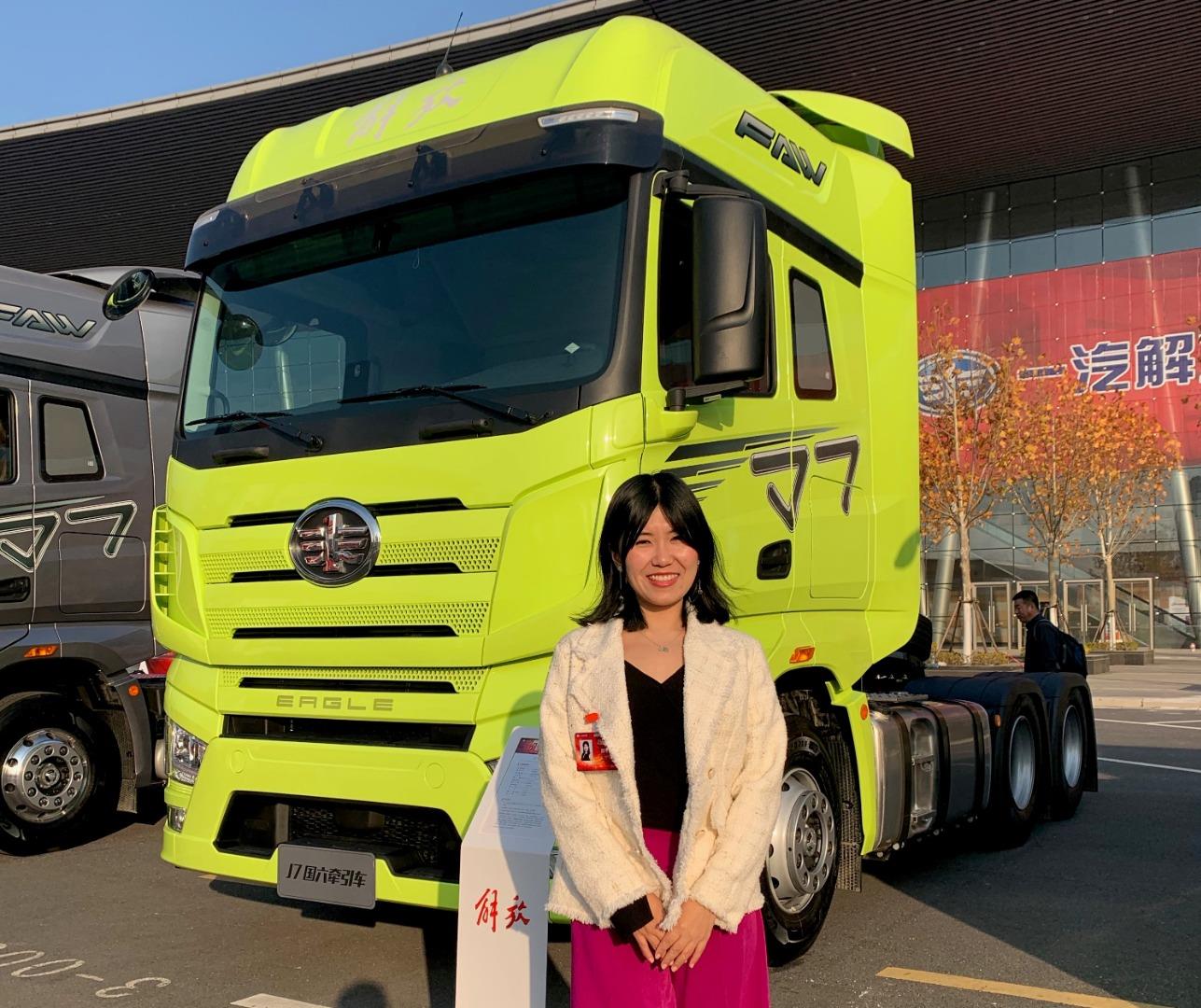
According to Zita Shao, executive chief editor of cvzone (China’s leading commercial vehicle website), the impact on the industry as a whole and her personally has been dire. (She’s pictured next to the bright yellow FAW J7.)
Shao works in Beijing but, like millions of other Chinese people, she travelled home to celebrate Chinese New Year (also known as Spring Festival or Lunar New Year) with her family. “My hometown is called Zhaodong. It is a small city 53 km from Harbin (the famous ice and snow fairy tale city in Heilongjiang province), and I went there to celebrate the festivities. But then – thanks to the outbreak of the virus – I was not allowed to leave,” she reports.
According to Shao, the control measures in Zhaodong are much stricter than in Beijing. “Since February 8, no one is allowed to travel – except for the doctors, policemen or related first-line staff. All vehicles are prohibited from the roads (except for the ambulances, police cars, epidemic prevention vehicles and goods vehicles). When we need food, it is ordered and placed outside our door. We don’t have any human contact with anyone else. Our entire family has been isolated for 25 days,” she reveals. She hopes to return to her office in Beijing in April – but this obviously depends on what happens with the virus.
Road closures
Things have been equally painful for the Chinese companies involved in the trucking industry, she says. “Many logistics companies believe the epidemic is a great test and will bring a big reshuffle to the logistics industry. This is now a totally different world for commercial vehicle manufacturers and the entire logistics industry. In order to control the spread of the virus, many provinces have implemented strict controls, which influence transportation. The large-scale movement of people is not desirable (because then the disease will spread). So many villages and towns are spontaneously closing roads, and highways in some areas have also been closed,” Shao reports.
The Hubei province is home to many automotive, truck and associated component manufacturers. General Motors, Honda Motor, France’s Groupe PSA and the Renault-Nissan-Mitsubishi alliance all have plants in Hubei. So does Dongfeng Trucks, and its plant remains closed. Suppliers in Hubei include BorgWarner, Lear, Tenneco and Visteon. An estimated 90 000 vehicles have not been built – thanks to factory closures.
These companies have done their best under the circumstances. “The commercial vehicle companies are trying their best to help fight against the coronavirus epidemic and support their customers during this hard time. On February 2, Foton Daimler officially announced that during the epidemic, all customers who require loans through Foton Daimler could apply for dormant (deferred) repayment, and they can apply through the mobile app. The top two CV manufacturers in China – FAW and Dongfeng – as well as other truck manufacturers have also introduced similar policies,” says Shao.
FAW is hopeful that the effects of the virus will be short-lived. “FAW Jiefang believes that the impact of the coronavirus epidemic on commercial vehicle production and market demand is short-term, and its overall impact on the domestic market is limited. The impact on overseas markets is mainly short-term – such as production and shipment, and personnel responsible for overseas sales being temporarily unable to return overseas,” says Hu Hanjie, general manager assistant of FAW Group and chairman of FAW Jiefang.
He believes that positive news is coming. “The impact on FAW Jiefang throughout the year will be limited. The country's strong epidemic prevention efforts can achieve results by the end of March, and the domestic economic situation will return to normal. Secondly, the whole country's development goals throughout the year will remain unchanged, and a series of measures will be introduced to support the economic development, so the total demand for the commercial vehicle market will not change a lot. Thirdly, production at FAW Jiefang resumed on February 10, and operations are gradually recovering, which will ensure that we meet domestic and overseas market demand. We have stepped up our overseas development efforts and hope that overseas sales will not be greatly disrupted,” he maintains.
The Chinese government is also endeavouring to assist. “If the annual permit for road transport vehicles expires but vehicle inspection facilities are temporarily unavailable due to the epidemic, the permit may automatically extend to 45 days after the end of the epidemic,” reveals Shao.
SA implications
But what of the local implications? Are companies purchasing or operating Chinese trucks or components likely to be impacted?
The good news is that most tyre companies are not situated in the Hubei province. However, according to Liana Shaw, editor of SA Treads (the only dedicated tyre publication on the African continent), some factories are facing challenges because, due to travel bans, their staff cannot get to work. “Production is being impacted as a result. Furthermore, according to the Tyre Importers Association of South Africa, delays due to shipping backlogs could occur. More worryingly, price increases could be on the horizon,” she warns.
The news on the trucking front is better. According to Brent Smith, brand manager at FAW Vehicle Manufacturers SA, the company has not experienced any negative impact since the outbreak of the coronavirus. “Our production and parts supply remain unaffected at this stage,” he says.
It’s more of the same from Ever Star Industries. “We have not been affected by the coronavirus. There are no delays; our stock has arrived according to schedule. We are also up and running when it comes to parts availability...customers can rest assured that we will have parts in stock,” says Naseera Barnard, the company’s marketing manager.
In order to help their Chinese colleagues, Ever Star Industries has purchased thousands of face masks and has sent them to China. So, on a local front anyway, it seems to be a case of good news all round.
Photographs by Macau Photo Agency on Unsplash and by Gerd Altmann from Pixabay.