Away with wheel alignment woes!
The cost of incorrect wheel alignment on a truck can be astronomical – and yet this is something we see on South African trucks (and indeed trucks the world over) all too often. An Australian invention, however, could see this situation change dramatically.

Why is wheel alignment important?
Wheel alignment on trucks is vital. If the wheels on trucks are misaligned, even by only a small degree, the engine has to work harder to make the vehicle move. According to Bridgestone South Africa, wheel alignment reduces operating costs through longer tyre life. But that’s just the beginning. Not only do tyres on a properly aligned vehicle last longer, but some manufacturers suggest that there are significant improvements in fuel economy and even less driver fatigue. Additional benefits include reduced carbon dioxide emissions, less stress on mechanical components, improved driver comfort and safety and a reduced potential for tyres overheating.

Industry experts differ in their predictions when it comes to the actual impact on tyre wear and fuel consumption. Australia’s Active Truck Alignments promises increased fuel economy (up to 7.5%) and increased tyre life (up to 10% improvement in tyre wear). Haweka South Africa, on the other hand, claims that correct wheel alignment saves up to 10% in fuel costs and increases tyre life by up to 25%.
Scientific study shows impressive results
A June 2006 study in the United Kingdom (UK) by Freight Best Practice probably provides one of the best scientific estimates of the benefits of proper wheel alignment. The study was conducted at two UK transport operators, namely Kidds Transport and Co-operative Retail Logistic (CRL) Distribution. Both companies incorporated laser wheel alignment into their preventive maintenance programmes – and the benefits were quite remarkable.

Kidds Transport reported fuel savings of up to 18.6% on articulated trucks and up to 11% on rigid trucks. Steered axle tyre tread life went up from 180 000 to 220 000 km (an increase of 22% in tyre life). Drive axle tyre tread life improved from 280 000 to 310 000 km (an actual increase of over 10% in tyre life). Super single tyre tread life increased from 65 000 to 75 000 km (an increase of 15% in tyre life). The company reported added safety as aligned tyres were less likely to overheat. The drivers gave wheel alignment the thumbs up too. "The drivers are less fatigued when not fighting to keep the vehicle in a straight line,” noted Martin Morris, Fleet Engineer at Kidds Transport.
CRL Distribution reported that steered axle tyre tread life rose from 70 000 to 140 000 km (an increase of 100% in steer tyre life). Drive axle tyre tread life improved from 140 000 to 160 000 km (an actual increase of 14% in tyre life). This company also reported added safety and reduced driver fatigue while noting that wear on mechanical parts had reduced.

Despite this convincing evidence, many South African transport operators still fail to give wheel alignment the attention it deserves. “Wheel alignment is extremely important, but it is unfortunately not well managed by local transporters. There are also fly-by-night wheel alignment companies that give the profession a bad name,” reports Brian Clarke, sales manager at Bandag South Africa.
One of the reasons for this sorry situation could be the fact that operators don’t want to take their trucks off the road. After all, a truck that’s stationary doesn’t earn revenue. Imagine, then, if that did not need to happen – because trucks were able to adjust their alignment orientations on-the-fly…
No pipedream
Active wheel alignment is no pipe dream; an Australian company by the name of Doftek is well down the road in terms of bringing this to market.

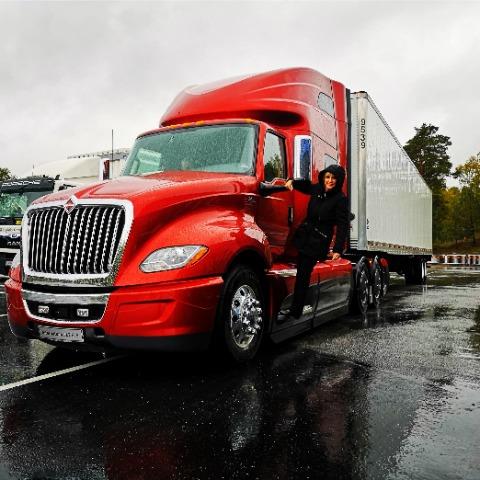
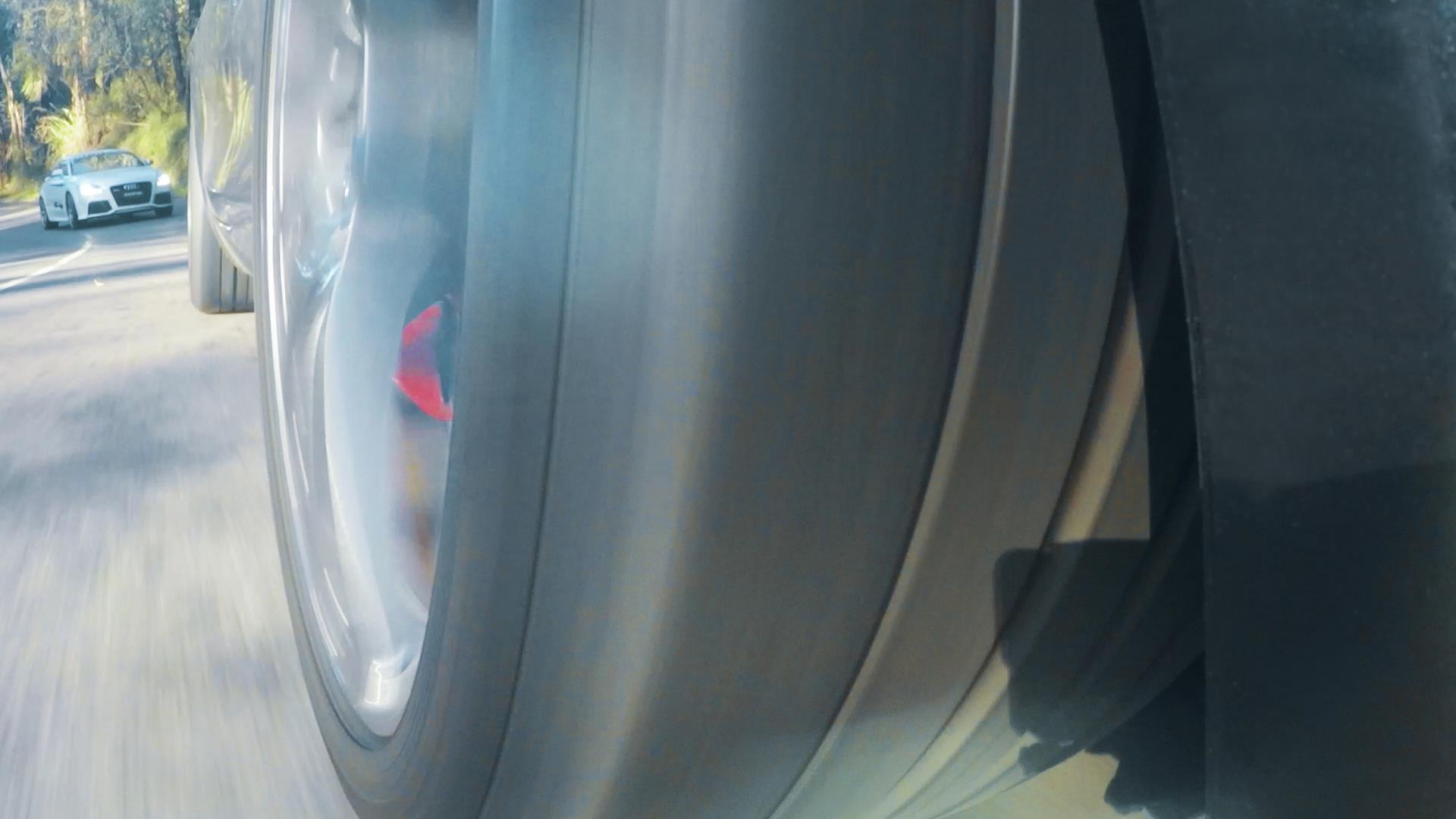
The Doftek Active Wheel Alignment System (AWAS) was developed by husband and wife team Geoff and Priscilla Rogers (pictured above) and business partner Dr Paul Dowie – and it’s a world first. The company’s website explains that the AWAS allows the contact patch between the tyres and the road to be optimised at all times. “We achieve this by providing rapid and precise electronic control of wheel alignment parameters, in particular camber and toe, in real-time,” it explains. Doftek says that the system will reduce rolling resistance and tyre wear by 10%.
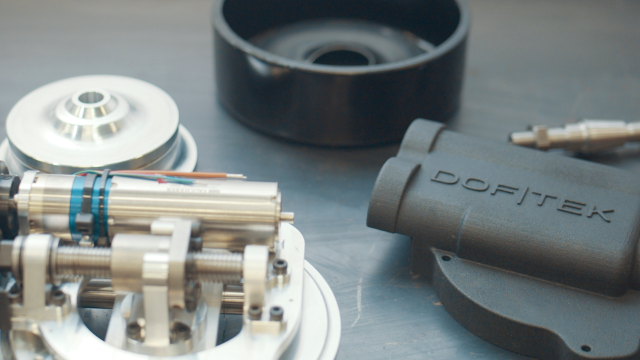
According to New Atlas, the AWAS can be fitted to the front – or all – wheels of a passenger vehicle, to the wheels of a prime mover truck, and to the truck’s trailer wheels. “Some truck manufacturers are now looking at his product because of its advantages, specifically at a time when emissions and fuel use are becoming stringently regulated,” Geoff Rogers told the website.

The AWAS could be licensed to vehicle manufacturers or offered it as an aftermarket product. “We are currently developing partnerships with global car and truck manufacturers. Through these partnerships, we very much hope our products will make their way to South Africa soon!” says Priscilla Rogers.
Either way, it seems as though transport operators’ wheel alignment woes could soon become a thing of the past.