
Taking logistics management one step further
Taking logistics management one step further



By Colin Windell
Managing a fleet of delivery vehicles is one thing. Managing them and being able to quickly and efficiently update customers whose own business could be adversely affected by late arrival, is entirely something else.
Making logistics work
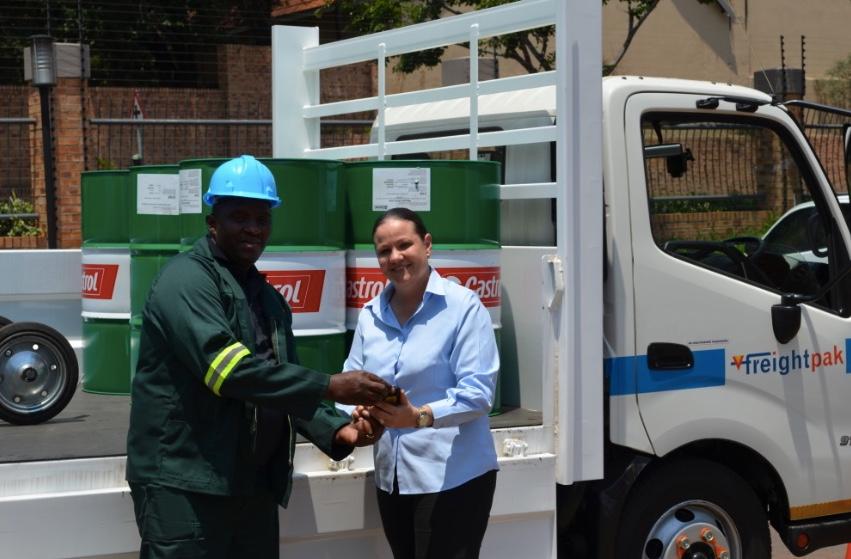
The knock-on effect of deliveries delayed for whatever reason can be quite serious and Castrol in South Africa has taken the challenge of making real-time tracking of multiple transporters making more than 100 deliveries a day to the next level.
This means it can provide updated information to customers about expected versus actual time of delivery.
Melanie van Straaten, Africa Logistics Manager, BP Southern Africa, says: “Key to being a truly customer-centric and customer-focused business, we realised there was a real need to introduce an execution measurement system to track and trace our deliveries, thus ensuring real-time and ongoing communication with our customers – car dealerships, retail outlets and distributors across Gauteng – during the process.
“In collaboration with our transport solution partners, we introduced Trackmatic software into the transporter fleets. It is a people-led, technology-enabled mobile solution that has enabled us to provide the service our customers expect and set us apart from our competitors, while simplifying and streamlining our operations.”
Understanding the transport industry challenges, the Trackmatic solution provides end to end, real-time delivery visibility at every touchpoint on the road to multiple stakeholders via a web-based solution. For Castrol, the implementation of the software logistics solution has enhanced the customer experience through systems-driven planning and performance monitoring.
“The team is now in a position to keep the customer informed of the exact delivery progression using an automated email system that communicates the Estimated Date of Arrival directly to the customer. The order is placed with Castrol either through the customer services unit or via the New Customer Order Portal.
“The dispatch team is then in direct communication with the customer from the initial email alert advising them that the delivery has been dispatched from our depot and their order is en route. A second email notification confirming that the delivery has been completed, is sent to the customer once the goods have been accepted at the delivery point, and includes a snapshot of the on-glass signature,” says Van Straaten.
To streamline the process, each customer address location has been geocoded into a secure database that enables the driver to be directed to the customer site using GPS technology embedded in a singular dashboard. This also informs the driver of the most efficient and cost-effective route to take, as well as the forecasted arrival time. If there are any traffic delays or problems en route to the customer, the data gets updated immediately to alert the customer, and the driver can make informed decisions regarding safe and alternative routes to follow.
“While the Trackmatic solutions are already providing our customers with a 98% on-time execution solution, we are looking to introduce enhancements in 2019 to further improve the overall customer satisfaction experience. If for example a vehicle reports a 30-minute or more delay to customer A, an email will automatically be generated and sent to customer B, advising them of the delay and updating the expected delivery time. This system is all about the customer,” she says.
The efficiencies and effectiveness of the system have also had a positive impact within Castrol. A 20% cut down on calls from customers querying order delivery times to the Customer Services Unit and Sales teams has been recorded, enabling these employees to focus more on their core business operations.
Following its successful implementation in Gauteng, Kwazulu Natal and Cape Town, Castrol is now looking to roll-out the Trackmatic solution to its operations in Limpopo Province by the end of December 2018 with further plans to roll out to Mpumalanga, Eastern Cape and the Western Cape in 2019.