
Loaded with technology and handsomely styled - the Volvo XC90 T8 AWD
Loaded with technology and handsomely styled - the Volvo XC90 T8 AWD


By Martin Pretorius
It's loaded with technology, handsomely styled, and makes some serious performance- and efficiency claims. But are the Volvo XC90 T8's promises realistic, and how much of that technology is useful in the real world? We've spent some time with Volvo's flagship SUV to find out.
First impressions
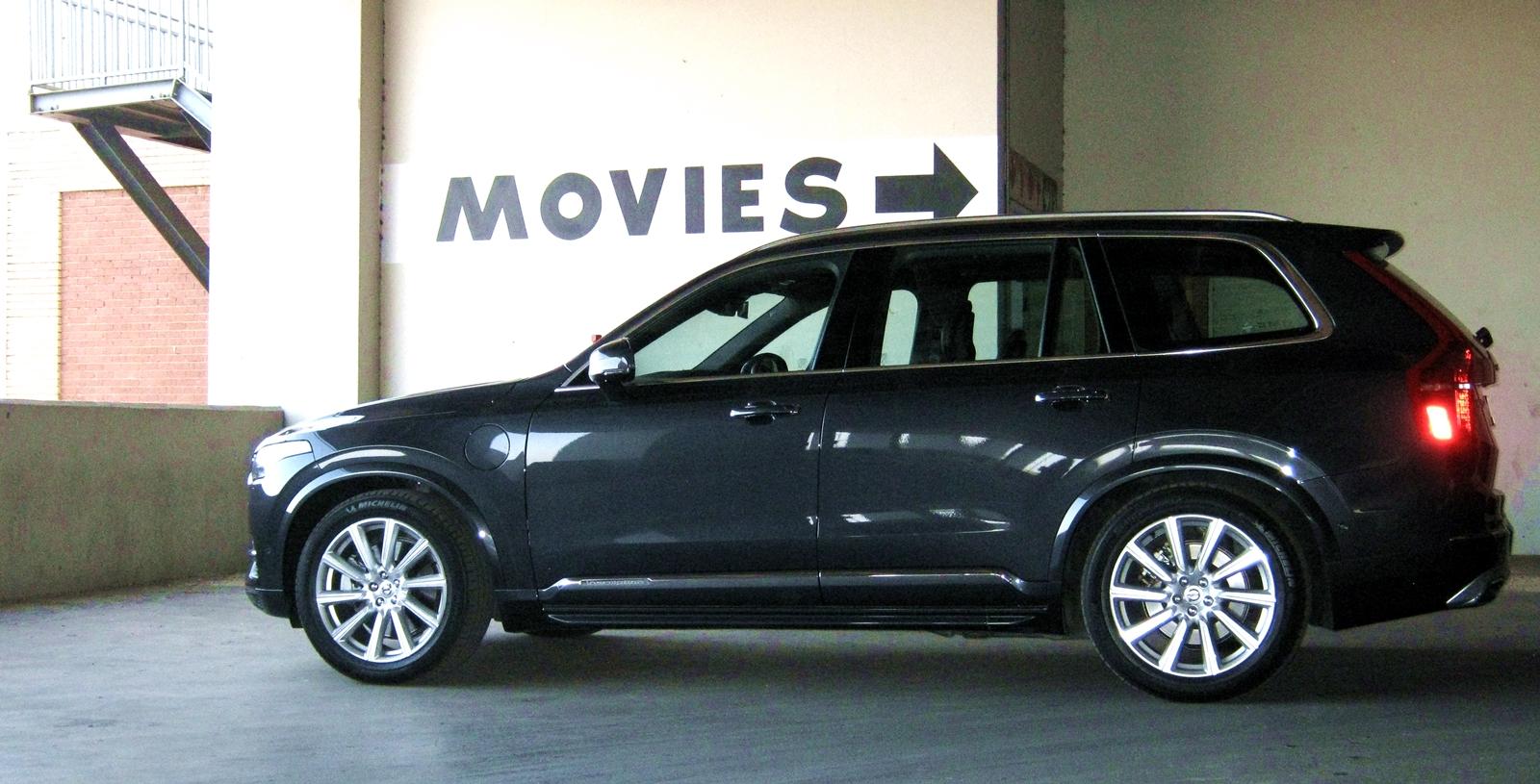
At first glance, our test car looks just like any other XC90 derivative in mid-level Inscription specification. Finished in a dark gunmetal colour, it is cleanly styled and very handsome, with an appealing blend of squared-off shoulders and rounded edges, capped off by a big, bluff grille at the one end and delicately-detailed tail lights at the other.
Discreet styling
Some brightwork around the grille and side glass, on the bumpers, and down its flanks breaks the severity of the dark paintwork, but it still errs to the conservative side. Badging is kept to a minimum, with only a smattering of trapezoidal identifiers on the tailgate giving any clue that this is an unusual car. It rides on the standard 20-inch alloy wheels, and features very little other bling to draw too much attention. Sober, classy, and discreet – that's the Volvo way.
Inside the cabin
Opening the hefty-feeling door, the cabin greets onlookers with an equally sober, upmarket but high-tech ambience. While the dashboard is trimmed in no-nonsense soft-touch plastic, the door panels, seats and steering wheel are upholstered in almost-black Nappa leather, lending a really plush feel to the cabin.
Neat details abound, such as an illuminated Orrefors crystal gear selector, knurled drive mode controller and trim strips made from finely woven stainless steel strands. There is a Swedish simplicity to the décor, which might actually have been a tad sombre, were it not for the duo of bright digital displays – one serving as instrument cluster; and an iPad-like touch-screen above the centre console serving as primary man-machine interface.
One screen to rule them all
About that central display: it looks very futuristic, set in its piano-black surround, and it's fairly responsive and intuitive, but the sheer number of features under its control means that some concentration is needed to operate it while on the move. It also suffers from the usual touch-screen bugbears of showing finger smudges and less-than-perfect legibility in certain light conditions. Some simple twist knobs for air-con controls would also not go amiss.
Comfort comes first
Being a Volvo, it almost goes without saying that the (electrically adjustable) seats are absolutely superb: comfortable and cosseting, but with exactly the right amount of support in all the right places. This test car features extending leg supports, adjustable side bolsters, heating and ventilation, and a selection of back massage options – making traffic jams something to actually look forward to.
Audio extravagance and loads of space
The sound system is equally impressive, with an (optional) thundering 19-speaker Bowers & Wilkins audio setup to impress even the most jaded car audio connoisseur. There is also plenty of space in the two front rows of seats, with the middle row featuring independent backrest- and sliding adjustments, and air-con outlets and controls for all seating zones.
The rearmost seats are mostly for occasional use, and will spend most of their time folded into the boot floor, but small adults or children relegated to this row will appreciate the thoughtful cupholders and arms rests, integrated into the side trim panels.
Riding on air
The test car is also equipped with adaptive air suspension, which clearly prioritises comfort above all else. Only the sharpest road shocks ever makes their way into the cabin, but the ride quality is otherwise exemplary – remarkable, given those huge wheels and low profile tyres. What the air suspension cannot do is disguise the XC90's size and heft under more enthusiastic driving conditions. Body roll through the corners is quite pronounced (an effect amplified by the elevated seating position), and hard acceleration and sharp braking has the nose lifting and diving rather emphatically.
The air suspension compensates with a nifty trick, though: upon start-up, the car would lift itself off the ground for a proper SUV stance, and when shutting down or selecting an “Eco” drive mode, it would hunker closer to the ground to respectively ease entry/egress and reduce drag.
Just like a normal XC90, then...
Up to this point, it isn't all that different from any of the other XC90s we've driven, but looking below the surface, that perception changes quite dramatically. The XC90 T8 has a few tricks up its sleeve, and while it still rides, looks and functions the way a Volvo should, it is a fundamentally different proposition – and that is all down to the drivetrain. Those tiny badges on the tailgate give some indication, with the two which stand out reading “Twin Engine AWD” and “Polestar+”. Things are about to get interesting...
Twin engine? How does that work?
The front half of the T8 is familiar from the T6 version, with a twin-charged (both turbo- and supercharged) 2.0-litre 4-cylinder turbo-petrol mill, driving only the front wheels through an 8-speed torque converter autobox. The big difference comes in the absence of the T6's Haldex all-wheel drive system, which leaves the tortured front tyres to manage the full compliment of petrol-powered ponies - 235 kW and 400 Nm, to be exact. The T8 has a battery pack where the driveshaft to the rear axle would live in the T6, feeding an electric motor which powers the rear wheels only. This gives a new system total of 300 kW and 640 Nm for the “normal” T8. However, our test car was also optimised by Polestar to liberate an extra 11 kW and 40 Nm.
It's powerful, so it must be thirsty as well?
311 kW and 680 Nm pitches the XC90 T8 bang in the middle of a gaggle of high-performance SUVs such as the BMW X5-50i and Mercedes-AMG GLE43. It out-torques them both, and plays second fiddle only to the BMW as far as the kilowatt output goes. But it's also a hybrid, which means that it claims some remarkable economy figures.
Consuming a mere 2.1 ℓ/100 km in the NEDC test cycle, that claim seems wildly optimistic for a big, tall and heavy 7-seater SUV, especially since not even the smallest city car can even come close to that figure. How does reality compare to those fanciful figures?
It can be extremely economical – under the right conditions
Depending on the usage pattern, the XC90 T8 can present really startling fuel economy. In daily driving duties, which entail coping with heavy traffic and round trips of up to 35 kilometres or so, it is entirely possible to reach your destination without using a single drop of petrol.
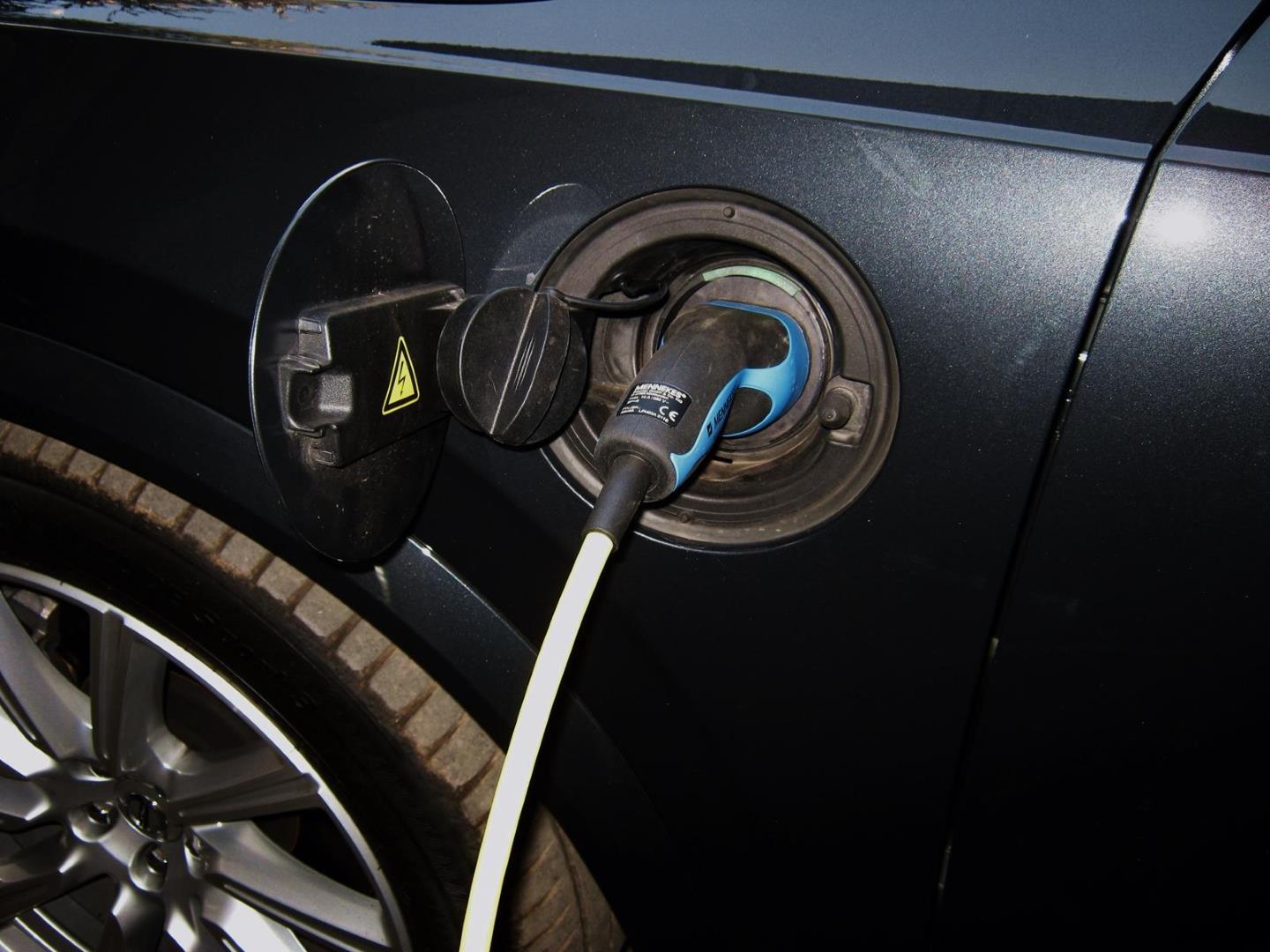
Of course, this means that the batteries have to be fully charged when you set off, but that's easy enough to do by simply connecting it to a nearby 220V power point via the supplied charger unit. Recharging the battery from a mains power outlet takes about 3 hours and costs around R20. The batteries also regenerate in the usual hybrid way, by harvesting energy from the wheels under braking.
Saving fuel in town
When driving on battery power alone, acceleration is rather leisurely (higher power demands would have the petrol engine starting up and helping it along), but it is quite sufficient to keep up with the traffic flow. Longer (urban) trips, higher speeds and steep inclines obviously need some petrol assistance, but even then, it still registers low single-digit consumption figures. Trip computer readings between 1.7- and 3.6 ℓ/100 km are easy to achieve – remarkable figures for any car, let alone for something of this size and weight.
The open road tells a different story
Longer trips and higher speeds present the other side of the plug-in hybrid equation. Eventually, the batteries will run dry, which will leave all propulsion (and some battery-charging duties) to the petrol engine. And while it might be a thoroughly up-to-date, downsized petrol engine, it simply can't match the diesel variants on open-road consumption. Count on the trip computer reading in the 9 ℓ/100 km bracket on long trips, with enthusiastic use of the accelerator pushing it well past 10 ℓ/100 km. The T8 is optimised for urban driving and heavy traffic, and there's no doubt that an XC90 D5 would use a lot less fuel on a cross-country dash.
T8 and Polestar makes for explosive performance
Although the XC90 D5 would be a fair bit lighter on fuel, it just cannot do what this T8 does so easily, which is to accelerate with genuine vigour. Once the novelty of extracting the biggest distance from the batteries wears off, the temptation arises to bury the accelerator pedal in the carpet. This is where the T8 shows its rather surprising duality of character, for while the suspension is tuned for comfort, the drivetrain bristles with vitality.
It's like somebody slipped double espresso into the decaf coffee maker at the engineers' offices – everything about the XC90 proclaims its maturity, but then the power plant betrays that promise with some serious hooliganism. Volvo claims a 0-100 km/h sprint in 5.6 seconds for the standard T8, and this “Polestar optimised” variant is obviously even quicker. On-road performance certainly doesn't disagree with this claim, because the T8 hurtles down the road with the urgency of a really hot hatchback.
Traction in short supply
The traction control actually struggles to keep the front tyres from lighting up, and there is sustained thrust well into the territory where those friendly people in brown uniforms would confiscate your license and send you straight to jail. It definitely has the performance angle well and truly sorted, with massive and immediate urge on tap for overtaking, and a governed top speed of 230 km/h.
Volvo-levels of safety
If safety is your primary concern, the XC90 would probably be the beginning and end of your car-shopping mission. Forget about normal things such as stability control and 7 airbags (they're all there, of course), and rather look at Volvo's “City Safety” system: it incorporates automatic emergency braking, pedestrian- and cyclist detection, “run-off-road mitigation with impact-absorbing seats” (which detects when the vehicle leaves the road and then adjusts the seats to reduce spinal impacts), and automatic braking at intersections (to keep the vehicle from veering into the way of oncoming traffic). If there's a safety gadget, this Volvo has it.
Technology everywhere
Not all the other gadgets are as successful, however. The adaptive LED headlights sometimes gets confused by the surrounding traffic and flashes a bright white beam at an oncoming car, and Volvo's “Pilot Assist” (a combination of lane keeping assistance and adaptive cruise control) struggles to cope with Gauteng drivers who keep on slotting into the gap between the XC90 and the car ahead. These gripes are more about this technology in general and less about Volvo's implementation, though – these features are less-than-perfect in just about every car so equipped.
Hybrid: Hype or merit?
If you use your SUV for long road trips, it doesn't really make sense to choose an XC90 T8 over a D5 – the diesel will cost you less both to buy and to drive from Johannesburg to the coast, it's as simple as that. But if you're mostly confined to the city, and your parking space has easy access to a mains power outlet, the T8 makes a really strong case for itself.
And if you're in the market for a performance SUV (albeit not quite up in the realm of the X5M or GLE63), this is the only Volvo capable of satisfying that need. Seen in this context, the fuel consumption penalty (compared to a D5) is less severe, because it is significantly more parsimonious than anything else of comparable performance.
Swedish split personality
That's perhaps the nicest thing about the XC90 T8: it's quiet and comfortable on the school run, but there's enough power underfoot to blow pesky GTIs into the weeds, while still saving fuel en route to the office. This elevates the T8 from being a mere transportation device to a genuine fun car, and in the process gives it a unique character. Fun and frugal (sometimes), the T8 is an SUV unlike any other.
Volvo XC90 T8 Twin Engine AWD Polestar Specifications:
| Engine | :1969 cc Petrol 4-cyl, turbo charged, intercooled, Hybrid |
| Gearbox | :8-speed torque converter automatic, all wheel drive |
| Output (combined) | :311kW, 680 Nm |
| Performance (claimed) | :0-100 km/h in 5.6 seconds, max speed 230 km/h |
| Consumption (official) | :2.1 ℓ/100 km average (urban), 7.7 ℓ/100 km (test ave.) |
| Luggage compartment | :314-692-1947 litres (with 7 seats, 5 seats, or maximum) |
| Price (before options) | :R 1,175,600 (Inscription trim) |