
Volvo V90 T6 AWD Cross Country: Who needs an SUV anyway?
Volvo V90 T6 AWD Cross Country: Who needs an SUV anyway?



By Martin Pretorius
Volvo knows a thing or two about estate cars (or station wagons, as many of us know them). They’ve been making them for decades, after all, and they’ve become really good at making them. But they’ve been making SUVs for quite a while as well, and those also turned out very nicely indeed. For proof of this, just take a look at the excellent Volvo XC90 and XC60, both currently into their second generations, and now augmented by the cute little XC40. But what happens when you take two of Volvo’s key strengths and mix them into one modern car?
Well, you’ll get a real crossover, in the purest sense of the word. Taking its bodyshell from the very attractive V90 estate, and then raising the ride height a bit and adding some plastic cladding, Volvo attempts to combine the important characteristics of their traditional estate with a dash of SUV attitude. Volvo’s been pulling this trick for years, ever since the first V70 Cross Country hit the roads back in the 1990s, so it obviously works for them. This is apparently meant to create the station wagon for buyers who don’t want to feel like outsiders among all those SUVs at the golf club. Sounds fine in theory, but how well does it work?
Styling
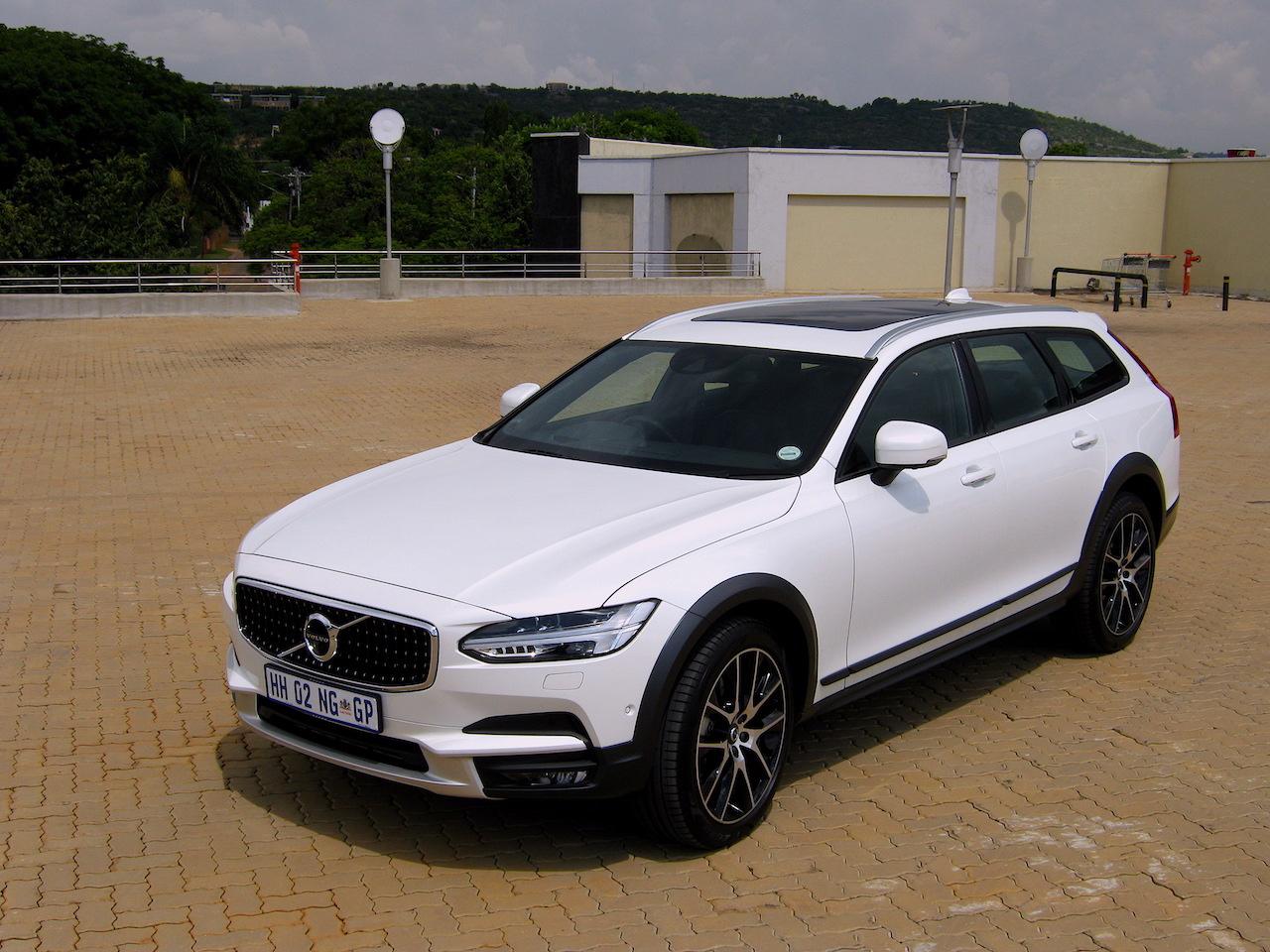
I loved the styling of the red S90 D5 R-Design I drove earlier this year: it had just the right combination of style and aggression, and carried an air of understated elegance. But, while this white V90 Cross Country (CC for short) is a good looker in its own right, it’s nowhere near as sleek as the sedan, so it’s not really my cup of tea.
This is exactly what the Volvo stylists wanted to achieve, though – the CC is supposed to be more imposing than the unadorned sedan, and it’s certainly successful in this regard. Nonetheless, I’d still rather have a lower-riding, smoother-surfaced “normal” V90 station wagon (or an S90 sedan) in my driveway, but that isn’t available here. Remember, South Africans don’t buy normal estate cars!
The best bits of the normal S/V90 styling themes remain, however: the wagon’s long roof is gracefully integrated with the S90’s tapered shape and in no way seems like an afterthought, and those tautly-drawn shoulder lines flare out neatly into distinctive C-shaped tail lights. Up front, you’ll find Volvo’s gaping grille and “Thor’s hammer” headlight details, even though part of its face is now bedecked with black plastic. The black plastic extensions wrap around the lower bumpers, door sills, and wheel arches, and at least offer some protection against fender damage in the mall parking lot.
This isn’t a Volvo wagon in the traditional sense, because the tailgate’s upper half lies at an angle – forget about those boxy old Volvos, this is New, Sleek Volvo. As a result, the load bay is a bit less capacious than Volvo’s older fare, but this compromise is worth it for the styling improvement alone. As for the SUV-like bits, that black plastic cladding and aluminium-look roof rails comprise the sum total of cosmetic changes. Well, that and the raised ride height, which adds about 70mm of extra ground clearance for the slightly tippy-toe stance buyers apparently prefer.
The Drive
The extra air between the V90’s belly and the tarmac doesn’t ruin the driving experience, however. It’s just about as athletic as the low-riding sedan, but with an added measure of compliance (due to the increased available wheel travel) and an improved ability to cope with poor road surfaces and speed bumps. The ride quality doesn’t suffer, either, and may just be even more comfortable than the aforementioned S90 sedan managed. That car rolled on optional 21-inch wheels, which gave a slightly brittle low-speed ride, while this V90 CC’s optional (and very pretty) 20-inch alloys eliminates that minor issue. The optional rear air suspension fitted to this test car certainly doesn’t do its ride comfort or driving dynamics any disservice, either.
As with the other two “90” series cars (S90 and XC90), the V90 marks a bit of a departure from the engineering norms. Like the others, the V90 CC is propelled exclusively by some variation of a 2.0-litre four-cylinder engine in either petrol-or diesel flavour. The T6 AWD variant uses a twin-charged (turbo- and supercharged) petrol mill, good for 235 kW and 400 Nm. The power goes to all four wheels through an 8-speed torque converter automatic and an electronically-controlled on-demand AWD system.
As a result, the traction is unbreakable and the driving experience is confidence-inspiring, even with the extra suspension compliance. Slinging the big wagon along a twisty road is a surprisingly drama-free exercise, even if it’s not quite as agile as it could be – that’s the higher centre of gravity speaking. But, with all things being equal, the handling balance shows no vices: understeer is well-contained, the steering system is accurate and responsive, and stability under heavy braking is first-rate. In short, there are few serious compromises involved in the V90’s transition to the Cross Country format.
Performance
While a 0 – 100 km/h sprint in 6.3 seconds and a governed top speed of 235 km/h (Volvo’s claims) are not to be sneezed at, it’s about par for the course in the million-Rand Crossover class. The power delivery is gentlemanly rather than aggressive, with a smooth pull-away and unobtrusive-but-quick gear changes. Don’t let its civilised demeanour fool you, however: that small engine (for a car of this size) shunts the V90 C around with considerable authority. The engine’s torque curve is essentially a flat line, running at its peak value from 2200 r/min to 5400 r/min, making all of that wholesome boosted surge available over a very wide rev range.
Sure, the engine does feel a bit breathless on the far side of 6000 r/min, but with such a chunk of torque available lower down the rev counter, there’s no real need to wind it out anyway. Earlier gearshift points also cut down on the cabin’s noise levels. It’s not exactly noisy, but at very high engine speeds, some induction roar and four-cylinder gruffness squeezes past the otherwise exemplary sound insulation.
Fortunately, the slick-shifting gearbox helps make the most of the engine’s optimal operating range, and very good transmission control software ensures that the appropriate cog is always selected before the driver even realizes that a gear change is needed. Should the need arise, the gearbox can be prompted into another ratio through the steering column-mounted shift paddles, but this kind of intervention is very seldom required. In fact, some other many-speeded gearboxes could learn the arts of anticipation and decorum from this Aisin-sourced automatic.
Space and Comfort
Being a modern Volvo, comfort is a given. For starters, the seats are as comfortable as your favourite easy chair, only with extra side support. Leather trim features heavily on the seats, dash top, door cards, steering wheel and gear shifter, and both front pews are heated, cooled, electrically adjusted, and have memory and built-in massage functions as part of the (R70 500) Premium Pack.
Also included in this pack is blind spot assistance, adaptive cruise control with traffic jam assistant, lane-keeping assist (as part of Volvo’s Pilot Assist system), a 360-degree camera arrangement, and a thundering Bowers and Wilkens audio system. Some of these items are optional, but all of them are must-haves. Volvo’s excellent (and very pretty) touchscreen infotainment system and central control display features prominently in the middle of the dashboard, and it seems to work better with each new model introduction – the V90 CC was entirely free of those small gremlins which could pester earlier XC90s.
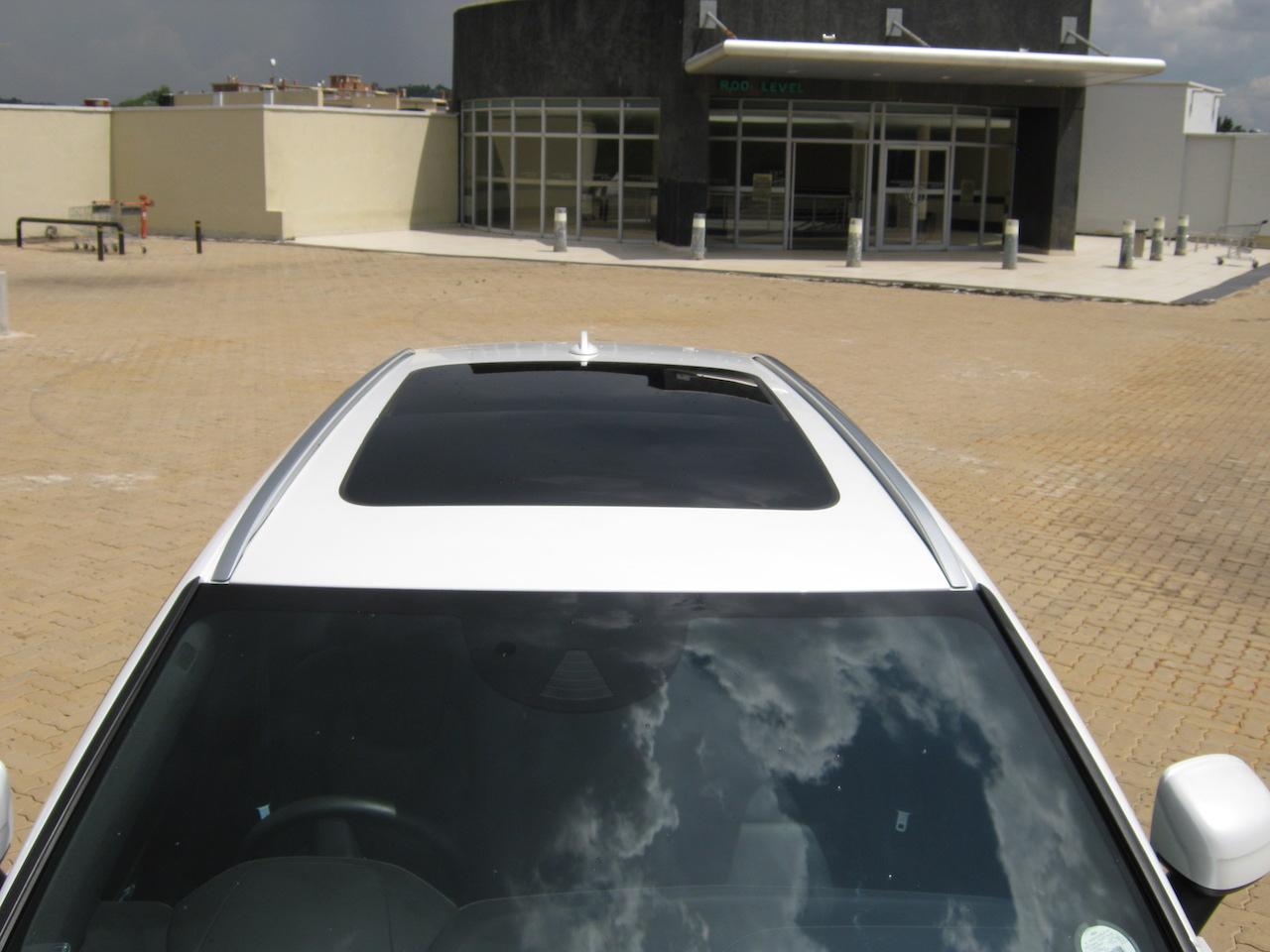
Comfort is given a further boost by ample cabin space and really good seating positions. The cabin was finished mostly in shades of black and dark grey, but a large panoramic sunroof let enough light into the interior to keep the atmosphere from becoming oppressive. Five large South Africans will find enough space to stretch out, and the luggage space is very useable as well: there’s 560 litres available under the neat roll-up cover, growing to 1526 litres with the rear seats (electrically) folded down. The load lip isn’t too high, the tailgate aperture is large, and the loading area is smoothly-shaped, which makes it clear that Volvo has been doing kind of thing for a while. Inside the cabin, there are plenty of covered compartments scattered throughout, while the door pockets are deep and have good accessibility.
Safety
Predictably, the V90 CC scores a perfect 5-star Euro NCAP safety rating, and has every conceivable safety aid from 6 airbags to automatic emergency braking. Volvo’s Sensus early-warning system primes the car for a collision before it happens, and will even apply the brakes if it senses that an oncoming car is heading your way at an intersection. There’s a cross-traffic alert system, adaptive LED headlamps, and stability control. The list just goes on and on – and in true Volvo style, most of the neat safety items are standard equipment.
Fuel Consumption
This is one area where the T6 is at a distinct disadvantage to the D5, because it’s a pretty thirsty car in spite of its downsized engine. That’s the problem with plenty of horses under the bonnet (or in the stable, if you wish): you need to feed them. Volvo claims an average consumption figure of 7.7 litres/100 km, but a week’s worth of real-world driving saw actual consumption running perilously close to the 10 litre/100 km mark. It must be said that there were quite a few full-throttle applications in that time, however, and a conservative driver will probably be able to drop that figure somewhat below the 9 litre/100 km barrier.
Here’s the thing, though: the D5 is scarcely less pleasant to live with, has 20% more torque (which is useful in daily driving), and not much less outright pace (which isn’t that useful on normal roads), along with about 25% lower fuel usage. Unless ultimate refinement is your primary consideration, you’d be much better off buying your V90 CC with a diesel engine.
Price
With a list price of R982 684 before options in Inscription trim (as tested), the V90 Cross Country is by no means an inexpensive car. It is however a fairly unique proposition, as the only other conceptually similar offering in our market is the less-powerful Subaru Outback 3.6 R-S, which would be better matched against a smaller V60 CC. As such, the V90 CC really has its class to itself, which automatically makes it best value proposition in its class. Just be aware that those nice options can easily load the price tag by another R200 000, which suddenly moves the Volvo up against some really serious (and larger) luxury “proper” SUVs. Pick your options carefully, and rather go for the D5 Inscription variant to save almost R60 000 from the outset.
The Verdict
At this price point, you’d expect a car to be damn-near perfect in concept and execution, and fortunately, the V90 Cross Country delivers on this count. Forget about its crossover ambitions, and just enjoy it for the smooth-riding, practical, luxurious and high-tech estate car it really is. It might be in a class of one, but that doesn’t detract from the fact that it is a properly classy car in its own right. Who needs that SUV anyway?
Expert rating:
4/5