Volkswagen Golf GTI review (2021): The segment benchmark reveals chinks in its armour
There are few vehicles as universally loved by South Africans as Volkswagen’s evergreen Golf GTI, so when a new version comes along, it’s a big deal for the local automotive scene. We recently spent some time with the eighth generation of this performance hatchback to see what it has to offer.


What started as a bit of a passion project in the mid-70s by half a dozen Volkswagen employees, the original Golf GTI would go on to inspire an entire vehicle segment, the performance hatchback. Fast forward to 2021 and the eighth iteration of the icon has been launched locally, and at the time of writing, was the only variant of the latest generation Golf to be sold in South Africa, such is the importance of the GTI.
While the new GTI shares its platform and drivetrain with its predecessor, there have been quite a number of changes made to the eighth-generation model, some of which are positive, and some which we found quite irksome during our week spent on board the newcomer. We also had an early example of the MK7 GTI as well as an MK6 variant at our disposal for a short time during our test, allowing for the obvious comparisons to surface.

Styling
One of the more contentious topics surrounding the new GTI is the way that it looks, particularly from the front, where there are small headlights (matrix LED items fitted to the press unit) with an LED light bar that extends from the centre of the front quarter panel on either side and meet at the Volkswagen badge just above the number plate. There are large front air intakes on the lower side of the front bumper which also house the daytime running lights. The side profile of the car is relatively similar to the product it replaces while the more angular rear-end complete with the signature dual exit exhaust tips, to this writer’s eyes, is the new car’s best angle.

Interior and space
The interior of the latest GTI is polarising, as it certainly appears modern and well-executed, but upon further inspection, and with its predecessors in mind, we found some of the material quality to be of a lower standard than you would expect from a GTI. Volkswagen has endeavoured to fully digitise the interior of the latest Golf, and there is no denying the clean aesthetic that this has created by removing or relocating various buttons in the cabin, but this has not exactly worked as well as you may imagine.
We found the infotainment system to be slow to respond in some instances, which is frustrating when media, climate control, driving modes and various other vehicle-related settings must be carried out on the screen. Settings for the traction control and various other vehicle-related items are still better operated by a simple button or will be more user-friendly if they are not hidden within the sub-menus in the system.
There are shortcuts to some of the assistance systems, the climate control, the parking assistance menu and the driving modes below the screen, where the hazard button is housed, which are helpful. Below these shortcuts there are two USB C ports and a wireless smartphone charger, allowing wireless Apple CarPlay and Android Auto functionality, which is a big plus.
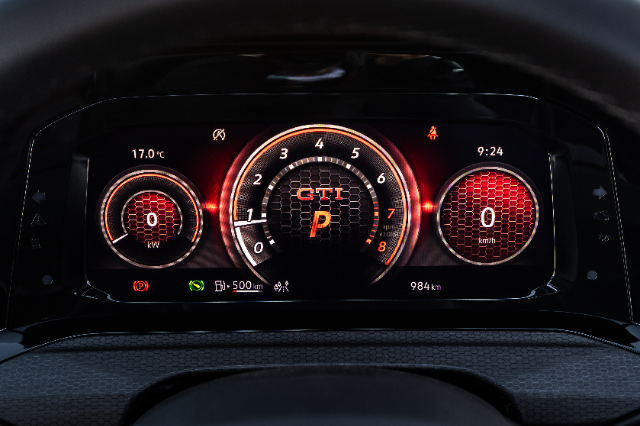
There is a 10.25-inch digitised instrument cluster that works well and is configurable in terms of both colour and display while the latest steering wheel again highlights an issue for the GTI. In place of regular buttons for functions on the multifunction steering wheel are haptic pads, meaning you can run your finger over the pads to change settings, which proves irksome and less effective than a standard button while also ensuring the glossy surface is perpetually smudged.
Moving away from the in-car technology, the beauty of things not changing very much from a platform perspective means that the MK8 is still a practical 5-door hatchback, with supportive sports seats, a reasonable 374-litres of boot space and enough space in the second row for two adult occupants over longer journeys.

Performance and driving impression
The familiar EA888 engine can be found under the bonnet of the GTI, and the same can be said of the 7-speed DSG gearbox, however, both have received some updates, with the engine getting a new Garret turbocharger and improvements to its refinement. Power is up to 180kW and 370Nm of torque, but weight is also up, meaning that the front-wheel drive GTI is not any faster than its predecessor, with -100km/h coming up in 6.4 seconds and the top speed rated at 250km/h.
Out on the road, the GTI is certainly firmer than its processor and slightly more up for spirited driving when in Sport mode, versus a standard MK7, but is not an incredibly sharp driving tool when compared with the likes of a Honda Civic Type-R. We managed to drive the MK8 back-to-back-to-back with an MK7 and an MK6 and noted that the current model has a busier ride quality but has a more linear power delivery and handles slightly better, with improved traction out of low-speed corners and a more confidence-inspiring turn-in on medium to high-speed corners than standard versions of the previous GTI.
The progress is minimal, and only obvious when stepping from an MK7 into an MK8 within a short time frame. Some of the progress can also be attributed to the latest tyres with improved technology on the MK8 versus the older rubber on the MK7 and MK6 sampled. When you are not driving in a spirited manner, the GTI is still a very good daily driver, but is more dialled towards a firm ride than the previous models, making it slightly less usable than before, but still the best performance hatch for those for an all-rounder.
Safety
The GTI forms part of the larger Golf 8 range, which was crash tested by the Euro NCAP assessment programme in 2019, where it achieved the maximum 5-Star rating. The rating includes 95% for adult occupant safety, 89% for child occupant safety, 76% for pedestrian safety and 79% for its safety assistance systems.
Fuel economy
Volkswagen claim a fuel consumption figure of 7.0 L/100km for the GTI, however, our time with the product resulted in a combined figure of 9.2 L/100km, which is respectable for a performance car driven by someone with a heavy right foot.
Pricing
The base price for a GTI is R669 300, but our press unit was fitted with optional extras such as pearlescent paint, Parallel Park Assist, a rear-view camera, a panoramic sunroof, IQ lighting, a Harmon Kardon sound system, the Travel Assist package, the black styling package with 18-inch wheels, Blind Spot Monitor with Lane Assist and the Discovery pro infotainment system, inflating the price closer to the R800 000 mark. The model comes with a 3-year/120 000km warranty as well as a 5-year/90 000km service plan.

Verdict
The biggest problem that the MK8 GTI faces is its predecessor, which was such a complete product in terms of its design, engineering, performance and packaging that in an era where Volkswagen has had to cut costs while trying to innovate, has resulted in a new GTI that isn’t immune to its own shortcomings.
The criticism levelled towards this product would be less severe if the expectations for this model weren’t as lofty, simply because the GTI has been so good, for so long. Some updates and enhancements to the GTI’s operating system, changes to some interior trim quality and perhaps the introduction of the Clubsport would negate many of the issues noted in the current model.