
Suzuki Jimny: Dynamite, a small package, and Big obstacles
Suzuki Jimny: Dynamite, a small package, and Big obstacles


By Martin Pretorius
The diminutive Jimny has earned its stripes to become one of the most-respected vehicles in the off-road fraternity. With a combination of light weight and compact dimensions, it simply scrambles over obstacles which would stump many other 4x4s. Meanwhile, the presence of solid axles front and rear, combined with a low-range transfer case, means that Suzuki’s small off-roader has the basic hardware to turn serious trail rides into a drive through (and over) the countryside.
But, until the latest Jimny arrived at the end of 2018, the tiny bundu-basher was a bit of a one-trick pony. While it was simply brilliant in the bush, it was also pretty terrible everywhere else. Its rock-climbing-capable suspension made for a bouncy ride quality, and that very vocal little 1.3-litre engine fairly screamed its lungs out just trying to keep up with slow-lane traffic – and barely succeeding at that task.
Sure, it would have gotten you to your destination (eventually), but the journey was generally neither comfortable nor rapid. Then again, the previous Jimny has been around for two full decades, so it stands to reason that it would have fallen behind modern trends by the end of its run. The new one couldn’t have arrived soon enough, really – but in the end, it was definitely worth the wait. The latest Jimny improves on its predecessor in every single metric, and finally becomes the all-rounder it’s always wanted to be.
Styling
Retro design seldom has wide or lasting appeal, but in the case of the new Jimny, the designers definitely hit the bull’s eye with their re-interpretation of classic styling elements. It’s boxy in the way of all its predecessors, and incorporates the clamshell bonnet which featured on the first two generations. There’s also a return to round headlights, bracketing a blunt grille with 5 vertical slots.
Looking down its flanks, the international-market Jimny (the only derivative we’re getting) features burly dark-grey fender flares and an extremely slab-sided appearance – accentuated by the upright glasshouse and a crease which runs around the car at the same height as that clamshell bonnet’s sides.
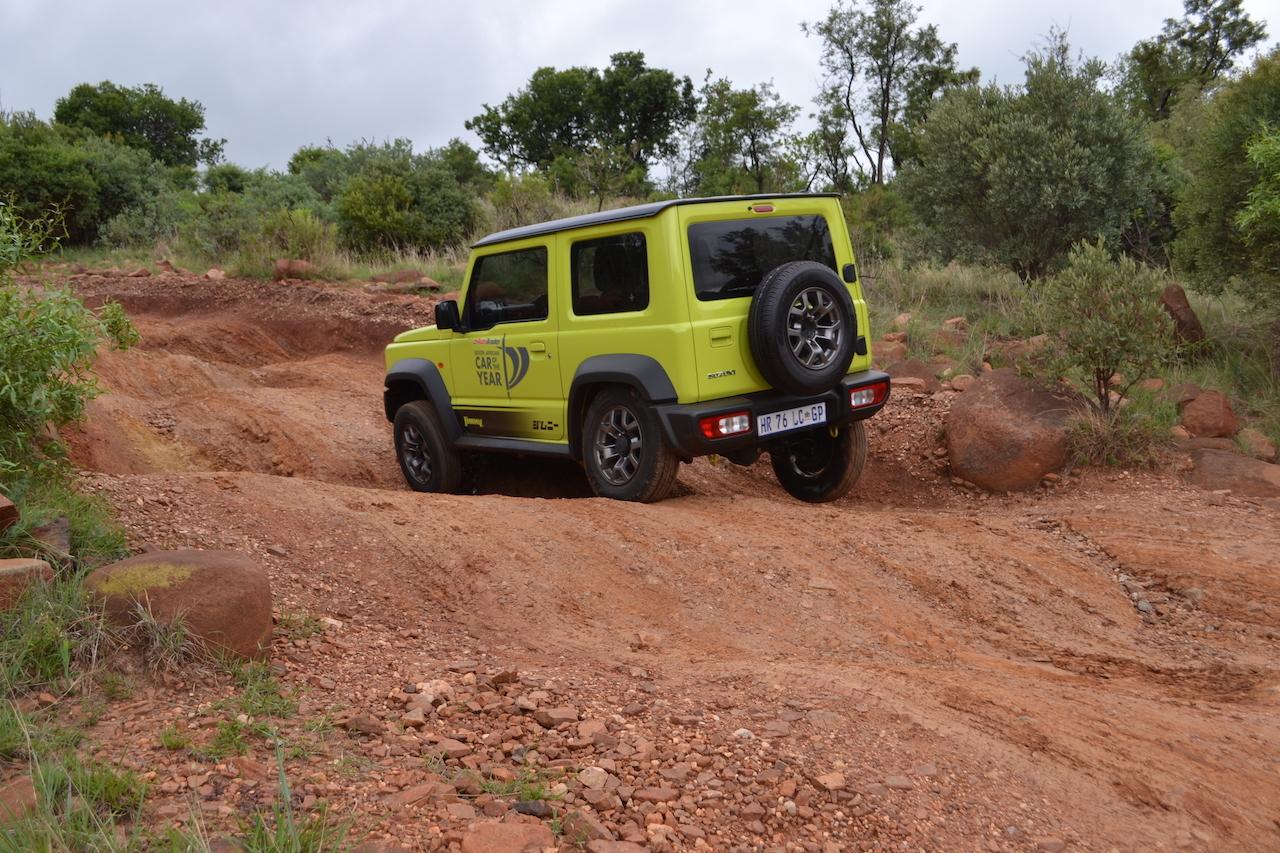
Particularly cute is the little kick-up towards the rear of the roof gutters, lending the side profile a rather cocky attitude, accentuated by the stepped shoulder line (which recalls the early Vitaras). Out back, a sturdy bumper (finished in dark grey, just like the front bumper and fender flares) incorporates the light clusters, leaving a wide aperture for the side-hinged rear door.
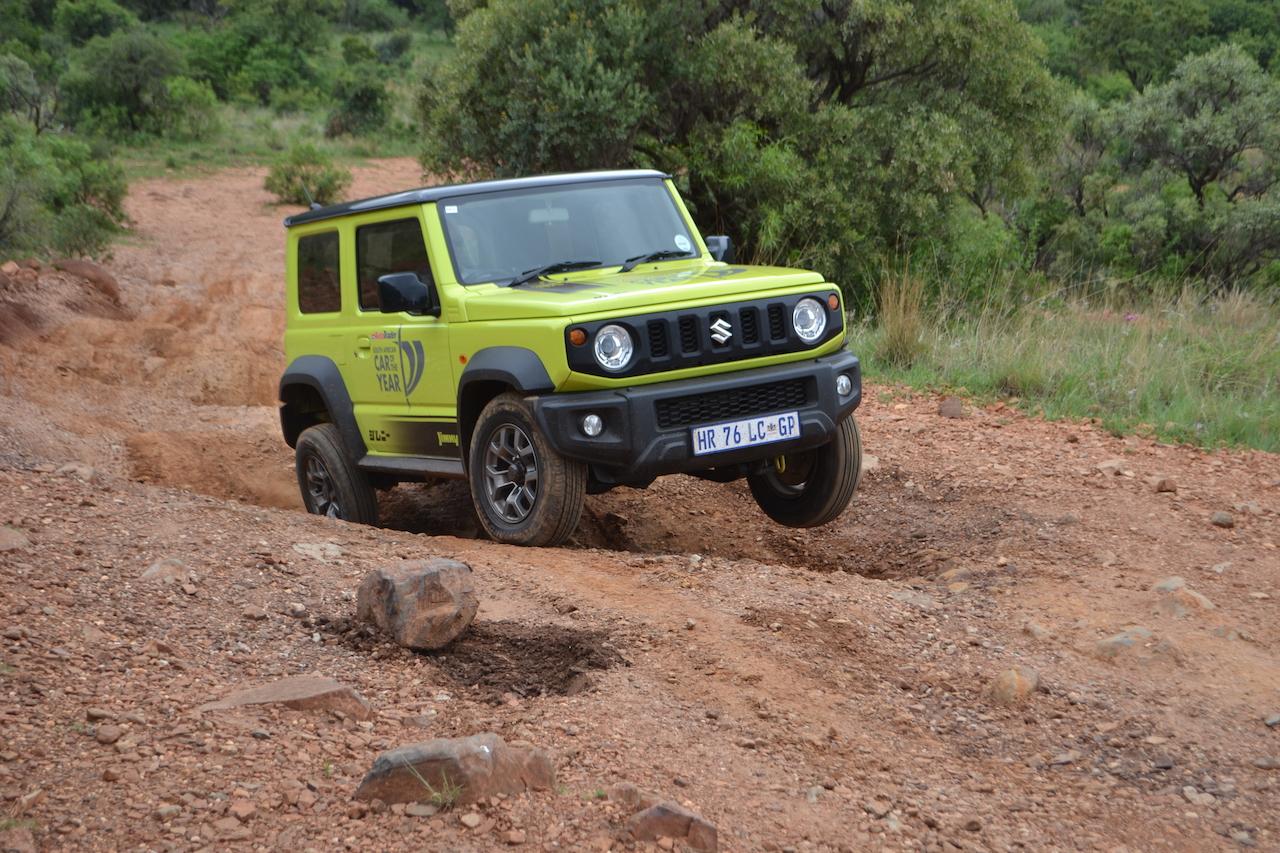
Our test Jimny’s vivid greenish-yellow paintwork obviously drew a lot of attention, but even the automatic variant we tested earlier (which had rather nondescript olive-drab paintwork) received plenty of thumbs-up reactions. It’s a cheerful-looking little car, and to the eyes of many onlookers, it draws inspiration from icons such as the Jeep Wrangler and Mercedes G-Class.
Of course, those assumptions are completely wrong, as the only thing that looked like the new Jimny was the old Jimnys. In fact, the original (LJ) Jimny predated the first G-Class by almost a decade!
The Drive
One of the old Jimny’s many failings was the driving experience on offer. It was noisy, slow, bouncy, and generally unrefined. Those attributes may have been acceptable back in 1998, but in the modern era, buyers have come to expect more. Fortunately, Suzuki’s engineers worked very hard to make the new Jimny a much more palatable all-rounder, with refinement, ride comfort, space efficiency and even directional stability being greatly improved.
It’s still not a highway stormer, mind you: at typical freeway speeds, there’s noticeable susceptibility to cross winds, and the Jimny still demands constant steering inputs to maintain a straight line on the N1. But at least you can now venture onto the freeway without fear, as the whole thing is tied-down a lot better than ever. The ride quality is also a lot less bouncy than before, and even road-shock kickback through the steering wheel has been brought down to manageable levels.
Cabin noise has been greatly reduced, with the engine’s gravelly note only really becoming intrusive at the upper reaches of the rev counter; while even wind noise is surprisingly muted, considering the upright windscreen and boxy profile. All in all, the latest Jimny manages to retain the charm of its predecessor, but removes the rough edges which have made the older car taxing to live with. It’s still just as easy to park as always, though – those small dimensions helps it squeeze in almost anywhere.
Performance
With the old 1.3-litre engine making way for a new 1.5-litre unit (still 4-cylinder, and without a turbo), power takes a useful jump from 63 kW to 75 kW. More importantly, torque is now up to 138 Nm (a 28 Nm increase). The difference is profound: acceleration moves into the realm of “adequate”, and there’s finally enough power and torque on hand to enable to Jimny to actually venture into the freeway’s overtaking lane. It’s still no fireball, though, but it’s altogether much more driveable than before.
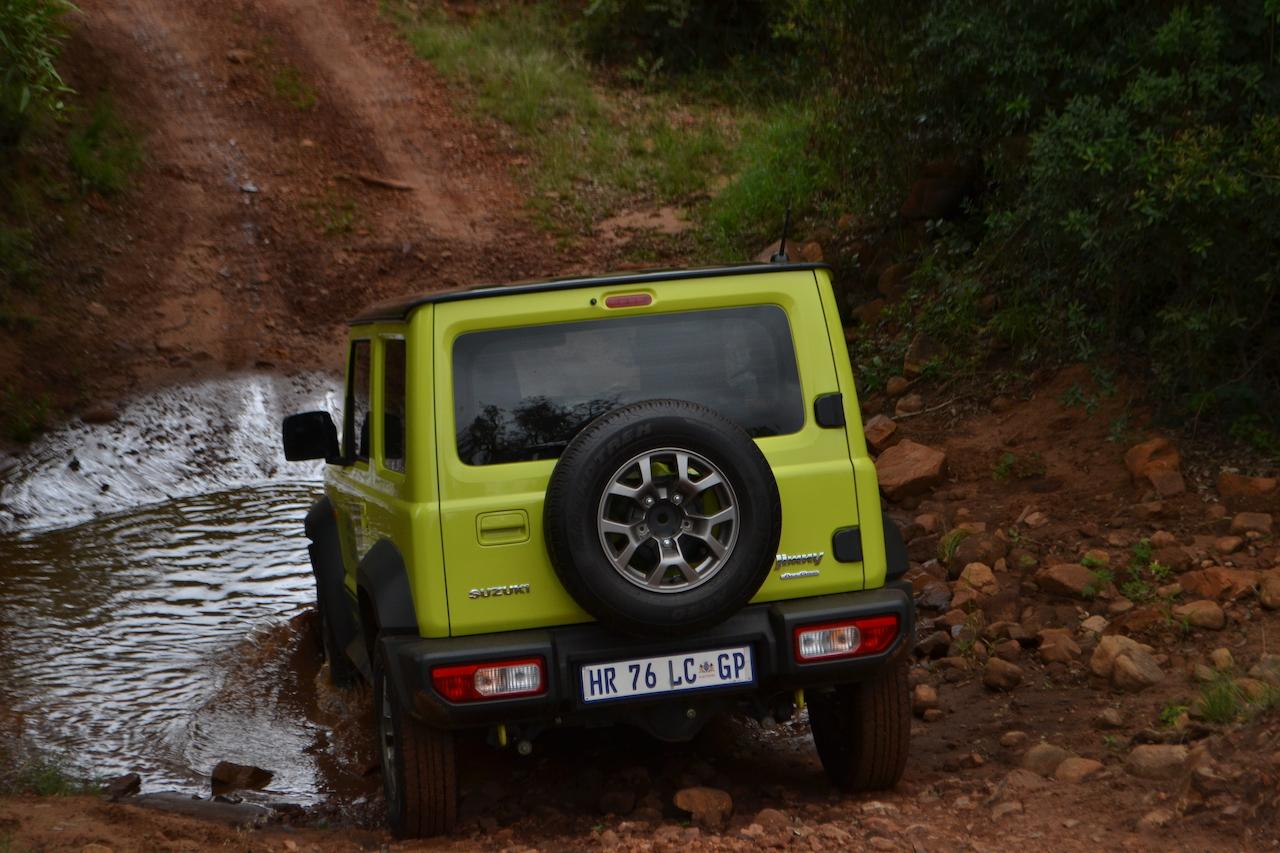
On-road performance has however never been what the Jimny is all about, so I decided to put it to a real test: going off-roading with some of the big boys. De Wildt’s 4x4 trail (to the north-west of Pretoria) was chosen as the venue, and my companions arrived with a variety of souped-up Land-Rover Discovery IIs. And guess what? The little Suzuki went everywhere these high-riding monsters did, with the sole exception of a deep mud pit – I had no intention of drowning the Jimny in water which would have reached up to its windows...
A few points stood out while off-roading. While the beam-axle suspension gives useful articulation, the small (15-inch) wheels and tyres don’t allow for a huge measure of clearance underneath the differentials. Everyone in attendance agreed that a set of larger-diameter tyres will have a positive effect on overall ground clearance, and the same applies to a mild body lift conversion.
However, even in the absence of a mechanical differential lock, the new traction control system did a fair impersonation of a locking diff, pulling the Jimny out of quite hairy cross-axle situations without too much effort. The same applies to the new hill-descent control, which worked smoothly and effortlessly. Serious off-roaders will probably want to add a diff lock along with larger tyres and perhaps a 50 mm ride height increase, though.
That’s the thing about a Jimny: much like a Wrangler or a Land Rover, it’s a blank canvas upon which owners can mix-and-match their own additions to turn it into exactly the vehicle they want or need. But, even in stock form, there are very few places a Jimny won’t be able to go – just as it’s always been, really.
Space and Comfort
Calling the Jimny spacious would be quite a stretch, really. It’s fine for the front seat’s occupants, thanks to that useful boost in shoulder-and leg room, but the rear seats are better suited to small children. Adults definitely won’t be able to get comfortable in the back, even with the adjustable backrests set to their reclining positions.
The space constraints apply to the luggage area as well. Even with the rear backrests in their most upright positions (which makes the rear seats all but uninhabitable), luggage space is severely restricted, and may be unable to handle a single person’s weekly shopping. I’m not exaggerating: it’s really tiny back there. Fortunately, the seat backs are easily folded down (with a 50/50 split), which leaves enough room for two people to pack for a week-long holiday. Hey, it’s not much, but it helps...
Comfort levels are markedly better than before, though, and just about makes the Jimny useable in the daily grind. The front seats are fairly comfortable, although their squabs are quite short and there’s no height adjustment. Nonetheless, even a 400 km one-day road trip didn’t draw too much protest from my back, and the reduced cabin noise helped to reduce fatigue to a manageable level.
Equipment levels are competitive in the modern era as well, with the GLX derivative on test scoring a nice touch-screen audio system with Apple CarPlay and Android Auto, along with Bluetooth and USB connectivity and steering wheel-mounted remote controls. Cruise control also features, as does auto-on/off LED headlamps. The usual creature comforts are also present, with remote central locking, electric (front) windows and mirrors, and climate control making their way onto the spec sheet of GLX derivatives.
Safety
While the new Jimny only scored 3 stars in the Euro-NCAP test programme, it must be remembered that it received quite a penalty for the lack of preventative safety features such as automatic emergency braking.
There are however only two airbags in attendance, along with ABS and traction/stability control. The Jimny isn’t the ultimate in occupant safety, but it’s pretty good for such a small, utilitarian vehicle, especially at its price point.
Fuel Consumption
After spending almost a month with this manual-transmission Jimny GLX, I added up the fuel slips and came to the realisation that it’s actually remarkably frugal. For such a boxy car, which was driven literally everywhere (in town, on the freeway, and on a few off-road excursions) without any concern for economy and with the air-con blowing full-blast all the time, an average consumption figure of 7.9 litres/100 km is pretty commendable - and a nice improvement on the old model. Yes, an average supermini (like a Polo or a Fiesta) will use a lot less, but they won’t be able to go where the Jimny did, and besides, it's much more frugal than any other genuine off-roader...
Price
With a list price barely scraping in below the R300 000 mark, some might see the Jimny GLX as very expensive for a car with such a limited spread of abilities. And yes, you can get quicker, more luxurious, or more spacious cars for the same money, but there’s a problem with such reasoning: The Jimny isn’t really a car, but it’s an off-road monster that can now double as a decent car.
Seen in this light, it really has no competition in the marketplace. It does most of the things the bigger Jeeps and Land Cruisers and Land Rovers can do, but for less than half the money. The fact that it’s now also usable on tar merely sweetens the deal.
The Verdict
Many potential buyers have in the past been turned off by the Jimny’s lack of performance, space, and comfort. By addressing all three of these issues (albeit with only a small boost in space), the new Jimny finally makes sense as a general-use car as well as an off-roader. Let’s look at it from a different angle: it still does all the things I’ve always loved about the Jimny, but it’s also massively improved in the areas where the older versions really annoyed me. Buyers clearly agree with this take – for proof, look no further than the waiting list, which currently runs close to 6 months.
Expert rating:
4/5