
Peugeot 308 – The Sleek Sleeper
Peugeot 308 – The Sleek Sleeper




By Stuart Johnston
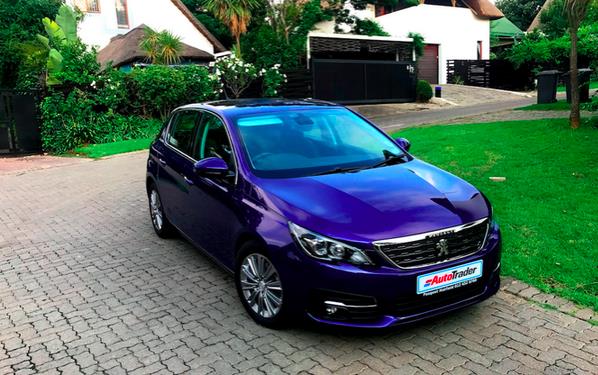
Peugeot’s 308 hatchback recently made a re-appearance on the new-car model list in Allure guise. It’s currently the only 308 hatch model in the line-up, as Peugeot focusses more and more on the Cross-Over market. Despite its understated looks it has a charm that grows on you.
Peugeot’s 308 model was launched here a few years ago, and then quietly disappeared off the price lists for a while. Presumably customer feedback from dealers told of a demand that still exists for a classy mid-sized hatchback like the 308. This was then fed back to Peugeot South Africa, because the car reappeared with a slight facelift a few months back, and in only Allure trim. Gone were the rather oddly named GT Line and GT models, which were an anomaly, as they weren’t real GT-type performers either.
Nevertheless we did find the 308 GT Line to be good value at the time, as you can read here in our 2015 review.
The 308 is a front-wheel-drive machine like most hatchbacks but like many French cars it has opted for small petrol-turbo engine power. In this case it’s a three-cylinder turbo motor displacing just 1 199 cc, and it is tuned to produce a rather impressive 96 kW. It is available here in both six-speed manual and six-speed automatic form, and our test machine was the automatic model.
Styling
The 308 has very clean styling with an almost total absence of pretence. The flanks are some of the smoothest in the business with no sharp creases or mouldings. This is both a good thing and a bad thing. The down-side is that it makes the 308 appear very ordinary at first glance, especially with the 16-inch wheels, and it may not immediately attract your attention.
The up-side of this styling exercise is that the 308 has a grace that becomes apparent the more you look at it. And yes, at the front end, there is now a chiselled edginess to the bumper, complete with requisite ducts and grilles for cooling.
The fact that the Allure model is fitted with the least dramatic alloy wheels in Peugeot’s array, in plain silver, also has the effect of understating the car’s charms. They are 16-inch in diameter, which is not that large for a car of this ilk, in this era, so once again there is little to draw the interest of a committed petrol-head.
Inside, the car has a minimalist approach to dashboard, infotainment pod and instrumentation that I personally find very attractive. The seats are covered in a durable-looking fabric in combination with leather. The console, dash pod and other trim items are quite dramatically styled, with sculpted edges high-lighted by bright metal. The overall effect is cutting edge in a way that is not at all brash.
The Drive
The engine has a very muted sound when you start it up, and it can take you a while before you realise it is in fact a three-cylinder. It’s also very smooth for a three-cylinder, indicating clever mounting systems to isolate the inherent balancing issues with these engines. I suspect the turbocharger also muffles the aural aspect of the triple.
Pulling away there is just a hint of lag on occasion, but the engine very soon picks up on its power band. The six-speed fluid-drive automatic is smoothness personified, and progress is unruffled.
Those 16-inch diameter wheels are fitted with relatively high-profile rubber - 205/55 R16s – and the ride is surprisingly supple despite the fact that the car is obviously firmly-sprung, as there is very good body control.
The steering is actually a delight, being light at lower speeds, but extremely quick and accurate in placing the car exactly where you want it. There isn’t huge feedback through the wheel, in terms of the steering system loading up in corners, but there is just enough to enable you to really enjoy cornering this car.
The brakes are powerful enough when you tramp hard on the pedal, but there is a bit of initial lag in the system that I didn’t enjoy. You then press harder and they bite too much, so it takes a while to adapt to this and achieve smooth braking.
Performance
That 96 kW output is allied to an impressive 230 Nm of torque at a low 1 750 rpm, and once you have overcome that very minor lag on pull away this car has plenty of acceleration at its disposal. We suspect that at sea level you wouldn’t even experience any turbo lag. The engine makes a nice three-cylinder howl when it’s provoked, and it will rev to 6 000 and beyond very smoothly.
The Peugeot 308 is no lightweight, being a fully-equipped mid-level hatchback with all the attendant equipment that such cars demand these days. It has an unladen weight of 1 370 kg, but the little 1,2-litre turbo handles this with aplomb. There is an excellent sense of solid build quality about the car, with no rattles or squeaks being present throughout the test.
As far as bald figures are concerned, it is rated at 9,7 seconds to 100 km/h while the top speed is in the region of 200 km/h. Those are very competitive figures for the class of hatchback it is up against.
Fuel Consumption
Peugeot rates the average fuel consumption of this car at 5,2 litres/100 km, and in truth you won’t achieve anywhere near this in daily driving. Like all small capacity turbos, these engines work hard when building speed in stop-start urban conditions, and the most likely average figure you will achieve is around 7,0 litres/100 km. But on long trips that figure will come down, and as there is more than enough torque once you’ve build up to highway speeds, you will in fact manage a figure in the region of 5,5 litres/100 km,
Space and Comfort
The interior space is about average for a car like this. There is a reasonable amount of headroom and legroom, and the boot is also reasonably sized at a claimed 385 litres. When you fold down the seats – a very easy operation to perform – the volume increases to over 1 200 litres.
As far as equipment is concerned, the generously-sized infotainment pod is touch-screen-operated and easily paired to smart phones for an array of entertainment and practical functions. Items we enjoyed included automatic headlamps and rain-sensing wipers, as well as dual-zone climate control.
The one comfort item that is disconcerting is the steering wheel adjustment. If the wheel is adjusted to a normal position it completely obscures the instrumentation! One soon learns to adjust the steering wheel much lower than you would normally, and it has a squared off lower section that should help avoid it brushing up against your legs. But it’s strange, nonetheless, and very large people with thick or long legs would have a problem getting comfortable while still being able to read the gauges.
Safety
The 308 is in essence a very safe car, because of its fine road-holding, good brakes ABS and EBD and Brake Assist for emergency stops. It also has useful systems like park sensors front and rear and fatigue-assist warning. The airbag allocation is generous, with six airbags present in the cockpit. Traction control and corner-assist is provided for those who stray beyond the laws of physics when delighting in the handling and crisp steering, and of course these items are extremely useful in emergency-avoidance situations.
Verdict
The Peugeot 308 is one of those cars that sneaks up on you. As this written I still have the car outside in my driveway, and I can tell you that I anticipate driving it again with no small measure of enthusiasm. Subtlety is its game, and the longer you live with it, the more you appreciate its nuances.
At R369 900 it is competitively priced. This includes a three year/100 000 km and a five year/100 000 km maintenance plan. To read more about its natural competitors, the Volkswagen Golf 1.4 TSI Comfortline and the Opel Astra 1.4 Enjoy, click here.