
Is the more-door MINI the one you buy with your head or your heart?
Auto Trader reviews the MINI Cooper Hatch 5-door


MINI has traditionally been only a 2-door little car, whether in the classic long-roof hatch shape, or station wagon or bakkie. A strong worldwide fan base has seen the Mini and MINI brands achieve a loyal following. When the German BMW brand took over ownership from Rover of the iconic British brand Mini and changed it to MINI, the company launched the modern MINI in 2002, and the world took an immediate liking to it.
The first “BMW MINI”, as it has been dubbed, was again available in classic 3-door long-roof hatch body, as per the original from the 50s, but in a much bigger yet still compact car. Soon after the BMW MINI also became available in a Convertible body. Such was the success of the 1st generation that BMW had to do a 2nd MINI in 2007, and started adding another body style in the form of the Clubman 3+half door mini station wagon, re-interpreting the original Mini Traveller station wagon.
Then it learnt that people want a MINI, but need it bigger and with 5 doors, so the Countryman was born. Though proving popular, there are still those who feel it has grown big, and despite the typical MINI styling cues in grille, headlights, rounded square-ness, retro round-dials interior and true-to-MINI customisation options, it is more MAXI than MINI.
There are many buyers who prefer the more traditional MINI look, but bemoaned the 3-door practicality and smallish boot. Some had no choice but to go for a more practical car such as the Countryman, or a car from another brand. Well, MINI listened, and was clever enough to take note of this need. So FFWD to 2013, when the 3rd generation MINI was shown. The all-new MINI landed here as 3-door, early in 2014, and within the same year, it is this new generation that gave a traditional MINI look with more practicality asked for – the first ever 5-door hatch body option was launched. Now you can have your MINI hatch and fit the kids or even smaller adults in the back, with access through the rear doors. The rear doors are particularly short and can open nearly 90 degrees which also reduces the risk of mistakenly banging the rear door against another parked car next to it or a wall. While it does make it easier to get in and out (or to get a child into or out of a child seat, or un/loading objects) the rear door openings between body and rear seat are quite small, so adults could struggle to get in and out comfortably – so it is a MINI with rear doors, but still a smallish car.
MINI didn’t just add rear doors – the whole car is longer, starting with a 7cm longer wheelbase, and a cleverly-integrated bigger rump (compare the 3-door to 5-door and you’ll notice the difference) to also create a bigger boot, increased from 211 litres in the 3-door to 278 litres in this 5-door, which in practice means the boot is more square and can take larger items. Incidentally, the extra size and doors added 60kg to the weight of the car.
Now to the engine: previous Cooper models were bought for fun or budget, but if you wanted power you simply had to go for the Cooper S which had a supercharger in the 1st generation and a turbo for the 2nd. Now even the Cooper – yes, the base model – has a turbo. Its 1.5-litre 3-cylinder is a little gem. No longer is the Cooper the underperforming sibling, as it pulls strongly right from the start, and is a joy to drive anywhere. 100kW from 4500-6000 r/min is strong enough, but it is the 220Nm of torque… and it is willing to give it all to you at just 1250 r/min, flat through to 4000, which makes the Cooper an eager lively car. Unintentional wheel-spins of the line are easy. The gravelly sound of the 3-cylinder lets its driver and all occupants (young and old/er) enjoy the sporty sound, which the more powerful Cooper S 2.0 turbo lacks due to its 4-cylinder layout. The Cooper has a single exhaust on the left, neatly flush with the bumper, while the Cooper S has a dual exhaust outlet in the centre.
The gear change in the 6-speed manual tested is smooth and direct, while a responsive and efficient 6-speed automatic costs R 16 900 more. The joy of this manual combined with the willing turbo engine make a great team. A surprise is the built-in rev-matching feature – when shifting down from 3rd to 2nd gear, the engine will, by itself, increase the revs to match the lower gear (just as modern automatics do when shifting down) making for a perfectly-synchronised smooth and sporty gearshift. The engine torque also allows the 6th gear to be very tall, with only around 2500 revs needed at 120km/h.
The new MINI, whether 3 or 5-door, is both more mature and more gadgety. It is more mature by feeling more like a baby BMW than ever before, with soft-sounding door closing, high-quality switchgear, even better cabin materials with liberal use of smart dark contrasted with glossy trim, upmarket touches like the gloss black climate control switchgear (with digital display of colour bars circling around the switches, which blacks out completely when turned off, coming alive when switched on), down to items like the light switch moved to the hang-down dashboard panel to the right of the steering, just like a BMW’s. The feeling is immediately more premium than before, and indeed more so than any rival.
One of the highlights in engaging the fun aspect is the starter toggle switch, which has moved from a small button horizontally between door and steering, to take central pride of place in the lower row of retro toggle switches – it is red, and glows in pulses like a heartbeat. However, all the extra tech means extra switches, like the head-up display, which has forced the relocation of the toggle switches for electric windows from the dashboard to the door, just like they were relocated in the MINI Countryman upgrade. MINI designers moved the speedometer from the original central position to the steering column – in the previous MINI, even if one specced navigation which sits in the central display, it simply had a glide-along short red pointer which went around the circumference of the central display, plus a digital speedometer read-out inside the rev counter on the steering column. In the new MINI, a half-moon rev counter is crammed into the left of the small speedometer, and on the right a gimmicky plastic block with orange light bars (looks an afterthought) is now the fuel level display. Killing the central speedometer and moving the window switches to the door is like killing the brand – mmm, some are glad, but others (true MINI fans) are sad.
Selecting one of the characterful interior cloths like the classic coarse pearl or the checked cloth combined with leather bolsters on sports seats (complete with separate sliding thigh support, like BMW’s sports seats) will make your MINI yours. Also choose from creative interior of your own combination of colour lines (in black, grey, brown or red) and dashboard inserts trim, like Dark Cottonwood opted on the test car – a dark grey matt wood-like finish. The ambient lighting can also be adjusted to a wider range of colours, including hot pink, which is sure to find favour with the feminine.
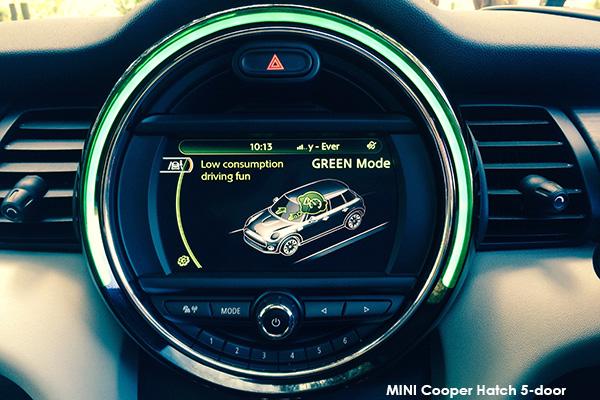
Gadgety yet fun-character-adding items include the driving mode switch which is a ring around the gear selector, rather than the traditional mode switch, which the driver or engaging passenger can rotate to activate Green or Mid or Sport modes, with informative fun or gimmicky (depending on your point of view) text shown on the enlarged central dashboard display – in Green mode it reads “Low consumption driving fun” and the display ring turns bright grass green, in Mid it reads “Typical MINI driving fun” with a bright yellow, and in Sport it brings out the cheeky character with “Maximum go-kart feel” and a rich red ring in the display. Such a laugh. Green mode also brings handy eco-saving driving hints, showing the driver when to change up gear in the manual – cleverly it doesn’t just suggest say 3 to 4, but accurately measures the optimum gear for the moment (for lowest engine revs and thus lowest consumption and emissions) by even showing 3 ^ 5 in the display, urging to change from 3rd to 5th gear. Clever. When the driver doesn’t change gear as indicated, an icon of a gear knob appears on the instrument and central display to nudge the driver to do so. Also clever is the typically MINI fun way it encourages the driver and entertains the passengers in a modern fun way by showing a fish in a bowl, reacting in different ways depending on driving style.
MINI has also gone very today-tech. The previous cute but perhaps fiddly joystick-type control is replaced by a more BMW iDrive style rotating selector with planetary switches for menu, audio, tel, back and option. Options include a head-up display (which pivots out from a recess on the dashboard top) to display speed and various helpful information items, including the list of radio stations when scrolling through the steering wheel switch – clever and safe.
Take care not to get carried away with the options list, especially if you are on a budget and wanting to control the Cooper money you spend. Wheels are a definite – upgrade to bigger nicer 17” wheels at R 7 500 which make a big difference to the look. Choose selectively from items like panoramic sunroof, and other BMW-like high-tech options like Park Assist (where the MINI can steer itself into a parking), rear-view camera, electronic dampers, LED headlights (standard on Cooper S) and Driving Assist which included adaptive cruise control.
The MINI 5-door rival would be limited to the Audi A1 Sportback, because the Fiat 500, Alfa Romeo MiTo, Citroën DS3 and VW Beetle, which could compete for 3-door MINI market share, are not offered with 5 doors.
Is the more-door MINI the one you buy with your head or your heart?
The sales figures released for MINI in the 1st quarter show an interesting split between MINI 3-door and 5-door: around 13 000 3-door MINIs were sold, and roughly 9500 of the 5-door, so there is a good uptake for the more practical car, though the favour is still towards the 3-door.
You can fit more heads and hearts into the MINI 5-door than in the more classic true-look 3-door, though the 3-door is most likely bought from the heart, whereas the 5-door is with the head.
The MINI Cooper Hatch 5-door price is R 312 500 in base spec manual, competing directly against the Audi A1 Sportback 1.4T SE manual at R 306 000 – this price is for the facelift the A1 will receive imminently.
The MINI 5-door’s extra space and doors command a premium over the 3-door of R 9 000 for Cooper and R 11 000 for Cooper