
Mercedes-Benz GLA 200d AMG Line (2021) Review – The Efficient Alternative
As with the first-generation model, the latest Mercedes-Benz GLA is essentially a slightly larger A-Class with butched-up styling. It’s not quite as athletic to drive as its smaller sibling, but it offers a bunch of other virtues in compensation. And, with a diesel engine, it strikes an excellent balance between frugality and usable performance.



In its first iteration, the Mercedes-Benz GLA was arguably the most-agreeable derivative of its platform, with its larger dimensions making it more practical and smoother-riding than the A-Class upon which it was based. And, seeing as the latest A-Class is a leap ahead of its predecessor in every way, the same improvements also apply to the new GLA.
Related: Shop for new and used Mercedes-Benz GLA-Class cars for sale here.

Styling
Even though there’s still an A-Class platform lurking underneath, the latest GLA has more visual distinction than its predecessor could manage. This is largely due to the addition of small quarter windows in the C-pillars (the rearmost roof pillars), which serves to elongate the shape, and allowed the designers to give the new GLA a more-distinctive rear end than it had before.

It is perhaps not quite as pretty as its predecessor was, though: While the old model had a squat stance with bulging wheel arches, the latest one looks a bit less-substantial when seen from the rear three-quarters. The added side glass also removes some heft from the GLA’s profile view, which makes the new car look a tad nose-heavy in a way the old one didn’t.
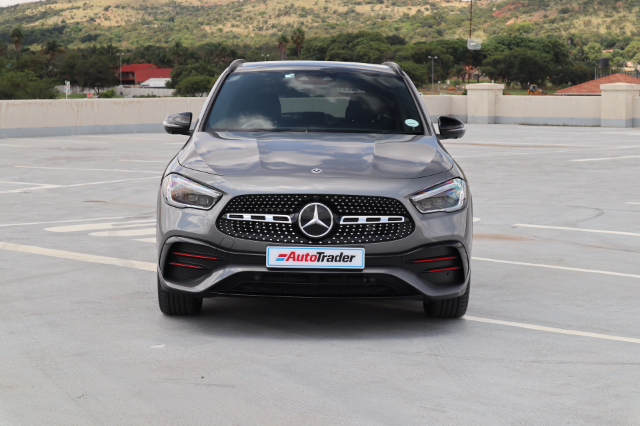
Nonetheless, our medium-grey test car still had plenty of on-road presence, thanks to its aggressive studded grille, AMG Line body styling bits, and black wheels with red rim detailing. Wheel arch cladding and roof rails are present as per crossover formula, and the GLA’s elevated stance makes it look suitably rugged from most angles.
Performance
Motive power is provided by the new-generation Mercedes-Benz 4-cylinder turbodiesel, with a displacement of 2.0 litres and outputs of 110 kW and 320 Nm in this application. The driving experience makes those output claims a bit difficult to believe, however, because it pulls so lustily across a wide rev range, that it feels quite a bit spritelier than the bare numbers would suggest.

Mercedes-Benz claims that the GLA 200d should run from a standstill to 100 km/h in 8.6 seconds, but on-road performance suggests that it may actually be quicker than the claimed figure. It’s not blistering by any means, but at the same time it never feels lacking for power on the road, either.
Overtaking performance is particularly pleasing, thanks to that broad swell of torque and a well-programmed gearbox. Overall, the drivetrain scores high marks, and represents a worthwhile improvement on the 1.33-litre turbopetrol 4-cylinder in the GLA200 (petrol), even with its higher pricetag and (on-paper) power deficit.

The Drive
Power is sent to the front wheels through an 8-speed dual-clutch automatic, and there is no option of AWD for the non-AMG GLA derivatives. The chassis and control systems do a great job of managing the turbo torque on tap, and maintains strong traction even in corners and at lower speeds.
Don’t expect very sporty behaviour on the road, mind you – it’s not quick enough to be genuinely engaging to drive, and its taller stance means that the GLA will never feel as agile through the corners as an equivalent A-Class would. Feedback through the steering wheel is muted as well, but the front end is grippy and eager enough to change direction, giving a secure and planted feel behind the wheel.

Of greater importance for a car of this type is ride comfort, a hurdle which the GLA 200d clears with reasonable ease. In spite of the AMG Line suspension bits and optional 20-inch tyres fitted to this test car, the springs and dampers are well-matched to dismiss most road imperfections with a minimum of fuss. It’s still compromised in comparison to non-AMG Line-equipped cars, however, so comfort-biased buyers would be much happier with the suspension fitted to the base GLA.
Space and Comfort
As we experienced with the closely-related Mercedes-Benz B-Class, the GLA is rather better-suited to tall occupants than the A-Class from which it spawned. Part of the improvement is down to larger overall dimensions, but the revised seating position also plays a role in creating perceptibly more interior space.

The GLA’s elevated roofline allowed the engineers to raise the seats, giving occupants a nicer view to the outside and creating more leg room all round in the process. Entry and egress is also easier than on an A-Class, thanks to the taller doors, and the roof pillars don’t intrude into the cabin as much as they do in the smaller car, either.
AMG Line trim endowed our test car with suitably sporty-looking bucket seats, which proved to be both comfortable over long periods, and supportive through the corners. And, importantly, rear-seat occupants will enjoy plenty of head- and legroom, on account of the GLA’s longer wheelbase and a newly-added (optional) sliding rear seat arrangement. In its turn, the luggage compartment presents a decent 485 litres, so loading volume is competitive if not class-leading.

The basic modern conveniences are present on the basic Mercedes-Benz GLA spec sheet, but the really cool stuff are optional, as we’ve come to expect. Notable extras fitted to this test car included excellent Multibeam LED headlights, dual-zone climate control, the upsized infotainment- and instrument displays, heated front seats, and an opening panoramic roof.
That’s an easy R 150 000 in options on top of a substantial starting price, pushing this test unit well over the R 900 000 mark. In short, be careful when ticking those option boxes on the order form!

Safety
The new GLA is yet to be hurled at a barrier by any official testing authority, but, seeing as it’s so closely derived from the A-Class, we could use the latter car’s test results as a guideline. The A-Class scored 5 stars in Euro NCAP crash testing, with excellent results for the protection of all occupants, and a good level of safety gear included as standard.
Stability control, ABS and automatic emergency braking are obviously present, as are rear ISOFIX child seat anchors, and 7 airbags (9 are optional). But blind-spot monitoring, a surround-view camera system, lane-keeping assist, and adaptive cruise control are all optional extras. As with the GLA’s creature comforts, you’ll need to select some extras at the time of purchase to get the best experience.
Fuel Consumption
Mercedes-Benz claims an average fuel consumption of 5.1 ℓ/100 km, and steady-state freeway cruising will see the trip computer display get pretty close to that idealised figure. However, our review period yielded an average consumption of 7.1 ℓ/100 km, which is decent but not outstanding.
It has to be mentioned that our test figure is likely as high as most drivers would ever see in mixed-cycle use, though, with plenty of congested traffic, the air-con on full blast most of the time, and generally unsympathetic accelerator pedal applications being the order of the day. Conservative drivers or better driving conditions should drop its thirst into the low-6 ℓ/100 km range in normal use.

Price and Warranty
While the GLA 200d could be had for relatively little money (for its segment), the AMG Line trimmings and long option list applied to this test car elevated its price premium by more than R 200 000 over the basic car’s pricetag of R 714 560. The AMG Line package alone adds R 50 000 of this premium, and the upsized alloy wheels make up another R 15 600.
To soften the financial blow somewhat, Mercedes-Benz includes a pretty good aftersales package. The warranty runs for 2 years with no distance limit, while the maintenance plan offers cover for 5 years or 100 000 km. Combine this with good fuel economy, and a GLA 200d should prove to be fairly affordable to run for the first few years.

Verdict
Nice to behold, pleasant to drive, and easy to live with, the Mercedes-Benz GLA 200d does everything you could reasonably want from a compact premium crossover. Refinement and comfort are up to class standards, and the standard equipment list is reasonably well-stocked as well.
Avoiding the AMG Line trim package will give comfort a further boost (albeit at the expense of some cosmetic appeal), and save quite a bit of money at the same time. But, to get the optimum GLA specification, you’ll need to add quite a few options, which will see the price shoot up dramatically. Would this bother the buyers Mercedes-Benz targets with the GLA? Unlikely – the fact that it’s rather expensive would simply add to its appeal...
*Prices include all taxes and were accurate at the time of publication, but are subject to change.


