
Mahindra Pik Up 2.2 CRDe DoubleCab 4×4 S11 (2020) – The big old easy
The Mahindra Pik Up first arrived in South Africa in 2006, and over the past 14 years, Mahindra has turned it into a vehicle that’s pleasant to drive while returning good fuel consumption. To find out what a farmer would think of the automatic Pik Up S11 4x4, we drove to a farm in the mountainous Hessequa area of the Karoo.


Styling
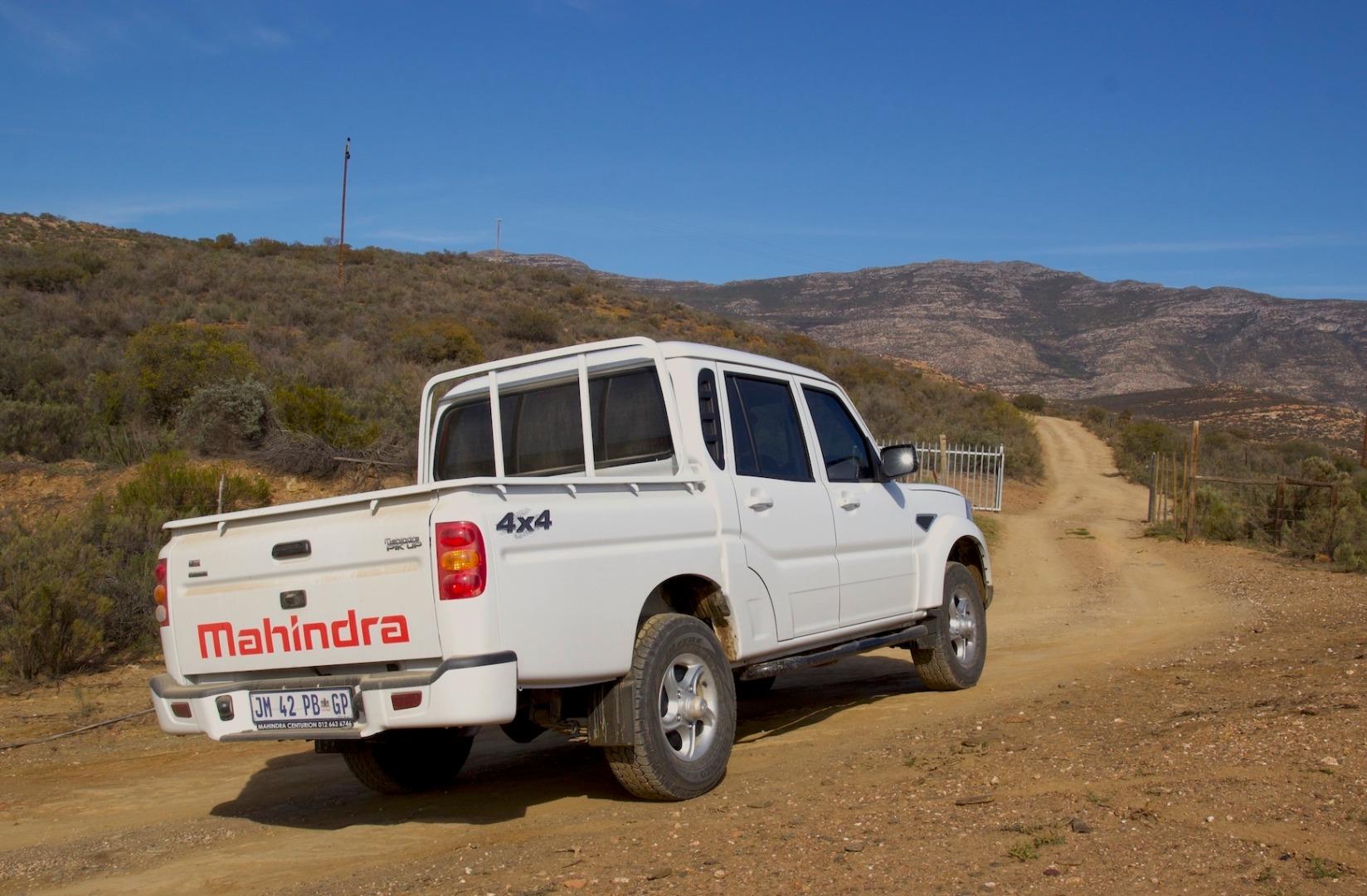
To make the Pik Up look good, was most likely not a goal of the design team. And yet there is a measure of charm to its appearance, perhaps because it reminds the onlooker of bakkies from decades past. You could call it ‘accidental retro’, or something like that. The shape of the vehicle does give it large windows and that gives the occupants excellent outward visibility.
The refreshed design has cleaned up the appearance of the nose and headlights, but the profile suffers from the presence of a steel frame made of thin, square bars. It sits upright between the cab and load-bin, and resembles the headpiece of an old cast-iron bed.
Its bars can be used to fasten items that are being transported. But there are no anchor points in the bin, so you will not be able to safely carry something that is prone to fall over or move around. Not easily, anyway.
Mahindra specifies a maximum payload of 995 kg (remember to include passengers), and it has a towing capacity of 750 kg for a braked trailer and 2 500 kg for an unbraked trailer.
The tailgate opens with a door handle in the centre and there’s a rear camera to make reversing safe and easy.
Related: Something different – the Mahindra Pik Up
Performance
The test-drive included a 300 km journey from Cape Town to a Karoo farm near Barrydale, in the Western Cape. The Pik Up behaved impeccably. The engine is barely audible and there is little road or wind noise. Like all the bakkies in the Pik Up range, the S11 4x4 uses a 2.2-liter, turbo-diesel, four-cylinder engine that develops a maximum of 103 kW and 320 Nm.
Generally speaking, there’s no such thing as too much torque, so another 50 Nm or so would be welcome, especially to cope with heavy loads. And yet there was never a time when a reasonable overtaking manoeuvre couldn’t be executed because of a lack of grunt.
Drive
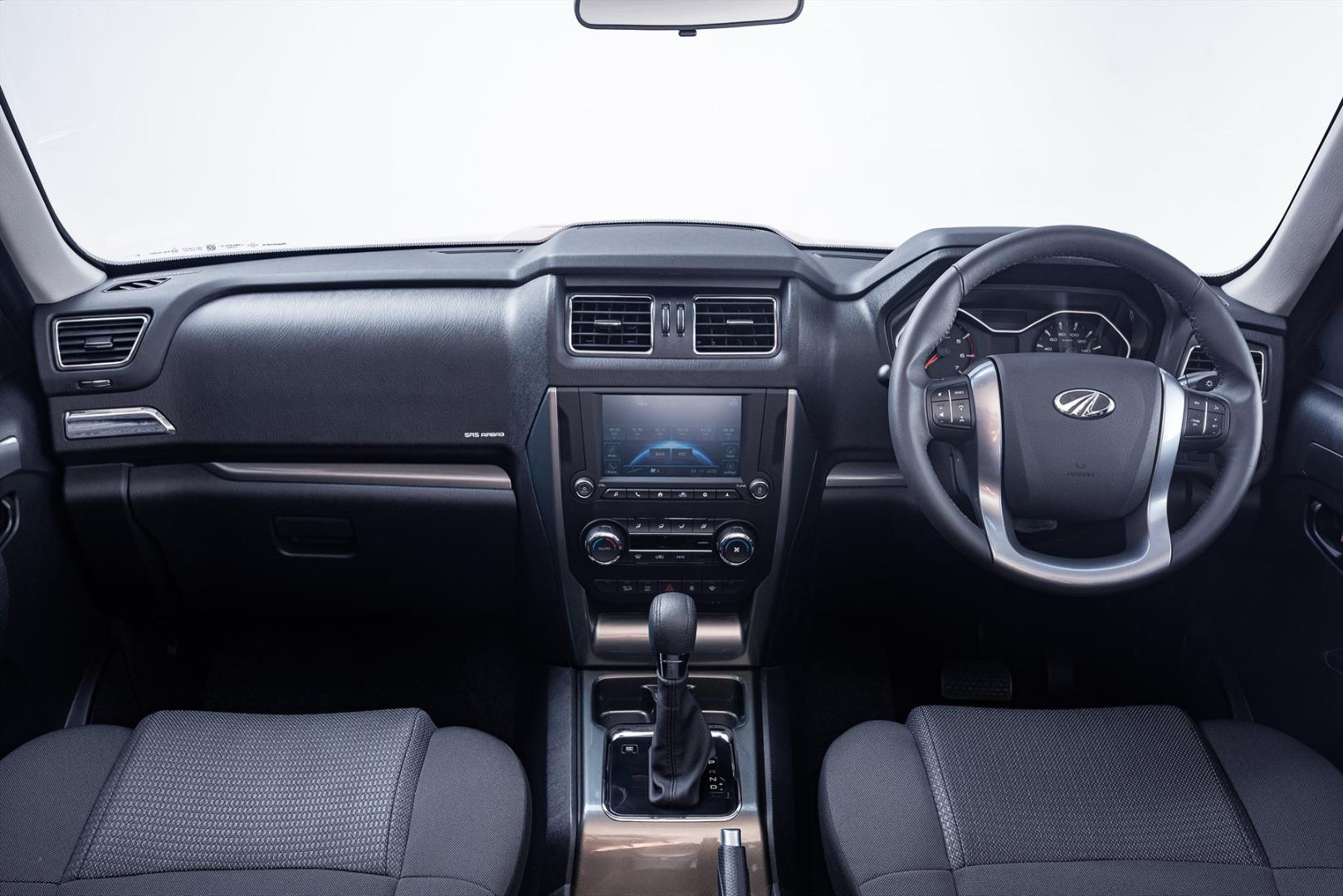
Automatic transmissions are new to the Pik Up range, and only available in the more expensive S11 models. It’s a 6-speed unit that shifts smoothly. It makes good use of the engine’s torque, so it rarely down-shifted and felt confident in choosing the right gear for the job and sticking to it.
Turning off onto a farm road, we met the gravel surface with trepidation, because of two past experiences of a tail-happy Pik Up on wet tar roads. However, traction was good on the dusty Karoo dirt roads and the ride was never bumpy. The next morning, the Pik Up was tasked with driving a party of three up a rocky mountain road. It was no grade 5 Rubicon trail and not challenging for a 4x4 bakkie, but a boutique SUV wouldn’t make it to the top. The Pik Up felt solid and there wasn’t a squeak or creak to be heard. To switch the transmission from 2H to 4H or 4L, you have to turn a large knob in the cabin clockwise, one click or two. There’s no differential lock on any of the axles.
Going slowly up the mountain in 4L, our test-farmer, Wicus Nel, enjoyed the smooth auto-box, which gave his left leg and left arm a rest from their normal duties. His daily driver is a manual, single-cab 2.8 Hilux that requires plenty of shifts when driving along this path. He appears somewhat surprised by the vehicle’s easy-going nature, as well as its ride comfort when crossing rocky sections of the track.
Working our way back down the mountain, our tester engages the hill-descent control (HDC), which works exceedingly well. When it’s active, the HDC limits the downhill speed, without requiring input from the driver. He can keep his foot off the brake and juice pedal, while the ABS system performs cadence braking. The Mahindra’s is one of the best systems around. It’s every bit as good as Mitsubishi’s system, if not better.
Related: Top 3 Mahindra XUV300 trims head to head: here’s our winner.
Space and comfort
If you expect a low-quality cabin that is poorly designed or messily assembled, the Pik Up will surprise you. Mahindra has made much progress since it first arrived in South Africa.
Nel’s girlfriend, Marcelize Koen, also had a turn at the wheel. She liked the fact that there’s enough space for the driver’s legs, because the dashboard and the area around the front occupants’ knees have no parts that stick out towards the driver. She also enjoyed not changing gears and was pleased with the 2.2-litre engine’s power output, although she admits it’s not as feisty as her gentleman suitor’s 2.8-litre Hilux.
With Nel behind the wheel, she sat behind him and commended the backrest’s comfortable angle. She enjoyed more than enough legroom, but two adults taller than 1.8m will not sit comfortably behind each other. The front seats are comfortable too and they provide good long-distance support. Investing in seat covers is advised, as leather upholstery is not available in the Pik Up range. The seat height cannot be adjusted and the steering column adjusts for height only.
A highlight is the large infotainment touchscreen that includes satellite navigation, Bluetooth and a trip computer. The images are sharp and the operation simple and logical. Other creature features include automatic air-con (AKA climate control), four electric windows, cruise control, remote central locking, electric mirrors and a front armrest.
Safety
As a cheaper alternative to the mainstream brands, the Pik Up offers two airbags only, across the model range. Unfortunately, that is the norm in its price range. A similarly priced Isuzu also has two airbags, but the Mahindra XUV300 1.5TD W8 (R 325 00) has seven airbags, while the Mahindra XUV500 2.2CRDe W8 (R393 000) has six airbags.
If you can find an additional R60 000 to add to the Pik Up’s price of R415 00, you can get a manual Mazda BT-50 2.2 double cab SLX (R477 300) with six airbags. Yes, Capitalism dictates that you get what you pay for. (The alternative would have us all drive Trabant bakkies, a thought too ghastly to contemplate…)
Other safety items in and on the S11 are fog lights, directional headlights (to illuminate slow corners), child-proof locks and Isofix child-seat mountings. If you want traction control, stability control and hill-hold, add R20 000 and buy a manual Ford Ranger 2.2TDCi double cab Hi-Rider XL (R436 100); but it has an airbag count of only two.
Fuel consumption
With the needle mostly hovering around the 120 km/h mark, diesel consumption was an acceptable 9.2 litres/100km. Mahindra’s official figure is 8.1 litres/100km, for a combination of city and highway driving. That would be possible on the open road at 100 km/h, but not if there’s a lot of dorp driving in the mix. The fuel tank holds 80 litres, for a range of just under 900 km.
Price
The Mahindra Pik Up 2.2CRDe double cab 4x4 S11 goes for R415 000. The Pik Up-range is priced from R316 500 to R430 000. Its warranty is valid for four years or 120 000 km, and the service plan for five years or 90 000 km. The Pik Up must be serviced every 20 000 km.
Related: How much are car repayments on a new Mahindra XUV500?
Verdict
A stellar reputation like Toyota or Isuzu’s is not built overnight, but requires decades of reliable performance. Mahindra will have to impress a multitude of local customers before it reaches that status, if ever. But, if you want a comfortable, fuel-efficient 4x4 double cab with an automatic transmission, consider the Pik Up S11. Would our farmer buy one? He’s holding his cards close to his chest, but he certainly didn’t expect the Pik Up to be so enjoyable to drive.
Expert rating
3.5/5