
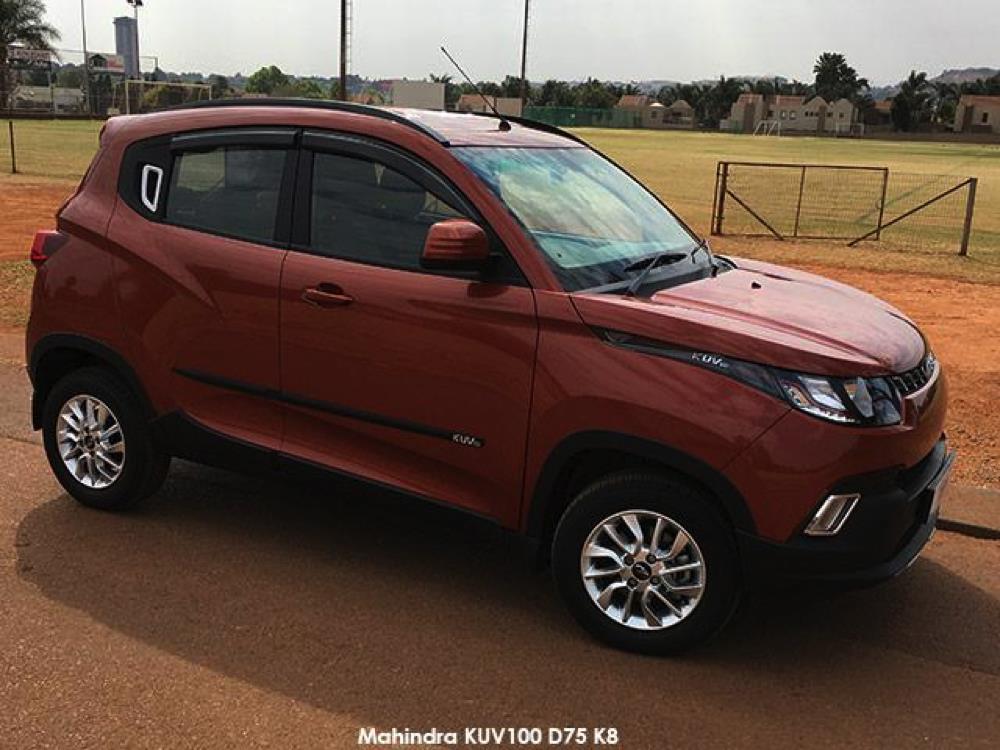
Mahindra KUV100 1.2 D75 K8 – a lively diesel “young SUV” at a budget-hatch price?
We review the Mahindra KUV100 1.2 D75 K8



Name the car
This car would have even most car experts stumped if a quiz was asked to identify it on description. Name the car: it is 3.75m short, as high as a cross-over, has a 1.2-litre 3-cylinder diesel engine, and has headlights inspired by the design of wraparound sunglasses. Hey?
The answer is Mahindra KUV100 1.2 D75 K8.
Learn from others’ failures
Let’s unpack this bit by bit. Mahindra has been building bakkies like the Scorpio Pik-Up (spelt that way) and Genio and larger SUVs like the Scorpio and XUV500 for some time now. If your car company is based in the East and you have not yet made inroads as a market-accepted passenger car brand, you’re likely to be ignored – just ask GWM who tried to add all kinds of sedan and hatch cars (in addition to their known pick-ups and SUVs) but withdrew all of them, or Geely, who pulled out completely – both tried to enter the SA market with cars, but failed.
Young SUV
Would it therefore be wise for Mahindra SA to add a smaller, more car-like, lower-priced vehicle to their line-up of mostly bakkies and SUVs? Aha, the trick is that the KUV100 may well be at the price (and of short length) as the average dreary hatchback, but it is not a car – it is a cross-over SUV.
Mahindra cleverly launched a few new SUVs locally this past year, after the XUV500 facelift, introduction of the Thar (Jeep Wrangler alike low-cost 4x4) and Scorpio S10 big SUV, leaving the KUV100 to neatly slip in at the bottom.
“Young SUV” is how the Indian-market brochure titles it. So it cleverly sidesteps the pothole of trying to compete against the exceptionally popular Polo Vivo or similar – instead, it aims to offer buyers the lowest-priced new cross-over SUV on the market.
Cashing in on the craze of “let’s trade in the car for a cross-over”, Mahindra made a bold move to push the KUV100 onto the tough-to-crack South African market stage. But with this product they have a better chance than the above-mentioned companies… as the KUV100 has uniqueness in its favour.
The 1.2 D75 bit means it is a 1.2-litre size engine, and the D75 on the left front fender is the reference for the diesel engine. There is also a petrol, named G80 (G for Gasoline).
The Mahindra KUV100 comes in 3 spec level options for SA: K4+, K6+ and K8. The badge on the back of the Fiery Orange test unit shows this to be the top K8 spec.
As this car is still a fairly rare sight on the roads, people will drive up to or walk around to the rear to read what this unusual-looking creature is. It looks friendly, but does it bite? After reading Mahindra there is some recognition… which quickly fades when seeing KUV100 on the tailgate, on the door, and even in the side of headlights.
Easy to drive
The “Young SUV” title probably describes this vehicle best. It has the interior space of a larger SUV-size vehicle, but the shortness of a hatch which makes it much friendlier.
What made a good impression is that this KUV is easy to drive around town. The pedals are soft to press, the steering is light to turn, the seats are high and big enough (could perhaps do with more side support) and it has good see-out visibility.
When viewed in side profile it may look like an angry cat that’s got its back curved up, but the SUV-height condensed into city-car shortness works well – people even commented that it looks cute from the side. Perhaps wheels bigger than the standard 14-inch will give it a much more stable stance.
Another pleasant surprise is the small turning circle and nimbleness. A quick u-turn or slipping into a parking is unexpected from this height of vehicle, so you can cut your 3-point turns and back-forward-back-turn-forward parking into an easy 1-step move.
Interior, yes and no
The centre console has controls neatly arranged in a large hangdown panel, with especially easy to grab (without looking) 3 rotary controls for the aircon. The gear lever is on the console next to the steering wheel, within easy reach and with short shifts.
However. The parking brake is the old-school commercial vehicle type – not electric or with the usual lever, but the pull a handle and twist to engage. In contrast to the air dials, the audio switch is small and a bit fiddly, and the centre controls screen is too small, flanked by buttons which have the set menu access like Info and Phone, and 4 inner buttons which correspond to the current screen menu displayed.
On the plus side, there are steering-mounted controls for audio and Bluetooth phone, and a USB port on the upper console, rather than down on the floor where it can’t be seen while driving.
There is no front armrest, though it leaves open space for a tray between the front seats with 3 areas, and the front-most binnacle is squarish so can be used for cupholders or devices or keys.
Have a closer look at the interior and you start seeing where some cost-saving comes in. The centre console has some of the piano black trimming already dulling from chafing, the floor carpet has an untidy slit to allow the fuel and tailgate levers to move, and some of the light-grey plastics seem to have doubtful longevity.
A drawback is that, as experienced during the review period as part of the cross-over/SUV load test, a large item was loaded into the boot. The boot is high and deep (volume 243 litres expandable to 473 litres) but quite short so the rear seat has to be folded flat… erm, which does not split into 2, so the whole bench folds forward as a unit, suddenly leaving the rear-seat passenger without a seat.
Another handy thought is the 12V power socket placed just behind the rear-seat backrest, which allows recharging for the rear occupants or for something in the boot.
Extra rear underfloor storage keeps items like wet shoes out the way, and clutter at bay.
D2 engine
What a great idea: if a small 3-cylinder petrol engine is economical and these days powerful enough (thanks turbo) and a diesel engine is more economical than a similar petrol (mostly) then why should more small 3-cylinder turbo diesel engines not exist?
In terms of economy, a 1.2-litre 3-cylinder turbo diesel makes so much sense. Why do more not exist? In fact, Mahindra is the sole car company to have a 3-cylinder diesel on the local market, after the Polo TDI BlueMotion disappeared.
You can read here that this Mahindra D75 engine makes 57kW at 3750 r/min and 190Nm across 1750-2250 of torque, which does not sound like much, but that’s before you’ve factored in that the KUV100 is a featherweight 1155kg kerb. No 0-100 times are needed for comparison – this baby diesel in this body works so well, it is really zippy around town. Maybe that “powered by mFalcon” badge on the side of the headlight is a bit much, but this little bird has some getup&go.
The 3-cylinder blended with unintrusive diesel also sounds good – never strained as small 4-cylinder engines easily do. It is quite smooth in sound and in operation, and one would be hard-pressed to tell that this is a diesel… except for the good low-down torque which overcomes the small-turbo-engine dead spot, and when watching the fuel gauge. The console display has an option to show the remaining fuel range in km. The fuel tank is just 35 litres which makes it seem thirsty at first, but when filling up you realise it is thrifty.
To the right of the steering wheel is a button marked ESS, which is for the engine auto stop&start. The other button there is for PWR (Power) and ECO modes. The ECO mode cuts power markedly – so much so that it actually makes it slow, and will not de-activate (override) even when you suddenly have to accelerate, so it is best kept in PWR mode, which is normal power anyway.
This diesel is the one to have, but is not available in the base cheapest model, and costs R 18 000 extra on the same-spec petrol for the K6+ and K8. The petrol is a 1.2-litre, but has no turbo, so this would not be a suitable option for driving on the Reef around Johannesburg/Pretoria, nor for carrying adults and heavier luggage. It would also be a false economy, as a plain 1.2 engine would have to work overtime. No, upgrade to the D2 diesel – this car is still cheap enough.
Wraparound sport sunglasses
Headlights inspired by the design of wraparound sport sunglasses, they say. The lenses are quite wraparound long, and have a red line running the contour splitting the LED daytime running lights and front indicators along the side to the base of the windscreen.
Low low price
The K4+ is the entry-level KUV100 you can buy from Mahindra, and it comes at a low low price. So much so, the Mahindra KUV100 dominates the sub-R200k SUV-ish market.
The 1.2 G80 K4+ model is priced at just R 149 995, reaching R 197 995 for the top-spec K8 tested here. Only the GWM M4 cross-over interrupts, at R 189 000. As Daihatsu also stopped operating in SA, the Terios is no longer price king.
The next 5-door in this segment is the recently-launched Honda BR-V, starting at R 238 900. The Renault Duster and Ford EcoSport are now R240k+.
Back to the Mahindra KUV100 with its low low price: the K4+ makes do without some conveniences like remote for the central locking or audio system and does not have the LED daytime lamps as a safety feature, but by price comparison it is up against hatchbacks like the Chevrolet Spark, Kia Picanto, Suzuki Celerio or Swift, Renault Sandero, Suzuki Swift and Mitsubishi Mirage – all small hatchbacks. The Mahindra KUV100 towers above them, literally, by sticking up as the odd one out.
Should you find yourself in the market for a low-budget new vehicle but cannot settle for any of these hatches and find other small cross-overs just out of reach, then go look at the KUV100.