
2019 Range Rover Evoque S D180: Boutique hiking gear, now in this year's colours.
Ever since its début as the 2008 LRX concept car, the Range Rover Evoque has been a fashion statement: a very stylish cloak to disguise some mild off-road prowess. The recently-released second-generation remains true to this ethos, and still provides a great-looking and less expensive route into the genteel realm of Range Rover ownership. But what does being “the Range Rover of compact SUVs” mean in the modern world?



Like the first-generation Evoque, the latest one shares its platform with rather more mundane machinery. The old car was based on the Freelander 2, just stretched and massaged to accept those oversized wheels and that sleek profile. This platform has since been substantially reworked and renamed to become the “D8”, which has spawned the Discovery Sport, Jaguar E-Pace, and now, the new Evoque.
In concept, the latest Evoque stays true to its origins: a sporty-looking, pretty alternative to its more conservative siblings, with a bit of off-road ability and a huge lot of kerbside appeal mixed into the cocktail. There’s no reason to mess with a winning recipe, after all, and seeing as the world apparently can’t get enough SUVs, it definitely wouldn’t hurt to have yet another contender in the Jaguar Land Rover portfolio.

Styling
While the new Evoque stays true to the styling cues introduced by its predecessor (and which has since expanded to all Land Rover products except the new Defender), it’s all been updated to suit modern tastes. The headlights are slimmer, the bonnet is a tad flatter, and the edges are ever-so-slightly smoother than before. This isn’t a mere facelift, though, as the new Evoque is slightly larger than the old one, and rides on a longer wheelbase as well.

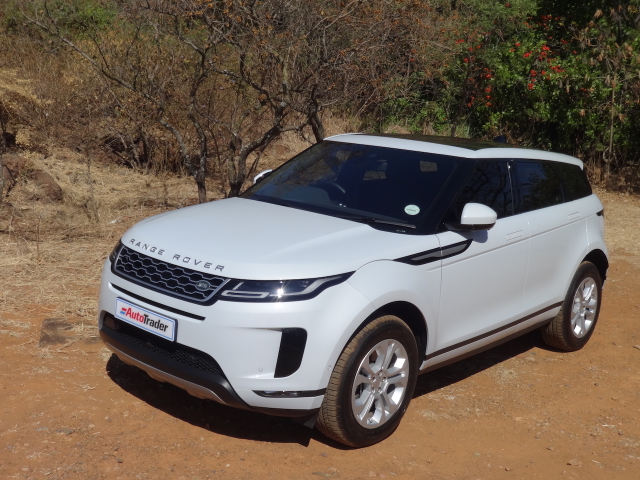
The Evoque’s frontal aspect is instantly recognisable as belonging to a modern Range Rover, and features cool details such as those slimline LED headlamp clusters and a honeycomb-style grille incorporating the offset Land Rover badge. Air intakes are chunky and sleek at the same time, but are less ornately decorated in our “S” trim test car than in more expensive or sporty variants.
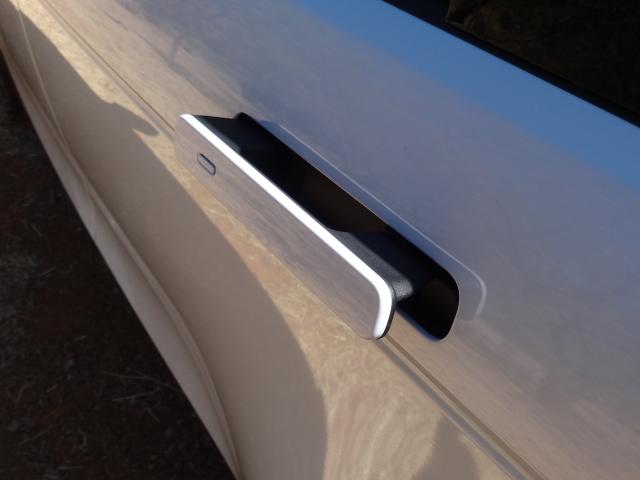
Look down the flanks, and the smooth surfacing, straight lines, floating roof, and simple detailing again recalls this car’s predecessor. The main talking points are mounted in the doors, where the exterior door handles electrically extend or retract at the touch of a little button on the handle itself. This trick is taken from the larger Velar, and seems equally cool on the Evoque.
The rear view is no more controversial than the rest of the car, being a neat evolution of established Evoque styling themes. Slit-like tail light clusters again mimic the shape of the old car’s, but can fit into a much slimmer slot, thanks to the LED technology employed within.
It must be noted that the test car was specified with a minimum of frills. No “R-Dynamic” styling add-ons were fitted to this example, which allowed the car’s intrinsic good looks to shine through without interference from extra strakes and various other plastic bits. And, quite frankly, it looks better this way, so it’s really not necessary to spice it up any further.

The Drive
The lack of sporty pretences in its basic styling extends to this car’s (standard) 18-inch wheels, which in turn adds a nice layer of polish to the Evoque’s road manners. Those tall tyre sidewalls result in a very plush ride quality, which combines with the compliant suspension and hushed noise levels to create a restful atmosphere while driving. And, while the absence of low-profile tyres and stiff springs leads to mild body lean in hard cornering, the ride/handling balance is actually spot-on for a car of this type.
Our test unit’s comfort bias was also perfectly matched to the gentlemanly performance on offer, because it arrived in “D180” specification – the least-powerful engine on offer in the new Evoque. In a car weighing around 1.8 tons, the entry-level engine predictably makes for rather leisurely acceleration, albeit with very good refinement from the drivetrain.

Performance
Under the bonnet is a diesel-fuelled variant of Jaguar Land Rover’s “Ingenium” engine family. In this application, it’s a 4-cylinder, 2.0-litre turbodiesel, which sends 132 kW and 430 Nm to all four wheels via a 9-speed torque converter automatic gearbox. While it’s far from flawless, this is perhaps the most agreeable combination of these components we’ve yet encountered.
First, the engine: Other examples of the Ingenium diesel mill exhibited noticeable clatter every time we’ve sampled it. However, it is all very nicely hushed in this particular Evoque – whether as a result of improved noise insulation or improvements to the engine itself, we don’t know. But whatever the reason, the diesel Evoque’s soundtrack is much more pleasant than this engine has ever managed in the past.

The gearbox is also a major improvement on what went before. While it’s the same 9-speed ZF unit which also serves in the Disco Sport and E-Pace, further development has at least smoothed-out its operation. The gearshift speed is still far from lightning-quick, and it can be a bit indecisive about kicking down when sudden power demands are made, but it’s a lot smoother and more responsive in operation than it’s ever been, and a step forward from its application in the facelifted first-generation Evoque.
However, outright performance is far from blistering. Even with a full throttle application from a standing start, a second or so would tick by before the engine really wakes up. This response lag is typical in most small diesels tasked with dragging along heavy cars, but it could become a bit frustrating in city driving. On the other hand, that nice chunk of turbo torque makes for effortless overtaking performance, and, once on the move, even this base-engine Evoque never lacks for useful urge.
According to Land Rover, the 0 – 100 km/h sprint should take 9.3 seconds, but on-road experience suggests a time closer to the 10.5 second mark – largely due to that take-off lag wasting precious time. For what it’s worth, this car’s claimed top speed is 205 km/h, which seems quite plausible, given the perceived open-road acceleration.
Space and Comfort
As we mentioned earlier, the Evoque’s cabin is a really nice place to spend time. Its comfort isn’t dependent on gadgets, either, because this near entry-level car proved to be a very pleasant companion in spite of its relatively sparse standard equipment level (in comparison to higher-trim Evoques).

The front seats are definitely the place to be, though: there’s plenty of head-, shoulder- and legroom, and even very tall drivers will find a comfortable seating position easy to attain. Two of the key differences between the base-spec Evoque and “S” trim is the 10-way electric front seat adjustment, as well as attractive leather upholstery. In combination, these features sets the tone for an enjoyable travelling experience.
Rear-seat occupants have a fair bit more legroom than in the old car (thank that elongated wheelbase), and while head- and shoulder room are both adequate for average-sized people, those slit-like and tapering side windows can create a somewhat claustrophobic ambience in the back. The luggage compartment is likewise not terribly capacious, and measures only 472 litres with the rear seats in use.

Space considerations aside, the test Evoque was extremely comfortable over almost any road surface. Only the sharpest of bumps could make their way past the absorbent suspension, and even then, the ride never became jarring or unsettled. Superb seats further boosted that smooth-riding demeanour, and combines with the muted interior noise levels to create a classy, luxurious atmosphere.
It may reside at the less expensive end of the Evoque price list, but that doesn’t mean that “S” trim is at all barren. In addition to the aforementioned leather trim and electric seat adjustment, this first step above the entry level also adds standard navigation, which helps to make some sense of its R50 000 price premium.

It’s probably not the best value specification, but it’s not ridiculously overpriced, either. Other standard features include keyless entry with pushbutton engine start, dual-zone climate control, and a 10-inch colour touchscreen infotainment system with smartphone mirroring. The non-opening panoramic roof and driver assistance package fitted to the test car are optional, however.
Safety
Standard safety spec on the new Evoque is very comprehensive. It’s equipped with the usual ABS and stability control, as well as 6 airbags and rear ISOFIX child seat anchor points, all of which contribute to this model’s 5-star Euro-NCAP safety rating.
Also included in the standard equipment list are parking sensors front and rear combined with a high-resolution rear-view camera, along with lane-keeping assistance, automatic emergency braking, and those brilliant LED headlights. Additionally, our test car also featured adaptive cruise control and blind spot monitoring (both optional), adding an extra buffer of safety between the car and possible collisions.

Fuel Consumption
This is where the test Evoque showed the only real chink in its armour. Instead of achieving anywhere near the D180’s official claimed average consumption of 5.8 ℓ/100 km, this test unit returned an average figure of 9.1 ℓ/100 km after a week’s worth of mixed-cycle driving. Sitting on the thirsty side of economical is however a trend we’ve noticed with other JLR products using the same engine, and this is the one aspect that hasn’t been improved upon with the new Evoque.
More’s the pity, because stellar fuel consumption is the main reason why most people would choose a small diesel engine instead of a more-powerful petrol – and this is the one area where our test car didn’t perform to expectations. But, when the Evoque’s substantial weight and all-wheel drive losses are factored into the equation, that thirst becomes fairly understandable: it takes a lot of energy to move around a lot of metal, and that energy has to come from fuel in the tank.

Price
Our test car’s list price of R 788 475 is exactly R 50 000 dearer than the entry-level D180, but only R6 000 more than a base-trim Evoque P250, which has a lot more power at its disposal. With that last statistic at hand, the niceties of the “S” trim level has to justify paying more for a less-powerful diesel engine, instead of settling for fewer toys and cloth seats but getting considerably more steam in the engine room.
Seen in this context, we’re not so sure that the diesel “S” makes enough sense. Less money can get you a lot more (petrol) power, even if the cabin is slightly less lavishly equipped. If the D180 offered enough of a fuel saving, it might have swayed our opinion in another direction, but as it stands, the diesel engine’s fuel efficiency doesn’t do enough to offset its drawbacks.

The Verdict
In D180 S trim as tested, the new Evoque sits in a slightly awkward position among its stablemates, and doesn’t quite represent the best value for money in its range. This doesn’t detract too much from the Evoque’s inherent goodness, however, and in a more sensible trim level, it would make a very compelling case for combining style, comfort, and an upper-class image.
The latest car is still a real Evoque, though: head-turning looks, surprisingly good driving dynamics, and a smidge of off-road ability still meshes into a package which will undoubtedly be very appealing to its target market. Whether there’s still enough room for the Evoque alongside the Jaguar E-Pace and Disco Sport is another question, however. Exactly how many lifestyle SUVs does one manufacturer really need? Time will tell, but we suspect that this Evoque will at least maintain its predecessor’s sales momentum.

Expert rating:
3.5/5
Pricing is accurate at the time of writing, but may change without prior notice.
Hungry for more information? Have a look through these links.
The new Evoque made a big impression at launch, and this report explains why.
Ané Theron tells us about some other highlights of the latest-generation Evoque.
We also investigated the Evoque's larger sibling, and found the Velar to be equally appealing.
Find out more about the Evoque's Euro-NCAP performance here.