
Land Rover Defender 90 TD station wagon Heritage Edition - If you like the first one, you'll like the last one
We review the Land Rover Defender 90 TD station wagon Heritage Edition


Why does the Heritage Edition exist?
The Heritage Edition exists for one important reason: to commemorate the end of Land Rover Defender production.
Taking the original Land Rover as inspiration, the last-of-line Heritage Edition is created purely and entirely as hat-off to the Defender and its world-changing predecessor.
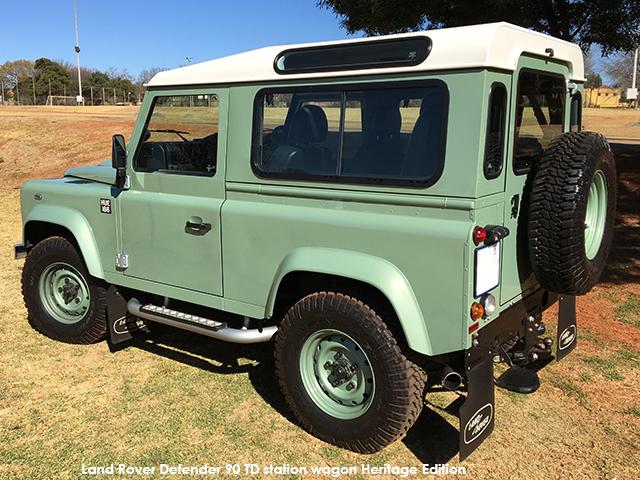
The Heritage Edition evokes Defender’s rich heritage, with a modern interpretation of HUE 166. That is why you see this Grasmere Green paint, green steel wheels, white roof, silver bumper, and the HUE 166 plaque as nod to the original Land Rover which had the HUE 166 number plate. You’ll get asked this a lot, so have the answer ready.
You’ll also get asked if this is an old or a new Landy. Job well done for Land Rover, then – the goal of making the new one resemble the old one is on target.
The Defender Celebration series models consist of this Heritage Edition, the Adventure Edition (the orange and black one) and the Autobiography Edition (not produced for Africa).
Why is it extinct?
The Defender is not extinct because it “stinked”. The production line was closed due to the safety and emissions regulations which have become so strict that it would no longer make sense to re-engineer this getting-on-a-bit Land Rover.
They may have added ABS and stability control, but it is not simply a matter of popping in an airbag pocket into the steering wheel boss – a vehicle body structure has to be designed with an airbag in mind.
The 2.2 TD engine is also, apparently, no longer as clean as it should be, and having to re-rig it to fit a new engine… not gonna happen.
Driving experience, kept authentic
If you are accustomed to driving a car on any SUV from recent decades, you’ll be in for a driving surprise when you set off in a Defender: it is like learning to drive again. Just like when you were a learner driver, you have to learn how to carefully do clutch control, smooth gear changes, and steering. In the Defender these are all exaggerated – the clutch is heavy and grabs quickly, the gear lever needs a proper manhandled movement to go from gear to gear, and the steering, although power assisted, needs a few rotations (more than you’d be used to in a modern car).
On the road, the very short 1st gear (perfect for crawling off-road speed) means the driver needs to quickly change to 2nd gear… and doing the lower gear changes require some practice to get done smoothly.
The clutch pedal is heavy and creaks, while the brakes squeak – is this built in intentionally for that old-school feel? Probably. The old joke of building a left leg muscle from pressing a clutch… well, this is one heavy clutch, which can tire your left leg, and also shows how used we’ve become to the soft clutches of today’s cars.
So, yes – they have kept the driving experience authentic Defender. It was quickly given the nickname “tractor” when it arrived for testing.
Rather than criticism to put you off from buying a Defender, these are pointed out to show that this is a refreshing throwback driving experience, unlike anything else on the road or off, and not as soft and over-electronic’ed as almost all of today’s cars, including so-called rugged SUVs.
Urban-road driving in this Defender, with the 90 model’s 90-inch short wheelbase, means your speedhump-crossing needs to be taken at a moderate speed, to avoid some bronco rocking.
The benefit of the 90 wheelbase is that it has a break-over angle of 33 degrees, compared to the longer-wheelbase Defender 110 which has a 30 degree limit. Both are superb, but while the extra 3 degrees may not sound like much, when you’re in the rough 4x4 stuff, this could mean the difference between getting over that rocky crest, or scraping the chassis, or getting bellied-down.
Open-road cruising in the Defender will be met with 4x4 off-road tyre whine from about 100km/h (so much so that one passenger asked if the tyres are inflated correctly). Some wind noise is heard simply because of the square pre-aerodynamic design, but not intolerable. The aftermarket radio, well… you may as well turn it way up or just off.
The Defender is superb off-road, but not a comfortable long-distance cruiser, especially if you’re in a hurry. It can easily stay with and potentially exceed the highway speed limit, though the lack of cruise control and a rather heavy throttle pedal would require patience and perseverance to go long distance.
The 2.2-litre 4-cylinder turbodiesel engine is capable enough, with overtaking and fuel consumption not a problem. The tall 6th gear makes it more quiet and reduces engine revs for lower consumption and less diesel noise. It does sound rough, though (the “tractor”, remember). Exact fuel consumption was not measured, and there is no on-board computer readout, so during a drive of over 300km in mixed urban and open road, this Defender was returned with half a tank left of its 60-litre capacity (the 110 and 130 models have a larger 75-litre tank).
A few Landy fans and owners commented how they miss the Td5 5-cylinder turbodiesel 2.5-litre engine used in the Defender years ago, and in the Discovery II, which was smooth and had a pleasant 5-cylinder + diesel sound, and was much smoother.
The only concessions to modern comforts are the standard-fit aircon (the Defenders do not have the flip-open air inlets below the windscreen anymore) and electric up-down for the front side windows. The rear side windows’ front halves still slide horizontally, unhitched by a clip inside.
OK, safety also had to be upgraded, so ABS and electronic stability control are standard.
Ergonomic quirks
Some Defender quirks are also still present, like the reach-down handbrake lever next to the gear lever, the truck-size steering wheel, and the driver’s door which shuts leaving almost no space for your right arm (Defender drivers say this is to rest your arm on the door, to be able to relax or to see obstacles when 4x4-ing).
The ignition switch is to the left of the steering column rather than the usual right side, where the short stalk for the lights sits – as a throwback, the stalk doesn’t twist to switch on/off the park or headlights like in most of today’s cars, but you push it forward one notch for parking lights, and to the 2nd notch for headlights, towards the ignition key. This is smart thinking – as the ignition key is also to the left, it means you are reminded to switch off your headlights, as your left hand will feel the lights stalk, and you can simply twist the ignition off and turn off the lights in a single hand movement. Who said older cars weren’t designed with ergonomics in mind?
The front passenger dashboard has a sturdy wide grip handle for holding onto when getting in and out of this high 4x4, and for grabbing when the off-roading gets rough. A complaint voiced by a few people is the absence of a roof grab handle for the front passenger, needed to brace oneself especially when taking corners or on a 4x4 drive. The 2 rear seat passengers get a roof grab handle each, and to hoist/lower yourself through the tailgate, there are another 2 roof grab handles at the exit. The front storage compartment is large, so the most decent way to get into the rear seats is via the tailgate, which also has the Land Rover typical rear step to help.
Heritage Edition spec
The grille is in heritage style, with the metal grid look, original Land Rover front oval badge, where the Land is linked to the Rover with a Z line, old-school style. You’ll also notice the “Solihull England” place of origin, and “1948 2015” date range. The Defender script was removed from the bonnet edge – the original Land Rover did not have this.
Made to look authentic, the Defender Heritage Edition only comes in the aforementioned Grasmere Green paint, which is actually a metallic, surprisingly.
To recreate the metal look, the bumper (there is only a front one), door and tailgate hinges (yes, these are still on the outside) are in Indus silver. The side tubes with metal criss-cross step plates are standard.
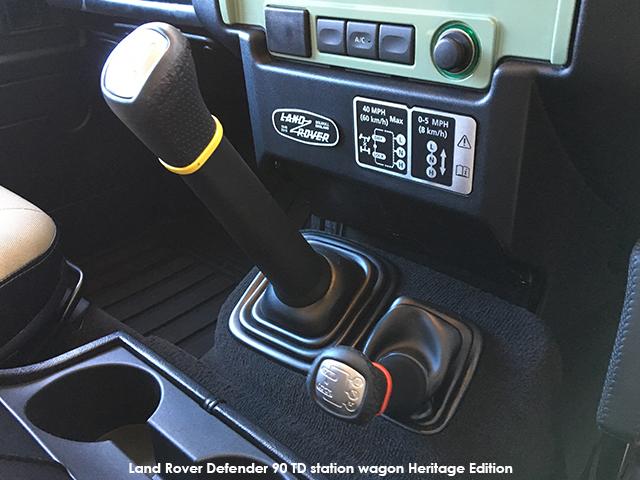
Inside the centre console is painted Grasmere Green. The gear levers have red and yellow O-rings (as of old) and the Heritage oval badge sits left of the old-school gear selection plate.
The interior is in Almond beige cloth – again to replicate the beige seat coverings of the original – and is the perfect complimentary colour scheme.
The Heritage Edition only comes in the station wagon body, in either 90 3-door or 110 5-door – no Defender pick-up, which would have been really nice, too, and perhaps closer to the original?
These are all sold out, before the last ones even arrived. The price was R 668 200. Collectors say this will rise a lot when used ones are sold in future.
Land Rover Defender 90 TD station wagon Heritage Edition – like last one, like first one
The original Land Rover stayed with us, with some updated details but true to its original basic form, from 1948 to 2015. It goes down in history as the longest production run on a motor vehicle. The final production series, officially titled Heritage Edition, highlights the nostalgia of the Land Rover Defender.
The Defender is a clear clone of that still internationally-recognised original Land Rover. No other vehicle can lay claim to that.
During the test period, even Land Rover dealers were offering to buy this, as they could not get enough to supply. This means it has become an instant collector’s item, sure to appreciate in value, especially if kept in pristine condition.
The Defender Heritage Edition is old and new at the same time. If you want something authentic and properly unique, and you can find one somewhere, this will make for a vehicle to be admired (by owner and fans alike) and enjoyed.
There is a Defender replacement in the pipeline, but when they’ve taken away what made the original Defender so special, would it still be so special…?
Like last one, like first one. Indeed. If you like the first one, you’ll like the last one. Quite possibly fall in love with it.