
Kia Cerato SX
All-new third-generation Kia Cerato sedan full of surprises


Introduction
Sporting a sleeker profile with futuristic and dynamic styling, the all-new Cerato sedan is longer, lower and wider than its predecessor. It features an all-new re-engineered body-shell structure and boasts improved quality, upgraded equipment and a host of additional convenience and safety features. New Cerato drivers will experience a more spacious and refined cabin as well as an upgraded power train line-up.
Styling & Design: New ‘dynamic muscularity’ highlights emotional appeal.
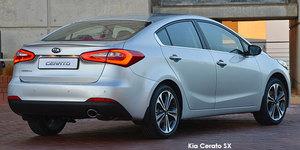
The all-new ‘look’ of the third-generation Cerato was created at Kia’s American Design Centre in Irvine, California. The design team was directed by Peter Schreyer, Kia’s Chief Design Officer and headed by Tom Kearns, Chief Designer, Kia Motors America. Sculpted to portray ‘dynamic muscularity’ and provoke an emotional response, the sleeker new Cerato has cab-forward styling, a lower coupe-like roofline, distinctive eye-catching concave door contours and a rising beltline with a chrome window moulding extending into the C-pillar to project an aura of elegance.
Moving the A-pillar forwards and the C-pillar backwards allows the addition of front and rear quarter glass panels which enhance the car’s sense of spaciousness and improves visibility by eliminating blind spots while enhancing the car’s premium image.
At the rear, the boot lid is shaped to reduce aerodynamic drag and the rear combination lamps smooth the airflow while reinforcing the Cerato’s wide stance. Compared with the second-generation predecessor, the new Cerato is 30 mm longer (4 560 mm), 15 mm lower (1 445 mm) and 5 mm wider (1 780 mm). The wheelbase has been extended by 50 mm (to 2 700 mm). Front and rear overhangs have been reduced by 15 mm and 5 mm respectively to give the newcomer a truly sporty appearance.
Despite the shorter rear overhang, boot capacity is increased by 67 litres from 415 litres to 482 litres (VDA). New Cerato’s external size and proportions, together with careful attention to surface detailing and airflow-smoothing panels beneath the car, have reduced the sedan’s aerodynamic drag to Cd 0.27 (down from 0.29) and lowered the car’s aerodynamic lift – which is Cl 0.11 compared with 0.16 for the second-generation model.
It will be available in a range of 10 exterior colours, and these include: Clear White (solid), Snow White and Aurora Black (pearl), plus Bright Silver, Glittering Metal, Golden Beat, Temptation Red, Planet Blue, Abyss Blue and Milky Beige (metallic).
Comfort & Convenience: Extra space, improved quality and new high-tech features.
The all-new Cerato will be offered in 3 different equipment levels across two engines – the 1.6 EX, 2.0 EX and 2.0 SX. Although the new model is lower, cabin and cargo space has been increased dramatically. The cabin floor is lowered and the seat ‘hip-points’ have been dropped (by 26 mm front and 20 mm rear) resulting in increased front headroom and legroom, while shoulder room is improved by 9 mm (front) and 5 mm (rear).
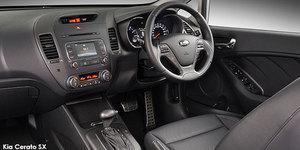
Driver comfort has been enhanced by fitting an organ-type accelerator pedal which more closely follows the natural movement of the user’s foot, while the steering wheel features ‘tilt & telescopic’ adjustment over a 40 mm range. Both front seat occupants will enjoy the wider seat cushions (now 322 mm wide) and increased cushion angle (up from 15.2 to 16.2 degrees). The new Cerato has a driver-focused cockpit, which places all the major and minor controls within easy-to-operate reach. For enhanced elegance, soft-touch materials are applied to the upper door trims, dashboard, door armrests, door centre trim panels and the centre console.
The new Cerato features three different types of instrument cluster designs across the range. A segment-type LCD cluster is standard on the 1.6 EX model, while a dot-matrix LCD cluster, standard on the 2.0 EX model, offers a broader range of information. The 2.0 SX model is fitted with a high-tech TFT colour LCD cluster. This features a new and more ergonomically designed GUI (graphics user interface) with a 4.2-inch screen and high-intensity white lighting.
The 1.6 EX model has an array of standard convenience features including a manual air-conditioner, automatic light control, built-in Bluetooth, steering wheel mounted cruise control, front and rear electric windows, LED daytime running lights, an MP3/iPod/USB compatible radio with CD front loader, rear air vents, six speakers, steering wheel mounted remote controls and 60/40 rear split seats. Upgrading to the more powerful 2.0 EX model gets you a dot-matrix LCD cluster, leather seats as well as the option of a sunroof. An advanced flex steer system allows the driver to individualise his driving style by the flick of a switch. Three settings are available: normal, sporty and comfort.
The top of the range 2.0 SX model features various high tech features including HID xenon headlamps, a rear view camera, a smart key with stop/start button, a smart welcome lighting system, front and rear park distance control and a supervision TFT LCD cluster.
Refinement: Quieter, smoother running, with improved NVH
True comfort when travelling by road is not just dependent on a car’s interior space and convenience features – it can be enhanced or undermined by the level of NVH (noise, vibration and harshness). Consequently, Kia’s engineers worked hard to ensure that the third-generation Cerato would deliver even better refinement than the previous model.
The stiffer bodyshell and new vibration-damping front subframe mountings are an excellent foundation for minimizing NVH. Additional measures taken to reduce NVH even further include lining the engine bay bulkhead with a new, three-layer, HMP3 noise-lowering pad, fitting new dual-frequency engine mounts and applying a new 700 g/m2 EVA (Ethylene Vinyl Acetate) sound insulating coating to the cabin floor.
Further measures see the rear parcel shelf and cargo bay side trims incorporate a thinsulator filling, while the rear wheel arches are covered with sound insulation material and a breathable film is adopted within the cabin headliner. The front side chassis members, A-pillar and side sills are filled with foam. A dynamic damper is also fitted to the shorter of the front drive shafts.
The NVH improvement program has achieved a significant effect. Idle vibrations through the steering wheel and cabin floor have been reduced by 2 dB, while idle noise level in the cabin is down 1 dB to 38 dB and noise during acceleration is cut by 1 or 2 dB – depending on model. Interior noise during a 110 km/h cruise is cut to 65 dB.
Engines: Highly competitive power and economy
The all-new Cerato is manufactured in Korea and is available in a choice of two petrol engines – a 118 kW 2.0-liter Nu engine and the popular 95 kW 1.6-liter Gamma engine.
These lightweight engines, which feature cast aluminium cylinder blocks and aluminium cylinder heads, are both equipped with MPI (multi-point fuel injection), an offset crankshaft (to reduce friction), a low-noise timing chain, mechanical lash adjustment, variable intake valve timing (and exhaust valve timing on the Gamma), and a plastic variable intake manifold (on the Nu engine).
In combination, these features (together with the upgraded transmissions) enable the new Cerato to deliver a highly competitive combination of class-best power (up 3.2%25 for Nu and 4.8%25 for Gamma) with modest fuel consumption and low emissions.
Powered by the 2.0 Nu MPI engine, the new Cerato with the manual gearbox accelerates to 100 km/h in 8.5 seconds or 9.3 seconds (automatic model) and attains a top speed of 210 km/h.
With Gamma power, the 1.6 engine has a top speed of 200 km/h and reaches 100 km/h in 10.1 seconds and 11.6 seconds on the automatic model.
Transmissions: Six-speed manual and automatic gearboxes
Every new Cerato model will feature a six-speed transmission and drivers are offered a choice of manual or multi-mode automatic gearboxes.
To reduce fuel consumption and lower CO2 emissions, both the six-speed transmissions feature high top-gear ratios (as high as 0.727:1 manual and 0.772:1 automatic). To ensure a responsive drive away from standstill, low first-gear ratios (as low as 3.615:1 manual and 4.400:1 automatic) enable drivers to fully enjoy the new Cerato’s performance.
The latest generation Cerato’s new manual gearbox features a smoother shifting performance, enhanced efficiency (reducing fuel consumption) and greater durability. Improvements include multi-cone key-and-ball type synchronizers, quieter running optimized gear teeth, a new reverse gear selection ‘button’, hydraulic clutch control and low viscosity oil – ensuring that the transmission does not require any servicing for the life of the vehicle.
The automatic gearbox delivers faster acceleration from low speeds and greater refinement at high speeds. The transmission has such compact dimensions that it is especially suitable for use in front-wheel drive cars.
This transmission features two operating modes – fully automatic or ‘Sport’ modes. The selector gate is a straight P-R-N-D arrangement, with the Sport mode engaged by moving the lever towards the driver when in D mode. For city driving, fully automatic mode is ideal, while ‘Sport’ mode allows for clutch-less sequential manual gear changes – up or down, one ratio at a time – for greater driver involvement.
Suspension & Running gear: Improved ride quality, handling agility and steering ‘feel’
While the specification of the new Cerato’s fully independent front suspension – MacPherson struts – and CTBA (coupled torsion beam axle) rear suspension is unchanged, both systems have been fine-tuned to improve agility, enhance shock absorbance and deliver greater refinement. Gas-filled dampers are fitted in the front and rear, delivering supple ride comfort and high-speed stability.
At the front, the suspension is mounted on an all-new, stronger subframe. The wide ‘L’-shaped lower arms feature larger diameter suspension bushes, the steering rack is moved forwards by 15 mm (closer to the axle line) and the suspension’s geometry is modified to deliver improved on-centre steering feel. The 4.22 degrees castor angle of the previous model is retained to ensure the optimum level of self-centering.
The CTBA rear suspension is a particularly compact design, which ensures minimum intrusion into cabin and boot space and also maximizes under-floor space to accommodate the 50-liter fuel tank, 482-liter (VDA) boot and spare wheel.
For the new Cerato, the steering wheel features ‘tilt & telescopic’ adjustment up/down and in/out over a 40 mm range, and the gearing requires 2.96 turns of the wheel lock-to-lock. The turning circle (with the 50 mm longer wheelbase) is still compact, measuring 10.6 meters.
To ensure responsive steering ‘feel’ and precise vehicle control, every new Cerato comes with Kia’s MDPS (Motor Driven Power Steering) system. Electric power assistance, rather than hydraulic assistance, delivers a significant (up to 3%25) fuel saving.
For maximum stopping power, all new Cerato models can be equipped with an all-disc braking system featuring large diameter (280 mm) ventilated front discs and 262 mm solid discs at the rear, backed up by ABS anti-lock, to achieve a stopping distance from 100 km/h of as little as 42.3 meters.
Safety: High strength steel: the foundation for high safety standards
Kia Motors invests heavily in R&D to maximize occupant protection and makes the safety of people using its products and other road users a top priority.
Now, incorporating a much higher percentage (63%25) of high-tensile strength steel than many competitor’s cars, the bodyshell structure features new engine bay bulkhead bracing linked to two new longitudinal chassis members each side of the central tunnel. New gussets provide extra connections between the B-Pillar and roof rail, while 60 kg steel is used for the anti-intrusion door beams and 150 kg ultra high-tensile strength steel for the B-pillars.
The new Cerato’s structure also benefits from additional cross members linking the front suspension towers, rear suspension mounting points at floor level and under the rear parcel shelf.
Torsional rigidity of the new bodyshell is increased by 37%25 (over the previous model), bringing the added benefits of improving refinement and creating a stronger foundation for the suspension and steering – in turn enhancing ride comfort and steering precision.
New ‘crash boxes’ are fitted to the longitudinal engine bay side members, reducing low-speed impact damage and the rear chassis side members are strengthened – minimizing distortion and reducing repair costs.
An additional benefit of the CTBA rear suspension layout is that its robust structure provides the under-seat fuel tank with added protection during a rear impact.
Safety technologies standard on all models include ABS (Anti-lock Braking System) with built-in EBD (Electronic Brake-force Distribution), active headrests, impact sensing auto door unlock, a passenger airbag on/off switch, six airbags consisting of driver, front passenger, side and curtain airbags, Isofix child seat anchors and fog lights.
The SX model features ESC (Electronic Stability Control), HAC (Hill-start Assist Control), which prevents slip-back during stop-start driving on inclines, and a VSM (Vehicle Stability Management) system that works with the ESC to provide ‘corrective’ steering inputs to help the driver avoid loss of control, especially on asymmetric (wet and dry) road surfaces.
Service Plan & Warranty
All models come standard with a 5-year/90 000 km service plan, a 5-year/150 000 km warranty and a 3-year/unlimited roadside assistance plan.
[source: Kia SA]
[Auto Trader News and Reviews brought to you by duoporta vehicle information specialists]