
JMC Landwind 5 review – Lost in Translation
JMC Landwind 5 review – Lost in Translation



By Lawrence Minnie
I am sure that, if you were to type the word “Landwind” into Google translate, translate it into Mandarin, and then translate it back into English, you would get the word “Hurricane”. This is probably what the management at JMC had in mind when they greenlit this family sized SUV.
Styling
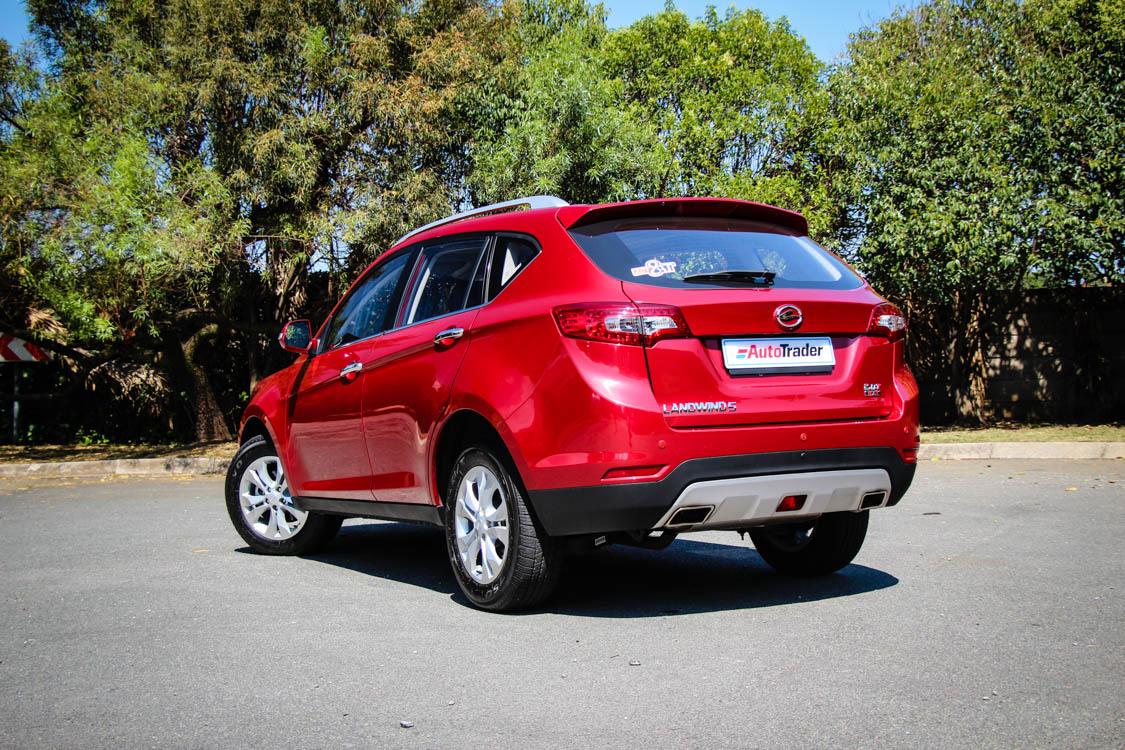
The designers at JMC really did their homework, and took note of the current styling trends in the mid-size SUV segment. The outward appearance of the Landwind is not offensive in any way, and wouldn’t look out of place in an upscale mall parking lot. It’s not incredibly eye catching, unless you order it in Sunset Red paintwork, and easily blends into the background.
The interior is just as inoffensive, and looks about the same as the interior fitment that you will find in a comparable Nissan product. The top of the line model we tested was fitted with a high number of conveniences, such as electric seats, chrome accents, leather trim in this “Flagship” variant, and a touchscreen infotainment system.
Taken separately, these sound great, but as whole they seem like afterthoughts tacked on as extras, and we experienced numerous failures with the infotainment system. It would randomly shut down and reboot, while the audio quality itself also leaves much to be desired.
There just seems to be an overarching disconnect, which can’t seem to pull all the parts of the whole together to make a quality product.
Space and Comfort
The Landwind boasts exterior dimensions of 4568mm in length and a width of 1855mm, and an impressive overall roof height of 1710mm. This leads to a very airy interior with class leading legroom, headroom and shoulder room inside the cabin.
Touch surfaces are hard wearing plastic, and everything seems to have an industrial feel about it.
The seats are covered in leather with red contrast stitching, and is neither too soft nor too hard. It’s comfortable enough for short distances, but I would hesitate to take a cross country trip. This does unfortunately contribute to the lack of cohesion one sense while driving the Landwind.
Safety
Although no recent Euro NCAP scores are available for the Landwind, it does have an impressive list of safety systems. ABS (anti-lock braking), EBD (electronic brake force distribution), ESP (electric stability control), front and side airbags, and a collapsible steering column all aid in keeping the Landwind’s occupants safe.
The Drive
Initial driving impressions revealed the Landwind to be a rather plain drive on the road. It easily reached the national speed limit, and maintained a cruising speed quite well. However, feelings of vagueness through the steering column began to creep in, and secondary elements such as NVH (noise, vibration, and harshness) levels began to annoy.
The drive is not bad or offensive, but it’s nothing to write home about either.
Performance
I found this to be rather interesting, as the Landwind is powered by the previous generation Mitsubishi 4G63S4T turbo charged, petrol engine – derived from the one which powered most of the Mitsubishi Evos. The engine is good for 140kW and 250Nm in this application, and performs well in propelling the Landwind.
Power is sent to the front wheels through a new 8 speed automatic transmission, which turned out to be the biggest talking point. Perhaps due to a poorly specified torque converter or poor transmission programming, the transmission would shift up to 3rd in the blink of an eye, and then get stuck there, refusing to shift up or down even at lower road speeds. This made trundling around the suburbs and over speed humps a nightmare.
Fuel Consumption
The downside to this is that, whether due to poor transmission programming, an older-generation engine, or a detuned fuel map for our environment, the Landwind was incredibly heavy on fuel. The manufacturer claims an average consumption of 9.5 litres/100 km, but we were unable to get the combination under 11.5 litres/100 km, meaning that we got less than 480km from a full 60-litre tank of fuel.
Pricing
The JMC Landwind 5 4x2 AT Flagship model is listed at R 299 800, making it the cheapest new mid-size SUV you can buy with this kind of spec level. A standard 5 year/100 000km service plan and a 3 year/100 000km warranty is included.
Verdict
As a whole, the Landwind is not a bad car, but it’s not very good either. It has all the right ingredients to make a good stew, but someone forgot to tell the engineering team how to cook it. It definitely has the potential to be a great Chinese brand like Haval, but isn’t quite there yet.
They have the styling right, as well as adequate power and reasonably modern equipment and a great options list. Now they just need to figure out how to blend it all properly, and make it work as a whole and not like badly translated owner’s manual.