
Review: Jaguar F-Type Coupé 221 kW
Review: Jaguar F-Type Coupé 221 kW


By Martin Pretorius
When sensibility and self-indulgence meets, the outcome can be refreshingly honest.
When the Jaguar F-Type first arrived in South Africa, I was one of the few privileged journalists invited to meet this beautiful sports car in Mpumalanga. I still vividly recall scything through the escarpment at video-game speeds: the sound of a howling supercharged V6 reverberating through the valley, the sensations of beautifully direct and communicative steering relaying the subtle nuances of the road surface, and the perfect pairing of exploitable power and a responsive gearbox.
And yet, the V8 variant I drove on those same roads the day before was never quite as cohesive as its little brother. The big engine's extra weight introduced some strangely nose-heavy behaviour in corners and skittishness when braking, and the flood of power threatened to unstick the rear tyres and repeatedly tried to send me tail-first into the bushes. It was like keeping a pet tiger, in fact: very impressive to outsiders, but quite obviously also very difficult to manage.
Having thus determined that a bigger engine doesn't necessarily make for a better F-Type, I was intrigued when Jaguar launched a new, entry-level version of their voluptuous sportster, this time with a four-cylinder engine. If six cylinders worked better than eight, might four be better still?
Only experts will notice that it's the junior F-Type.
Out of all the test cars which graced my driveway over the years, I can literally count on one hand the ones which drew unanimous praise from every single onlooker. It's a pretty eclectic list, until recently made up of only the Alfa 4C, McLaren 650S and Aston Martin Rapide S.
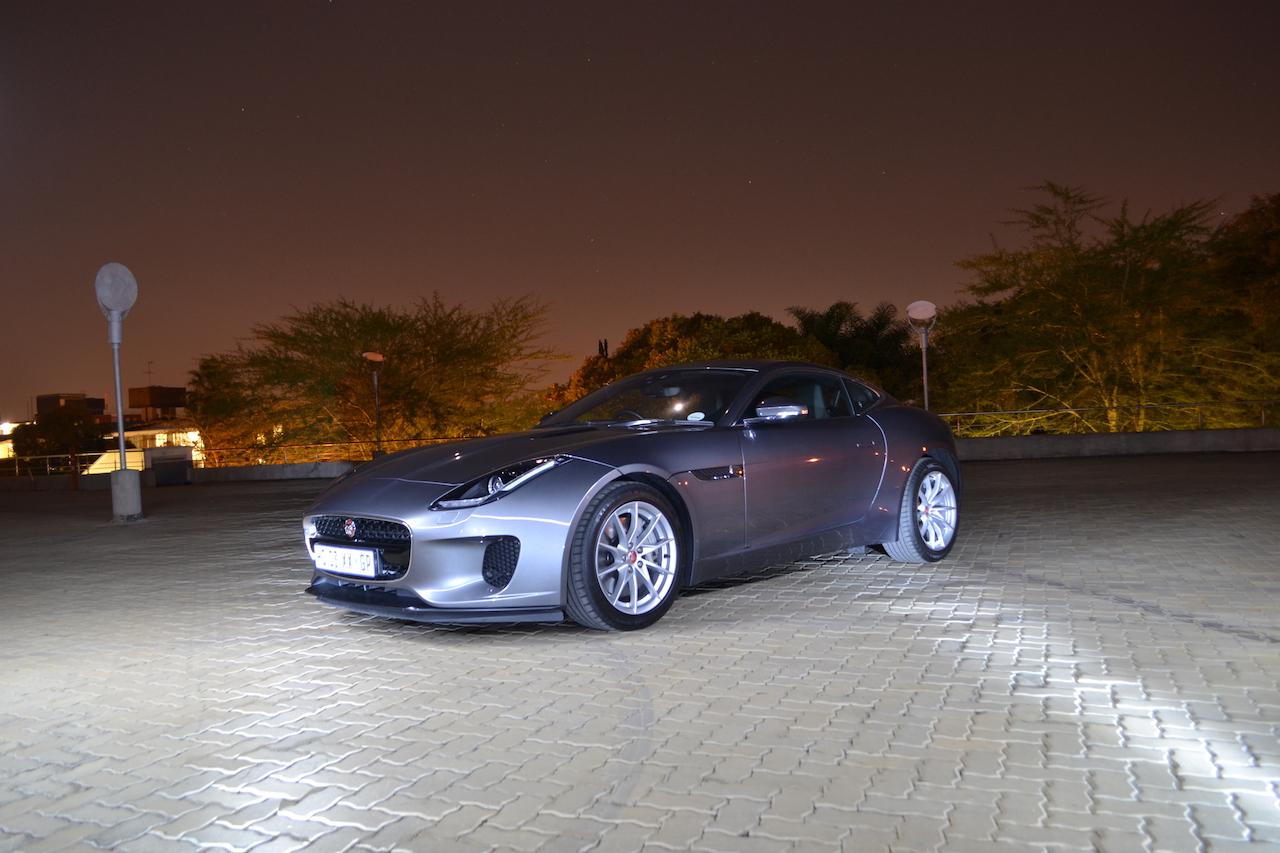
All of which makes our Jaguar F-Type test car's admission to this club all the more remarkable: it wore a subdued suit of dark-grey paint and rolled on modestly-sized 18-inch alloy wheels instead of the oversized rubber hoops fitted to the more-powerful cars. There were no ornate spoilers or flashy stripes either.
It's actually incredible that a car in such sombre attire could attract so much attention. It even got somewhat tiresome after a while (well no, not really), as everywhere I went, random strangers would stroll up to the car – some just to admire, some to take selfies, but almost all guilty of leaving finger prints on the gleaming paint by caressing the swollen haunches and subtle character lines. The styling is simply gorgeous, and hasn't aged a bit in the five years since it was first revealed.
See, it doesn't matter that this F-Type had a four-cylinder engine, because it looked almost exactly the same as the other versions. Only avid car-spotters would have noticed the single, squared-off exhaust outlet in the middle of the rear bumper, but for everyone else, it looked just as arresting as its bigger-engined siblings. If the fire-breathing SVR (the one which bulges with impatient V8 power and spoilers) is a sizzling Hollywood star, the four-cylinder car is that same Hollywood star, just without all the make-up: still beautiful, but somehow more innocent and approachable.
Fewer cylinders, less performance... but the difference is smaller than you'd think.
While on-paper outputs clearly favour the lower-powered (250 kW) V6 derivative, it’s closer than you would imagine, as the bigger engine holds an advantage of less than 30 kW and exactly 50 Nm. The four-cylinder mill comes from Jaguar-Land Rover's new all-aluminium Ingenium engine family, and features direct injection, variable valve timing and turbo charging to produce 221 kW and 400 Nm, the latter available all the way from 1500 to 4500 r/min. Thanks to this wide torque spread, in-gear acceleration is strong and consistent, while the staunch peak power output keeps it from feeling breathless at high revs.
The performance figures are still pretty impressive, with the 0 – 100 km/h sprint taking 5.7 seconds (0.4 seconds slower than the V6) and a top speed of 250 km/h (10 km/h down on the V6). It's also rather more fuel-efficient than the V6, with the claimed average consumption of 7.2 ℓ/100 km being considerably lower than the V6's claimed figure of 8.4 ℓ/100 km. During the test period, I registered an average consumption of 8.8 ℓ/100 km, but that was with fairly frequent meetings between the accelerator pedal and the plush carpeting. Freeway cruising saw the consumption easily drop to sub-7 ℓ/100 km figures, however – much better than the V6 is ever likely to return.
It's a bit softer than you'd expect.
Shuttling the power between the engine and the rear wheels is ZF's excellent 8-speed torque converter automatic gearbox. It's debatable whether an engine with such a flat torque curve really needs that many gear ratios, but the combination nonetheless worked very well. Gear- changes were always smooth and generally prompt, and the gearbox programming allowed for effortless progress whether prodded by the gearshift paddles or left to its own devices.
But, for all their smoothness, the gear-changes were also less emphatic than I'd have expected in a sports car. Even full-throttle applications couldn't get rid of the slight slur from one ratio to the next, something which definitely had an effect on outright sprinting abilities. This applied every time full-power demands were made, whether the gearbox was left in normal Drive mode, flipped over to Sport mode, or operated by the paddles, and regardless of whether the engine was working in Normal- or Dynamic modes.
Pulling away is similarly smooth and civilised, with a hint of take-off lag leading to a rather genteel departure from the starting blocks. But, once the car had travelled about 10 metres, it all came together, and the baby F-Type took off the way a real sports car should. There's no launch control either, so even quick getaways were always dignified rather than blistering.
Fortunately, the smallest F-Type retains some charm to its aural signature. It might not have the V6's howling soundtrack or the V8's rumbling warble, but it also successfully manages to avoid sounding flat or devoid of character in the fashion of most high-performance fours. The sound system does contribute some sound augmentation inside the cabin, but dropping the windows and driving through a tunnel reveals a raspy hum from the tailpipe – the noise inside is at least partly genuine.
It's all about the handling
In much the same way as the V6 F-Type is a sweeter-handling car than the V8, the four-cylinder car is sweeter yet. This is all due to the reduced weight over the front wheels, which sharpens the way it turns into a corner, and then resists the transition to understeer at the limits of grip. The relative lack of torque (compared to its siblings) means that it's quite difficult to unstick the rear tyres as well.
The combination results in a car with genuine agility and a generally neutral handling balance, eventually leading to gentle, controllable oversteer at the limit of adhesion. The overall experience is very engaging: because there's less power to work with, the driver has to concentrate to maintain momentum, and thus has to work with the car to extract high point-to-point speeds.
As for the ride quality, it's comfortable enough to allow daily use, even if the low-speed ride can be a bit stiff-legged over broken surfaces. It smoothes out nicely on the freeway, and combines with a generally quiet cabin to create a relaxing long-distance cruiser.
The specification sheet is still pretty loaded.
The four-cylinder F-Type carries exactly the same standard specification as the low-power V6 derivative. You get Xenon headlights with automatic on/off control, dual-zone climate control, electrically-adjustable seats trimmed in a leather/suede combination (memory seats and full leather are optional), an electrically-adjustable steering wheel, lane departure warning, and a touch-screen audio system with integrated navigation. Rear parking sensors and lane departure warning are both standard, but a rear-view camera and lane-keeping assistance is optional – the test car had the former, but not the latter.
Other options, notable on our test car by their absence, includes heated- and ventilated seats, adaptive LED headlights, and a panoramic sunroof. This particular example was really almost as basic as an F-Type could be specified, but even so, there were enough convenience features to stay comfortable.
Could a R1-million car ever be good value?
Seen as a car, the Jaguar F-Type is reasonably versatile, especially in coupé format. There's enough room to comfortably fit two tall people in the cabin, the luggage compartment is fairly usable at 310 litres (with the space-saver spare wheel removed, of course – there's almost no space with it mounted in the boot), and it's fairly well-equipped for its price point. Add to that the genuinely fun-to-drive character, sparkling handling dynamics and sufficient performance, and the entry-level F-Type starts to look like good value.
To be honest, the F-Type is a very self-indulgent car, but opting for the least-powerful (and lightest) engine adds a measure of sensibility up till now absent from the range. And because of the handling advantages brought about by the lighter engine, enthusiastic drivers will find even more to smile about on a winding road. What they lose in power, they make up in driving pleasure.
Verdict
It looks fantastic, it's very enjoyable to drive, and it's sufficiently quick: these factors may just compensate for the slight loss in performance (and bigger loss in charisma). Far from just a book-end for the range, the smallest F-Type is an enticing, refreshingly honest option in a world where stopwatch times have taken on a disproportionate importance. All it really needs now is a manual gearbox. Please, Jaguar?
Jaguar F-Type 2.0T 221 kW Coupé specifications
List price : R 942 440
Engine : 2.0-litre 4-cylinder, turbo charged
Transmission/drive wheels : 8-speed torque converter automatic, RWD
Performance : 0 – 100 km/h in 5.7 seconds, 250 km/h top speed
Consumption (official average) : 7.2 ℓ/100 km