
Ford Ranger 2.0 Single-Turbo Double-Cab XLT 10AT 4x4 XLT (2020) Review
With it’s 3.2-litre five-cylinder, the Ranger had bragging rights to the biggest diesel engine around, for many years. In line with the Amarok and a few other product lines, Ford has down-sized its latest engine to displace 2 litres. We tested the single-turbo version of this engine in the XLT 4x4 DC.


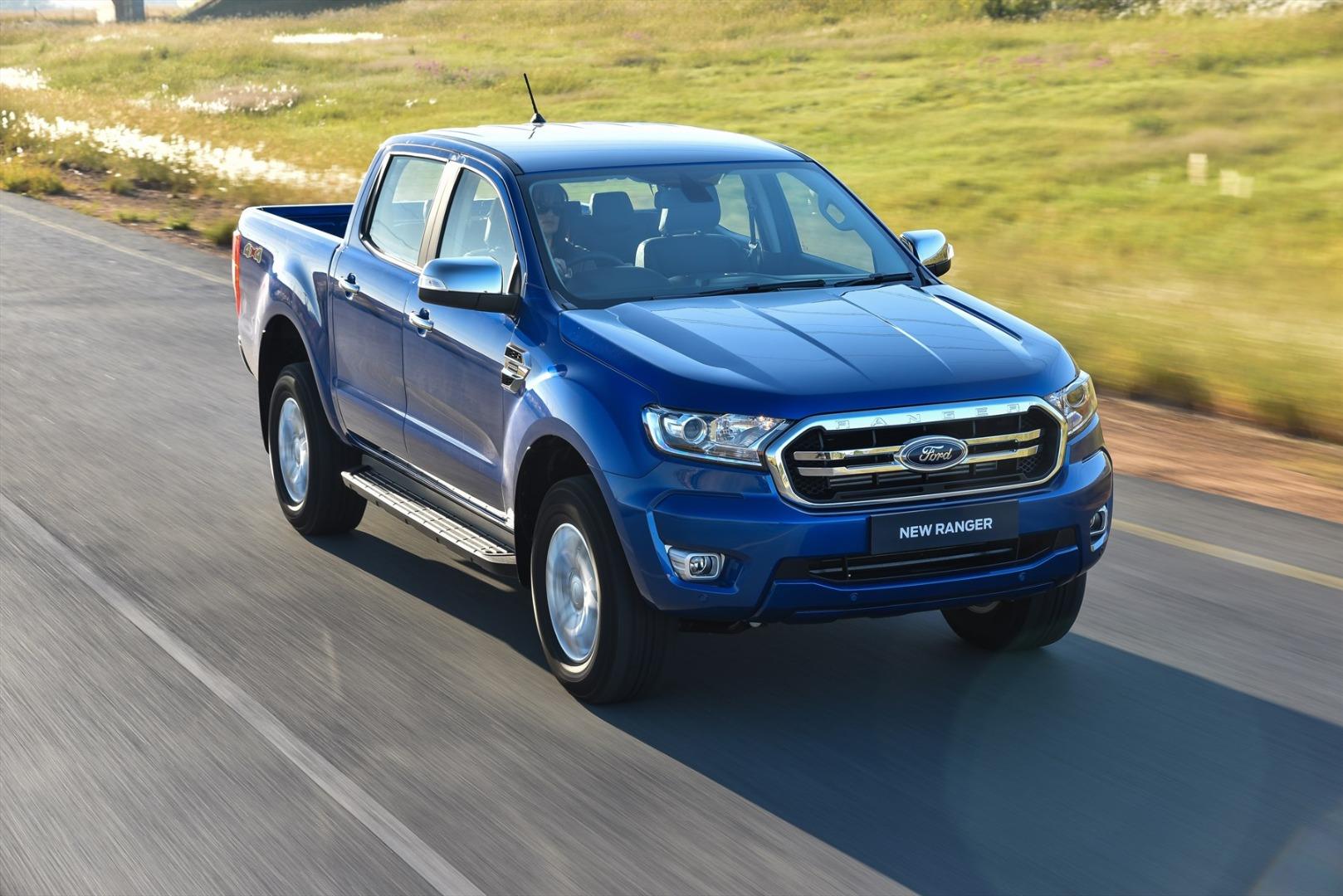


Who would have guessed 25 years ago that the high-riding double-cab (DC) bakkie would be South Africans’ personal vehicle of choice? Significant reasons for this transition is that double-cabs have become so comfortable and luxurious, it’s easy to get out a 3-Series BMW and into a premium Ford Ranger DC. We spent a week with the 2-litre, single-turbo Ranger XLT auto, that’s assembled right here in Mzansi.
Styling

The facelift that goes with the introduction of the new 2-litre engine is more than skin deep, but the Ranger’s outward appearance hasn’t changed a lot. The simpler front-end design of the Ranger XLT is characterised by a new-ish trapezoidal grille, with twin horizontal bars in the middle of the shiny chrome grille. It has distinctive ‘nostrils’ and a more chiselled lower bumper with a wider intake.
The front bumper is now fully colour-coded, giving the XLT a stronger and more dynamic presentation, as it spans between the fog lamps. The new wider and lower grille element, and the revised bumper, add to the virile appearance of South Africa’s favourite DC.
The drive

The previous Ranger (and its occupants) didn’t suffer from a harsh ride, but Ford redesigned the front suspension to improve steering, handling and comfort. Of course this is welcome, but fussy throttle control lets it down a bit. At very low speeds it was jumpy and jerky at times, for example when mounting a pavement or carefully driving up a steep, narrow incline. The Hilux and Fortuner outclass the Ranger here. But that’s the only fault to the drive. It has good high-speed stability, a quiet cabin and doesn’t feel colossal in city driving. The Ranger DC has a maximum towing capacity of up to 3 500kg and it can carry a ton. Thanks to the suspension upgrade, the tyres can now be run at 2.1 instead of 2.4 bar, which also aids comfort.
The two-litre engine is mated to the same 10-speed auto-box that does service in the Mustang, F150 Raptor and Ranger Raptor. Ten ratios sound like overkill, but it does allow the bakkie to make the most of its engine power, while never feeling hesitant or confused. It has a Sport mode, selected with the gear lever, that enables manual shifting. A toggle switch on the gear lever allows the driver to shift gears. There are no gear-shift paddles behind the steering wheel.
At 1 250 rpm the single-turbo engine already develops 340 Nm, while the full 420 arrives at 1 750 rpm. This makes the bakkie quick off the mark.
For the sake of comparison; the output of the Bi-Turbo 2-litre is 157 kW and 500 Nm.
Related: Three things you probably didn’t know about Ford’s new 2.0-litre bi-turbo diesel engine.
The engine
Equipped with a single turbo in the XLT DC, the four-cylinder engine produces 132 kW and 420 Nm. Perhaps that’s not particularly exciting on paper, but in practice you might ask yourself if the extra money for the twin-turbo is justified, because this engine is so potent. It certainly is for the heavy Raptor, with its sticky tyres, but probably not for the standard Ranger DC.
The engine seems to be reliable too, with no alarming reports of engine trouble. A highlight is the drivetrain’s responsiveness. Put your foot down and the gearbox quickly chooses the right gear, while the turbo starts working almost instantly. Ford said the following: “A new turbocharger actuator replaces the worm drive with a geared design that halves response times to 110 milliseconds – or the blink of an eye.” This is certainly not an exaggerated sales pitch.
Going off-road
Off road the Ranger has the go to match the show. It’s a pleasure to drive on fast gravel sections and caters for off-road enthusiasts – with a 0.8 m water wading depth and 230 mm ground clearance. It also has a rear diff-lock and traction control.
Its SYNC3 infotainment system has embedded navigation systems with digital Tracks4Africa maps. Ford says these include maps for Angola, Benin, Botswana, Burkina Faso, Burundi, Ghana, Ivory Coast, Kenya, Lesotho, Malawi, Mauritania, Mauritius, Mozambique, Namibia, Nigeria, Rwanda, Senegal, South Africa, Swaziland, Tanzania, Togo, Uganda, Zambia and Zimbabwe! This could be a strong selling point for those who undertake expeditions on the continent and it will inspire you to do a Cape-to-Cairo trip.
Ford says over 3.6-million kilometres of road and 869 000 points of interest are mapped and listed. Free annual map updates are included for a period of five years, and the text and voice guidance functions are available in Afrikaans, English and isiZulu.
Space and comfort

One of the smartest features of the Ford Everest has found its way into the Ranger XLT. It could be called something like ‘white-noise wizardry’, but Ford simply calls it Active Noise Control. This emits inaudible sound waves to fade out the noise associated with driving, like tyre roar and wind noise. Ford added acoustic glass and improved roof-pillar seals to make the cabin even more of a mobile sanctuary.
The XLT has Passive Entry and Passive Start, which means you can open the doors and start the vehicle if you have the key in your pocket or handbag, without taking it out or pressing a button on the key. It works with touch sensors on the door handles that lock or unlock the vehicle at a touch of the handle.
The cabin is truly spacious and the driver’s seat is height-adjustable. The steering column adjusts for height only. There’s automatic, dual-zone air-conditioning and the SYNC3 infotainment is operated through an 8-inch touch-screen. It runs Android Auto and Apple Car Play, is glitch-free and simple to use, although it’s beginning to look dated. But reliability and ease of use are more important than the latest, slickest design. Owners can update SYNC3 over Wi-Fi, when Ford releases software upgrades.
Ford gave the tailgate a welcome enhancement. It’s now much easier to lift and close, and it’s damped when opened.
Safety
Rear park-distance warning and a rear camera are blessings in a big bakkie. Ford includes this in the XLT and there are front sensors for parking too. The bakkie has a fairly comprehensive safety spec, consisting of seven airbags, ABS with EBD, stability control and traction control. Additionally, there’s trailer-sway control and HDC for the 4x4 versions. And there’s Hill Start Assist, Adaptive Load Control and Roll Over Mitigation, plus a Category 1 Thatcham-specification alarm, Ford says.
Related: We compared Ford Ranger engines, and the efficiency crown goes to…
Fuel consumption
Ford’s new engines are only available with the 10-speed transmission and it does help drivers to achieve decent fuel efficiency. The 4x4 we drove consumes 7.5 l/100km (official figure). Of course these ‘official’ or ‘claimed’ numbers aren’t exactly rooted in reality, so don’t expect miracles. We noted savings of about 0.5 litres per 100 km over the 3.2-litre.
Price
R614 100. The warranty is valid for four-years or 120 000 km and the service plan for six years or 90 000 km. Service intervals are 15 000 km and there’s AA road-side assistance for 3 years.
Related: What is covered under Ford Ranger manufacturer car warranty?
Verdict
There will be those skeptical of the down-sized engine, but anyone who doubts its abilities should really test-drive the new bakkies before forming an opinion. With its re-engineered front suspension and enhanced exterior, the Ford Ranger is even more compelling as an option than before. The icing on top is that you support the local work-force if you buy a Ranger.
Expert rating
4/5