
Fiat 500 TwinAir Pop Star auto – is this the unbeatable city car recipe?
We review the Fiat 500 TwinAir Star auto


Taken for granted
The things we take for granted. The Fiat 500 is one of those things. It is a little marvel, but with so much going on around us, and so many other new small cars vying for attention, the little Fiat Cinquecento (Italian for 500) is perhaps not appreciated as much anymore as it ought to be… time to set that right.
The recipe is such a winning one that it would be unthinkable to mess with it, which would just make a mess of it. Like taking a plate of bolognese and “adjusting” the recipe. No, it would be tantamount to sin against cultural food. Sure, if you cannot grow and chop the fresh tomatoes for the pasta sauce, you may substitute it with a quicker method. Use a modern way, but don’t change the key recipe.
The Fiat 500, too. The old one from decades ago was adapted for today, but the idea is the same – a small no-mess Fiat city car, which will be the default appealing tasty choice… like that classic Italian dish. So, a few years on and with international fame and success, how to “improve” Cinquecento without spoiling the bolognese?
TwinAir engine
When the Fiat 500 was launched, the engine options were 1.2 or 1.4, which were ideally suited to the car. A small car needs to stay with a small engine.
As time went by and the down-sizing turbo-charging began, Fiat created a bold engine it thought perfectly suited to the Fiat 500. Why not build a 2-cylinder? Just 2 cylinders? Where would this idea come from? Actually, from the classic Fiat 500 which had a 2-cylinder engine. OK, then modernise it, how? Add a turbo. But isn’t that what the Abarth 500 is, with its 1.4-litre turbo? No, that is the regular 4-cylinder engine, kept for the performance-tuned Abarth, based on the Fiat 500.
Right, so how much smaller than the base 1.2-litre engine can we go? Well, if the 1.2 has 4 cylinders, the 2-cylinder can be 875cc. Then-eh we add-eh the turbo, ya? And so the TwinAir 875cc 2-cylinder turbo was given life.
When reviewing an earlier Fiat 500, it was asked why South Africa is denied this new TwinAir engine. Fortunately this was approved, and from March 2016, the TwinAir engine is the one you can buy in the 500, launched simultaneously with the facelift (more on this, below).
Does it work, this little 2-cylinder engine?
Yes, very well. The 0.9T produces either 63kW in the Pop or Pop Star (tested here) or 77kiloWatt in the Lounge spec. Both have 145Nm, peaking at 1900 on the tachometer (rev counter) for the lower-output, and 2000 for the higher-kW. This compares favourably to bigger engines.
But those are just numbers. Shop-shooting around town is where this TwinAir comes into play. Take-off is eager, quickly zipping around, and never feels lazy. When you have to go at speed, you’ll be surprised that this city car is not afraid of the big bad highway – at one sprint, this baby Fiat with 4 on board outpaced the new Fortuner 2.4 diesel, which couldn’t keep up. Point is, even on the highway, reasonable overtaking is not a panic moment, and actually smooths out so comfortably (that gentle ride and humming engine) that one could easily exceed by 20-30 that 120 written on the sign you didn’t see. Ahem.
Numbers are 11.0 for the 0-100 in this 65kW version, and 10.0 for the 77kW, whether manual or auto. In reality, is feels quicker.
Taking yourself + 3 of your mates / parents + teenage nephew / friend + son in the little city car (it can take 4 people as the spacious rear bench has 2 amply wide seats, but 2 safety belts) comments included “This is a small car but has good headroom”, “It rides like a bigger car”, “It is well quiet on the highway”, and “You say this is a 2 cylinder (holding up 2 fingers to confirm)?”.
The only time it felt a bit overwhelmed is when we stopped at a red traffic light, with 4 people inside, at a fairly steep incline. The initial torque to get us moving was not on tap, and had a momentary roll-back and slight vibration as the little engine worked hard. To avoid this – when ready to go, foot off the brake and immediately give it midway right-pedal, then the turbo can help and its gearbox can engage more quickly.
The sound
Gotta talk about the sound. While we’ve become used to other cars’ 3-cylinder growls, the 2-cylinder has its own unique engine and exhaust note. At start-up, some describe it as sounding like a Vespa scooter… some not so kind, saying it’s a lawnmower.
Thing is, the 2-cyl turbo has a pleasant p-r-r-r (more than a g-r-r-r) and were it in another car, it would sound weird. Being in a Fiat 500, it just adds to the inert charisma.
TwinAir economy
The more cylinders, the more fuel… is the rule. 2 cylinder will use very little fuel then. Fiat figures show 3.8 litres per 100 km in the combined run, and in the urban 4.6 for the manual or 4.3 for the automated MTA Dualogic fitted to this test car.
Having done some foot-down acceleration and a mix of mostly shops-and-back then a 40km highway roundtrip, the standard on-board computer showed 7.2 for the week’s driving, and 6.7 l/100km for the long-distance average.
Driven with a fuel-pump-conscious mind, this should reduce to closer to 5 avg, realistically. Yay, no need to get a little diesel or hybrid.
It also has automatic stop-start, so when you reach a red traffic light or stand still in traffic, it will switch off the engine to stop burning fuel for no reason. Take your foot off the brake pedal, and it will instantly puff back into life.
Automatic city car
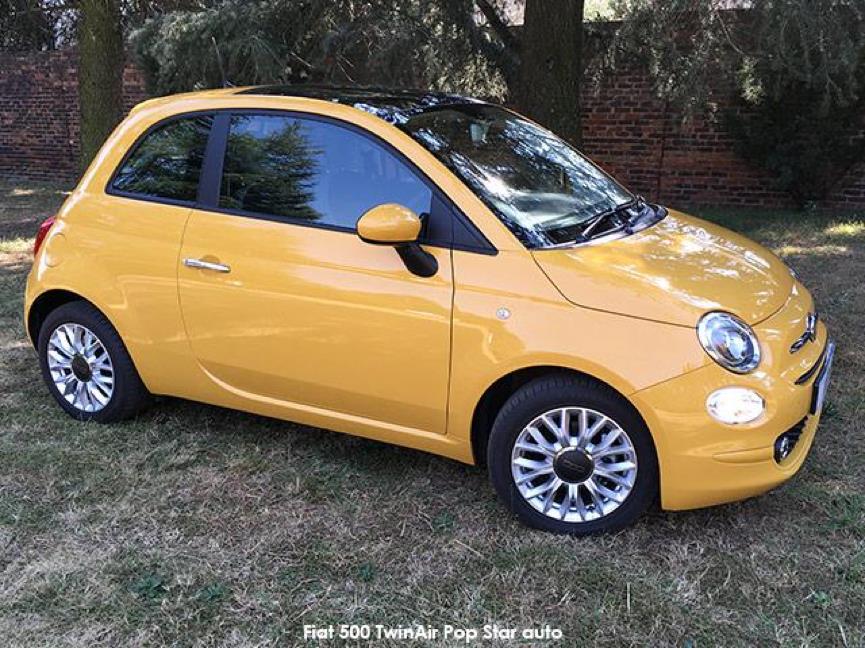
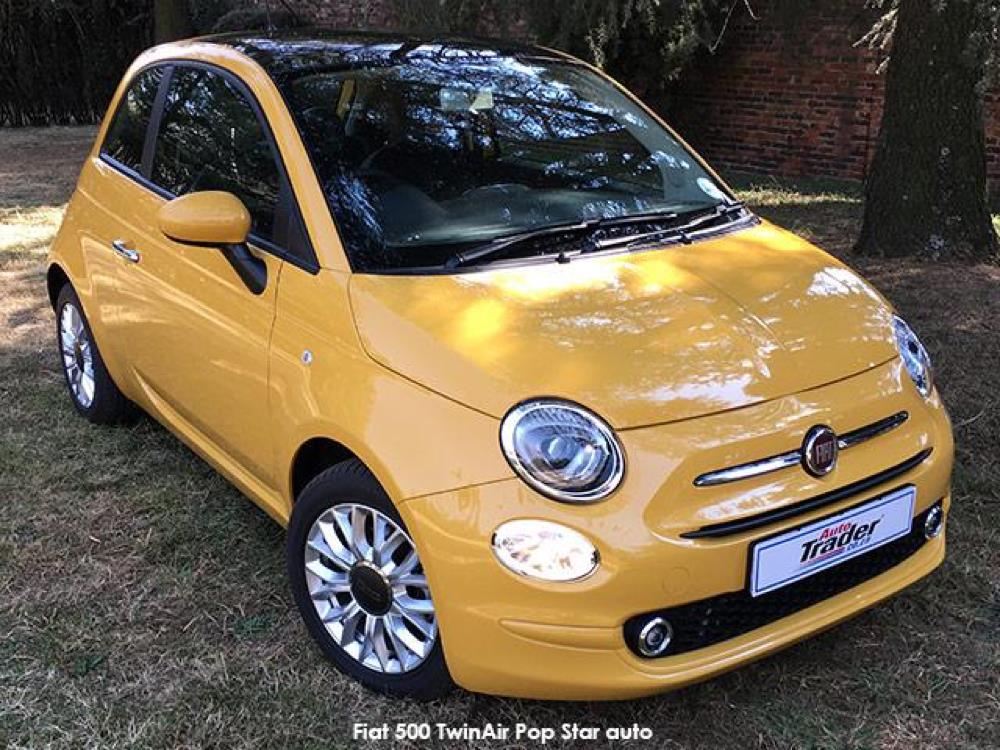
When taking delivery of the Fiat 500 TwinAir test car for the week, the team arrived in this Giallo Sole (Sole Yellow) and an Azzurro Cappelini (that baby blue). The pastel blue with ivory steering wheel and interior is so much more in line with the baby-Fiat’s classic look, but it was manual, and this custard yellow with black interior was booked as it gave an opportunity to test the automatic model. Baby blue, the men moan… it’s called style, guys. Also available in Mint Green, Bordeaux and other stylish colours on the Fiat 500.
All Fiat 500 models are available in manual or, for R 11 000 extra, the MTA Dualogic automated manual. No need to cringe – this is not a small car with a regular automatic, which almost never works – it uses the manual gearbox bits, but operates the clutch for you.
You just flick the joystick back to “ + “ to engage Drive, and off you go. You can also use this “ + “ or “ – “ just for fun to change up a gear or down (the gearbox is mostly in the best gear, automatically). R is located to the right and down, as with some manual gearshifts.
Must say, the gearbox is much improved. Earlier examples in this and a Panda auto had some lags during changes as the electro-mechanical bits did their bit. Now, the gear-changes are quicker and smoother.
If you drive in dense traffic a lot, a small city car with automatic gears is what you want. But avoid most other small autos which will have you irritated. Fiat gets it right.
Let’s re-decorate with some new light fittings
When you want to give your home a fresh look without going to the time, expense, dust and you-missed-your-deadline builders, you get some new light fittings.
For the Fiat 500 facelift, thankfully no new designers were allowed to go all fusion cooking nonsense in the kitchen… in fact the “facelift” is restricted to new lights front and rear.
Clearly the charismatic round headlights identity could not be taken away from the 500 look, so the actual inner bits were changed to show some detail. The new-look headlights now have a 3D look with rounded-triangle-pupil-like inners. Poly-elliptic, Fiat calls it.
Did you know the Fiat 500 was one of the 1st cars on the road, and 1st in its segment, to be fitted as standard with the daytime running lights safety feature? These were retained, but again retouched with new LED dual split semi-circle lamps, as per the Fiat 500X cross-over.
The rear lamps change from a single cluster to a ring-around. The taillights now go around a piece of the body, where the paint colour of the car forms a centre piece in the light. This yellow car, for example, will have a swatch of colour-coded yellow paint placed smack-bang inside the tail lens. A fresh spin. It also gets you noticed by other people on the road
The new-look Fiat 500 extracts compliments on how cute this effect looks. Just say “grazie”.
Interior modernised
The Fiat 500 unique stylised chrome “ 5 0 0 “ badge on the dash panel (colour-coded to the vehicle paint) and single round instrument cluster all stay.
The instrumentation is still the orange-on-black digital readout (for time, fuel, temps, computer, trip, odo etc.) within the rev counter, within the speedometer. Russian doll effect. Great. The Fiat 500 Lounge and Abarth 500C 595 turismo tested recently has the new-look all-digital 7-inch TFT, which loses the neatly-stacked dials. Messing with the recipe?
The centre console with high-mounted gear selector, electric window switches and driver’s-side storage net all in place. Good.
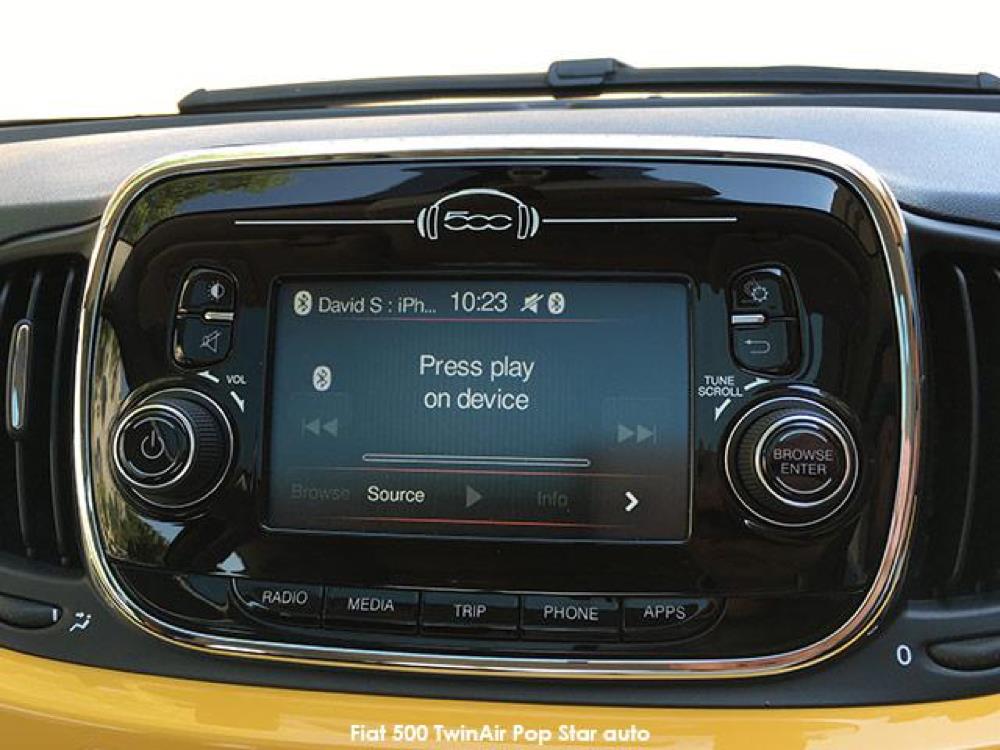
What is new is the controls interface, which is now a modernised tablet-style mount, with gloss black border, chrome frame, and a simple array of 2 round knobs and a row of buttons below… the rest is touch-screen. Notice the 500 wearing headphones graphic on the top of the screen?
A big improvement, as complained about on previous Fiat 500 / Abarth 500 tests, is the multi-function steering wheel switches. The older cars had switches which a normal thumb did not reach easily (something about the angles and places were not right), but in the new cars the switches are repositioned and very easy to use.
Pop Star
The Fiat 500 facelift range is sold through Fiat dealers in Pop, Pop Star and Lounge trim levels. The TwinAir Pop starts at R 179 900 for the manual, and already includes 7 airbags including the driver’s knee airbag (no other small car gives this protection), LED daytime running lights, manual climate control, chrome door handles (not to look plain), Uconnect audio with aux and USB and steering buttons, electric windows. It has classic-look wheel caps.
The Pop Star is the one tested, and adds rear parking sensors, front fog lights in the bumper, and a panoramic fixed sunroof (it can’t open, but a shade inside can be slid open or shut), alloy wheels, leather-wrap for the steering wheel, and electric adjustment for the door mirrors. This car costs R 199 900 for manual, or R 210 900 in this recommended auto. At this price, it is superb value.
The Lounge spec is for when you want to be elegant at first glance. The front bumper gets a chrome multi-pin grille to go with the upper chrome grille, wheels are bigger 16-inch, automatic digital climate control, TFT digital instrumentation, upgrade to the Radio Nav (nav app), rear privacy glass, and side “rubbing” strips (door mouldings) with the 500 logo. The stronger engine is also included. Lounge also gives you inspired-by-fashion interior choices, including Prince of Wales check fabric in tartan with options of green, ivory or coral red, or you can order Frau leather in Tobacco or Burgundy. Pricing is R 227 900 for the manual, and R 238 900 in Lounge auto.
Pop Star and Lounge spec are available in either the 500 hatch, or the 500C cabriolet where the cloth roof concertinas onto the boot. Add R35k for the C.
Timeless, class-less
Proof of the Fiat 500 design is how well it refuses to age. Very few cars manage to pull that off – the classic Mini and the Golf Mk1 come to mind. Update those unmistakable designs by adding airbags and ABS and mod-con features and some new bumpers and lights and drivetrains, and you could re-launch them as modern cars which wouldn’t look like they’re designed decades ago. That’s what the Fiat 500 is, which you can buy new today. 10 years old in 2017. Timeless.
Class-less – this term is not what it may seem at first – it doesn’t mean the car has no class, but on the contrary means it can mix with any class of society or event. Turn up at a gala dinner where guests can see you arrive in a modern-day same-price small hatch from another car brand, and you’ll be pointed to go park far away. Drive up in a new Fiat 500, in any model, and people would not sneer or dismiss your arrival, as you’ll be assigned a nearby parking spot among the longer and more expensive cars, and welcomed with a smile, as you’re seen as having chosen to take the Fiat’s key when you left home, and awarded for your choice.
MINI, take a back seat – you’ve become too big and your once-cuteness has been deformed into that snout. Until you build a mini MINI like the Rocketman concept again, no chance. VW up!, VWSA just stopped selling the 3-door, so you’re too grown-up. Opel Adam… also a young-looking 3-door, but the base model looks that. The Fiat 500 is now the quintessential small car with class-less style.
So, should you buy it?
Is pasta great Italian food? Now cook up that pasta with bolognese sauce or go find a proper Italian restaurant to serve it to you, and forget about the other new city cars which will just be replaced and look old and unwanted soon – stick to the classic can’t-go-wrong recipe. Style, simplicity, value, unbeatable… the Fiat 500 cannot be taken for granted.
“True legends don’t grow old. They simply change.” – Fiat 500 brochure