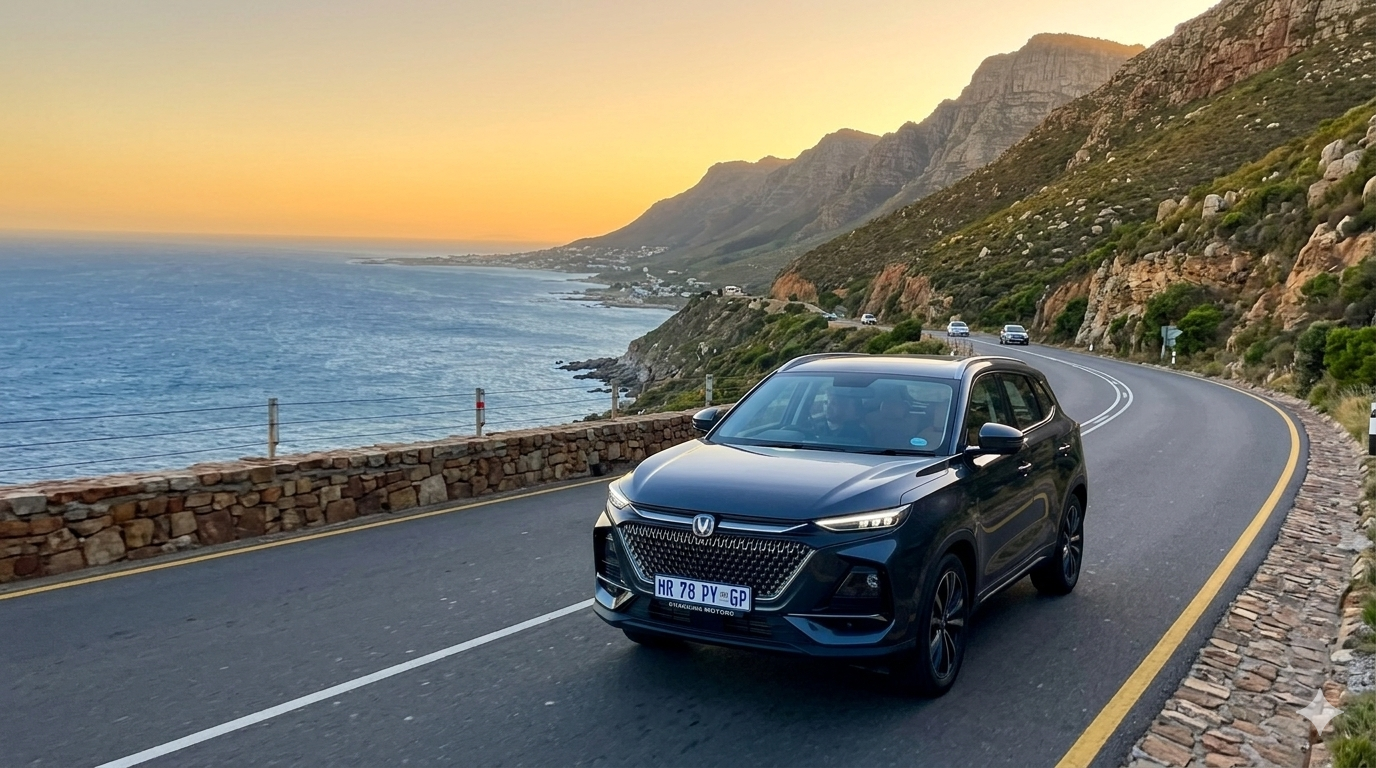


The Alsvin may have been the fleet-friendly appetiser, but the CS75 Pro is the turbocharged, internal-combustion SUV main course. Could this R499 900 seven-seater be the ultimate inflation-buster for South African families, or is it just old tech in a silky Chinese suit?
Related: Changan launches in SA
Styling
The CS75 Pro has serious road presence, wearing a flashy mesh grille that seems to be the mandatory uniform for premium Chinese crossovers lately, flanked by sharp LED daytime running lights.

In top-spec CE trim, you get 19-inch blackened alloys and a full-width rear light bar that looks on-trend and was clearly inspired by the Lexus NX. It’s not going to stop traffic, but it’s sophisticated enough to make your neighbours wonder if you’ve had a large promotion; it looks way more expensive than a sub-R500k car. Only the badge is a giveaway!
Related: Changang CS75 Pro vs Jetour X70

Interior
The cabin is a mix of old-school, high-end aspiration with a sprinkling of modern touches. In this CE model, you’re greeted by microfibre leather in a warm caramel tone that feels genuinely upscale, reminiscent of the Omoda C9; even the start button looks similar. The dash is dominated by two 10.25-inch screens that look the part, but the lack of logic behind it is where the frustration starts.
The infotainment headache
Despite it being 2026, the local system still shuns native Apple CarPlay and Android Auto. Instead, you’re forced to download a proprietary app just to mirror your phone. Having to sign into Spotify through a clunky third-party interface feels like using a dial-up modem in a fibre world.

The ergonomic issue
Then there’s the touch-sensitive climate control panel below the screen. I lost count of how many times I accidentally palm-pressed the air-conditioning to blow a freezing breeze on my feet while just trying to adjust something on the screen. Even changing stations on the radio is difficult. This is all highly frustrating and a potential deal-breaker for the tech-savvy.

No designated spot for your phone
You're forced to sacrifice a cupholder, unless you want to stash your phone away from sight in the central armrest cubby, but I'd want my phone close to me since I can't exactly utilise CarPlay to read my WhatsApps for me, so I'm left with Siri to take my orders on the go.

Charging shortcomings
For a vehicle aimed at modern families, the charging options are surprisingly sparse. There are only two old-fashioned USB-C ports up front in the centre console and one in the back for rear passengers. In a car designed for seven people, that is a bit of an oversight.

Space and Comfort
Up front, it’s akin to a classy lounge with a panoramic sunroof overhead. The CE variant's seats are electrically adjustable and both heated and ventilated, which is always a pleasure during heat waves or cold snaps. The door cards offer enough space for larger bottles and essentials. A wide armrest allows two sets of elbows to be comfy, side by side. Plush carpets add to the feeling of luxury and cosiness.

The second row includes a pull-down armrest with two cupholders, but legroom is not amazing and becomes significantly smaller when you utilise the rearmost seats, which are already tighter than a frog's behind. The second-row seats do slide and recline to allow the rearmost passengers access to their seats, but it's still quite a mission, and you need to play contortionist to successfully clamber over the second-row backrests. Most seven-seaters have this problem unless the second row has free-standing captain seats.
Related: Haval H6 2.0T Ultra Luxury 4WD Review (2026)

The Drive
On the open road, the CS75 Pro feels pliant enough, but it clearly hasn't mastered the art of the South African speed bump. Where a Fortuner glides over these with sophistication, the Changan feels quite harsh. I found myself having to slow down considerably more than I usually do to avoid a jarring jolt through the cabin.

Other than that, it's an easy, relaxing drive, but using the infotainment and other tech systems while on the road isn't very intuitive; however, the 360-degree cameras do their job well. And mostly, things aren't beeping at you from every direction, which is always a win in my books.
Performance
The 1.5-litre turbo engine punches out a healthy 138 kW and 300 Nm, and once the gearbox finally springs to action, the car is surprisingly quick. However, the 7-speed DCT's mapping is like every Chinese car, with the accompanying strange calibration. Pulling away from a robot can be an all-or-nothing experience, where there's a brief pause and then suddenly all the power arrives at once, making you lurch forward with spinning wheels like a teenager in a GTI, rather than a sensible adult in a family SUV.

Why does this happen, though?
To protect the mechanical clutches from wearing out, the car’s computer hesitates for a heartbeat to ensure it has a solid grip before moving. The problem is that while the gearbox is overthinking, the turbocharger is also waiting to kick in. When they both finally decide to join the party at the exact same moment, you get that undignified surge of power that makes you look like a learner driver. It’s not a mechanical fault, but rather a clunky, unpolished conversation between the engine and the gears that makes smooth pull-aways a challenge!
Is there a solution? Yes, switching to Sport or Normal mode will make the throttle more sensitive to your right foot's input, but remember to switch back to Eco because the fuel-saving can make quite a difference to your wallet.
Fuel Consumption
Changan claims 7.5 L/100 km, and the trip computer is a bit of a flatterer, showing a near-miraculous 6.5 L/100 km, with a maximum of 7 L/100 km in Eco mode. But let’s be honest: Trip computers are infamous for telling sweet little lies. Don't let yourself be gaslit; you're likely to get consumption closer to 8 L/100 km, which is still pretty good, considering that this is a decent performer. My heaviest usage was 7.7 L/100 km.

Safety
While the Changan CS75 Pro 1.5T CE is technically the third-gen facelift of a platform that’s been a global veteran for a few years, it brings a proven track record to South African soil. Built on a high-strength steel cage that previously earned a 5-star C-NCAP rating, it offers a solid foundation for family duties. However, there is a key difference to note for our local market: while international versions often boast six or more airbags, the SA-spec CE grade comes equipped with four airbags (dual front and front side).
The flagship CE 7-seater is packed with driver aids, including Autonomous Emergency Braking (AEB), Forward Collision Warning, and Adaptive Cruise Control. To top it off, the 360-degree HD Panoramic Camera (with an integrated driving recorder) gives you eyes in the back of your head.

Price
Changan is distributed in SA by Jameel Motors, and is backed by a massive 7,500m² parts warehouse in Kempton Park. This local hub is a crucial safety net for those worried about long-term maintenance in an unstable global supply chain.
Price: R499 900 (CE 7-seater).
Warranty: 5-year / 150 000 km.
Service Plan: 5-year / 90 000 km.

Verdict
My heart wants the seamless Google integration of a Volvo or the sophisticated suspension of a Toyota. But my common sense looks at the Changan's R499,900 price tag, and it seems like quite the bargain. However, there are other SUVs from more established brands that deserve your attention, like the Mahindra XUV700 2.0T or my personal favourite, the Hyundai Alcazar (naturally aspirated 2.0-litre petrol), which also seats seven at a similar price. (Read our review on the diesel-powered Alcazar model here.) Other Chinese competitors include the Jetour X70 (find our review here).
The CS75 Pro may be getting a little older, and the lack of CarPlay/Android Auto is an inconvenience. But, if you can live with the clunky infotainment and lurchy gearbox mapping, it’s a lot of stylish, powerful SUV for what you are paying. If money were no object, I’d be in a Toyota Prado, but in the current economy? The CS75 Pro is not a car I would mind owning.