BMW M8 Competition cabriolet review (2021): Drop-top Bavarian with supercar-rivalling performance
The BMW M8 has established itself as one of the fastest production BMW models ever made. There is now an M8 for those with a penchant for endless headroom in the form of the convertible. We had a chance to spend 48 hours with one recently and here are our thoughts.


Since BMW decided to discontinue the 6 Series and replace it with the 8 Series in 2018, a hint of nostalgia has crept into the BMW product portfolio as the first-generation 8 Series celebrates its 31st birthday this year. The modern 8 Series certainly pays homage to its predecessor in its design and basic shape, but it also manages to differentiate itself from the car that is replaces in many ways too, with four-wheel drive, various body styles, the use of turbocharging and of course, the introduction of an M version.
As the new performance car flagship in the range, the M8 Series is available in Coupe, Gran Coupe and Cabriolet body styles, all of which ride on the brand’s CLAR platform, which underpins cars as compact as the 3 Series all the way to the brand’s flagship SUV, the X7. With just 48 hours to experience this newcomer, we got right to the business of driving.
Styling
The exterior design of the M8 Competition cabriolet takes what in this writer’s opinion, is one of the most beautiful modern BMW designs and beefs it up further. There are 20-inch alloy wheels, an M-specific front bumper with wider air intakes, and a black kidney grille. The side profile reveals a silhouette that can be transformed from a coupe-esque look to a cabriolet in 15 seconds when the electrically operated roof is stowed. At the rear end, there are now four exhaust pipes, two on either side of the new diffuser while a boot spoiler finishes-off a far more aggressive exterior look.

Interior and space
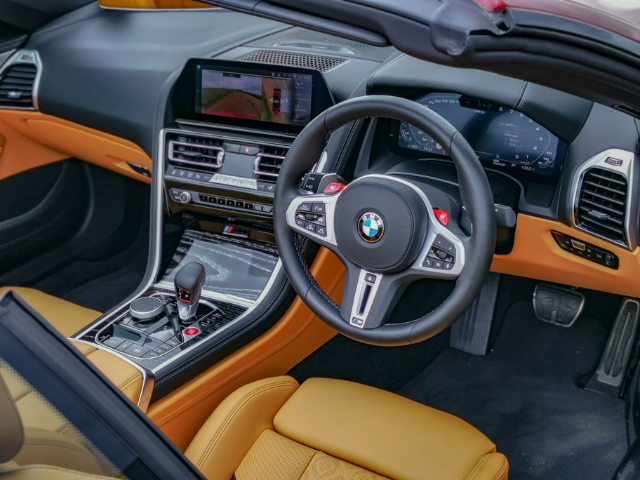
Stepping inside the M8 was a polarising experience, as it does not appear much different from lesser BMW models, aside from the fine stitching on the seats and various surfaces. This may be more of a compliment to products in the lower echelons of the range rather than a critique of the build quality, ergonomics and material usage in the M8, which is phenomenal, even at this price point.
The Motegi Red Metallic exterior hue of the press unit was heavily contrasted by the Merino Midrand Beige leather upholstery with BMW Individual fine-wood trim Ash black silver effect trim, certainly a combination that takes time to get used to, particularly with the roof down.
Being a BMW, there is a the superb iDrive infotainment system, which we are happy to report now includes Android Auto along with Apple CarPlay functionality. We still believe that this is the best infotainment set-up currently available for a car, it’s just so intuitive, with a toggle pad, steering wheel buttons, gesture and voice control functionality providing four ways with which to control your navigation, vehicle set-up and media.
In terms of practicality, the cabriolet suffers because of its fabric roof, which has taken-up 70-litres of boot space when attached and 140-litres when it is stowed, meaning 350 and 280-litres of boot space respectively when compared with the 420-litres provided by the coupe. In terms of rear seating, the M8 cabriolet is really only suited to shorter occupants in the rear, not offering much for those looking at taking on extended trips with four occupants on board.
Performance and driving impression
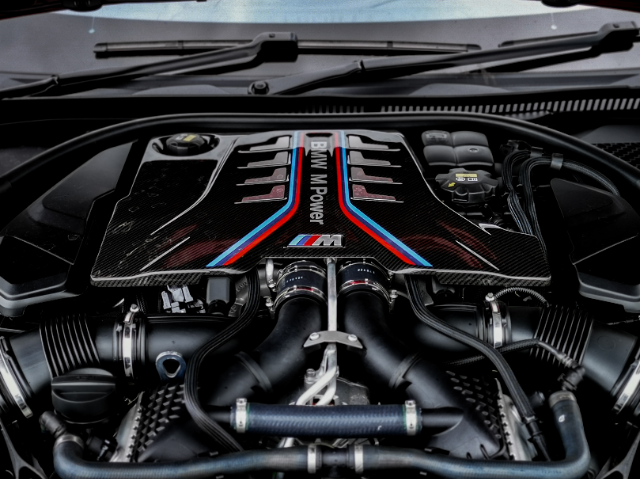
Despite tipping the scales at a plump 2 085kg, some 125kg more than the coupe and just 30kg more than the Gran Coupe, the cabriolet version of the M8 Competition is certainly no slouch in terms of performance. Since there is only the Competition version of all M8 models sold locally, the cabriolet features the same 460kW and 750Nm of torque from a 4.4-litre twin-turbocharged V8 engine paired with the mighty ZF 8-speed torque converter automatic.
Power is sent to all four wheels, allowing for a claimed 0-100km/h time of 3.3 seconds and in the case of the press unit, a de-restricted top speed of 305 km/h. It feels every bit as fast as the figures suggest, all the while the exhaust note provides a wonderful balance of V8 burble without being brash.
My initial reaction after first driving the cabriolet was surprise at its grin-inducing accelerative capabilities followed by a decided dollop of caution as the car felt rather large on the road, requiring a few minutes of careful piloting to get used to. Once acclimatised to the width and length of the M8, it becomes a confidence-inspiring GT-car, with the torque converter automatic, linear power delivery and supple ride quality (when in the right mode) making this a beautiful car to drive across the country.
Despite the loss of its roof, there is little wind intrusion with the roof up while rigidity remains commendable on account of its stiff body. The suspension set-up on all M8 Competition models has now been fitted to the updated M5 Competition, however, all M8 models have a lower centre of gravity, making it feel a bit more dynamically adept than the M5. There is no way of disguising the convertible’s weight and size though, meaning that it lacks feel and feedback versus a pukka sports car.
The xDrive all-wheel system in the M8, as in the M5 models, can decouple the front wheels, allowing for a rear-wheel drive experience, complete with no electronic stability programme, which makes traction an issue, allowing for more sideways action, if you are feeling brave enough. While a cool spec-brag around the braai, we do not see any point in this mode, unless you have access to a private road where this feature can be experienced.
Safety
As a relatively low volume product, the 8 Series range is yet to be crash-tested by the likes of Euro NCAP, however, as one of BMW’s flagship products, it comes fitted with a raft of safety items including semi-autonomous driving functionality, various sensors, surround-view cameras as well as six airbags, meaning that we are certain that it will be as safe as the other BMW products tested, which all received the maximum 5-Star ratings in 2019.
Fuel economy
Since we only had access to the car for two days, our goal was not exactly a fuel economy run to ascertain whether BMW’s claimed consumption figure of 10.8L/100km was accurate or not. Therefore, our combined figure of 16.7L/100km is not representative of the true figure, however, we suspect that those with the means to afford one of these will care extraordinarily little for fuel consumption.

Pricing
The press car is very well specified; however, its basic list price is R3 630 862, making it the most expensive of the three M8 variants on sale. There is most certainly performance and luxury in spades, however, you cannot help but think that the M8 Competition cabriolet has an increasingly small market of buyers ready to take the plunge on what is sure to be a rapidly depreciating product.
Verdict
Products such as the M3 and M2 Competition signify what the M-division is all about, performance, driver engagement and compromise all wrapped-up in what is usually a small saloon car or coupe. The M8, on the other hand, is already a large sporty coupe, Gran Coupe or cabriolet to start with, making its transformation into an M-car a bit less pronounced and indeed, more difficult for engineers.
The M8 Competition cabriolet, therefore, comes across as less of an M-car and more of a very fast performance GT. This begs the question, why spend R3.6-million on an M8 Competition convertible when you can get 90% of what this car offers for R1.3-million less with the M850i xDrive convertible?