
Tasty electric with a dash of petrol - the BMW i3 REX
Tasty electric with a dash of petrol - the BMW i3 REX


By Justus Visagie
The BMW i3 REX is quick, cheap to run, cleverly designed and fun to drive. But like sky-diving, caviar and art films, it’s not for everyone.
H3 Electric vehicles (EVs) have a hard time trying to crack the local market. Their sales can’t even be described as modest. Yet the three electrics available, bravely soldier on: the Nissan Leaf, BMW i3 and the i3 REX. I drove the REX for seven days.
So there are two versions of the i3. What’s the difference?
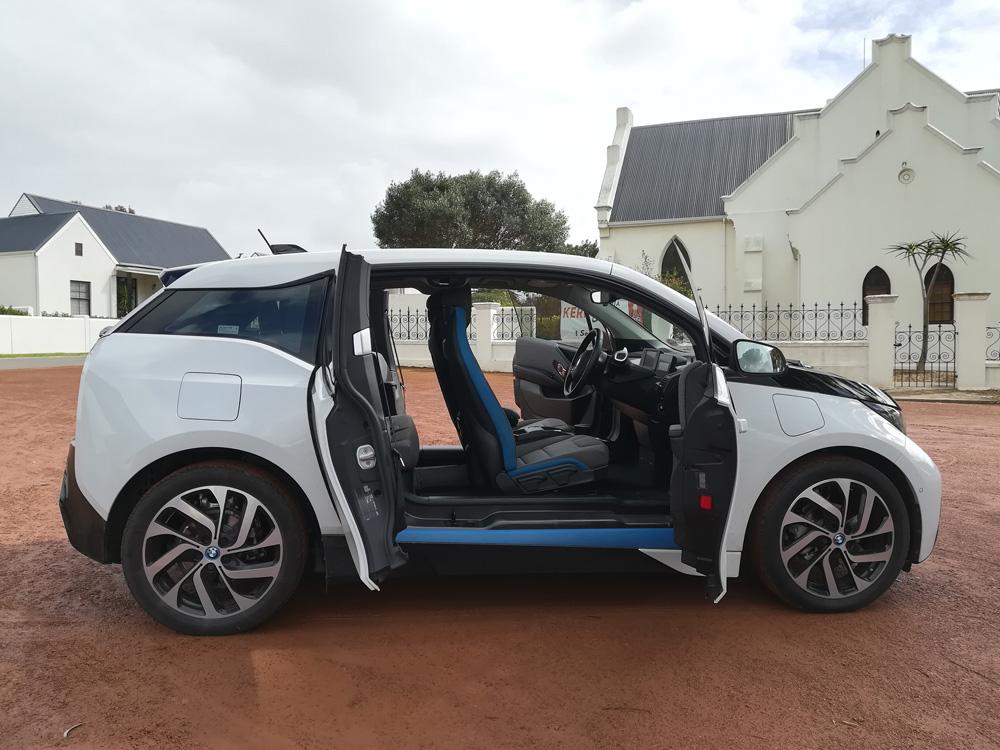
I drove the more expensive i3 REX or Range Extender. It looks exactly like the standard i3, but it houses a 2-cylinder-647cc petrol engine under the luggage area behind the rear seats.
The i3’s cute body shape also hides a large lithium-ion rechargeable battery pack that powers an electric motor that drives the rear wheels. Now here’s where it gets interesting. When the battery’s range drops to around 5km, the 647cc engine kicks in and acts as a generator. This tops up the battery, so it can power the wheels again to make the car go. The engine, therefore, never drives the wheels.
How far can it go?
Charge the lithium-ion battery to 100% and the i3 and i3 REX will do about 130km before the battery is spent. If you drive the i3 that’s the end of the road unless you stop next to a power outlet. But if you drive the i3 REX, you’ll get an extra 140km from the fuel it carries in its 9-litre tank. These distances depend on driving habit, just like a car with a normal ICE (internal combustion engine). So the range will decrease more rapidly if the driver has a heavy right foot or uses the air-con full blast.
On a full charge (9 hours at a domestic power outlet) I drove from Hermanus to the top of the Franschhoek Pass (95 km) before the engine came on to add juice to the battery. The descent to Franschhoek added a significant amount of stored energy to the battery. When the car coasts, i.e. moves forward without the accelerator pressed, the electric motor instantly becomes a dynamo and charges the battery. Within 5 minutes the i3’s range was indicated as 11 km and the petrol engine went back to sleep. Driving frugally, I almost made it to Paarl (133 km) before the generator had to come back on.
How does it perform?
Because it carries the 120kg weight of the generator and its plumbing, the i3 REX is technically slower than “plain” i3. Yet it doesn’t feel that way. The REX sprints from zero to 100 km/h in just under 8 seconds, against the i3’s 7.2 seconds. Rolling acceleration feels particularly quick and I couldn’t resist playing with the accelerator when on the go. Both versions of the i3 have their top end limited to 150 km/h. BMW rates maximum output for the electric motor as 125 kW and 250 Nm. These are modest figures, but because that 250 Nm kicks from standstill, at the press of the driver’s right foot, it feels much, much faster and more exciting than normal cars. The speed and sensation is amplified by the 1-speed transmission not changing gears.
When lifting off, the braking effect is strong, to maximise energy recuperation and storage in the battery. No doubt this will make the brake pads last very long.
Despite wearing narrow tyres to minimise road friction, the REX’s handling is fair.
What’s the interior like?
Electric cars can be packaged differently to ICE cars and the benefit is clear in the i3 REX. Even with the petrol generator under the boot, there’s still 260 litres of space and 1100 litres with the rear seats flat. Passengers have room to spread out and the interior feels spacious and airy. It’s like no car you’ve driven before and the use of carbon fibre and recycled materials (that look very stylish) are obvious. By the driver’s right hand, by the steering wheel, there’s a large, beautifully made aluminium toggle switch for selecting forward or reverse.
Should I get one?
If it will suit your lifestyle the i3 REX is an exciting and cost-effective alternative to an ICE car. Most people don’t drive more than 100 km per day, so the range is more than sufficient. For those long, fun trips to the in-laws you might need your spouse’s “normal” car. Other alternatives for when the REX’s range falls short would be cabs, public transport, rental cars and air travel.
Unfortunately the REX isn’t cheap. But think about it: for a R15-charge from Eskom you can travel 100 km. Unless you drive a Nissan Leaf or an i3, your ICE car can’t match that.
The numbers
Engine: Hybrid synchronous motor with integrated power electronics, charger and generator mode for recuperation
Transmission: 1-speed automatic, rear-wheel drive
Battery pack: 22 kWh lithium-ion
Output: 125kW and 250 Nm (battery)
Combustion engine: 2 cylinders, 647cc, 28 kW
Performance (claimed): 0-100 km/h in 7.9 seconds, max. speed 150 km/h
Consumption (official): 0.6 ℓ/100 km
Luggage compartment: 260 litres
Price (before options): R683 600
Also consider: BMW 420d Gran Coupé Luxury Line auto (for the same money)