
Is the BMW 320d a good performance-economy combo?
Auto Trader reviews the BMW 320d Sport sports-auto


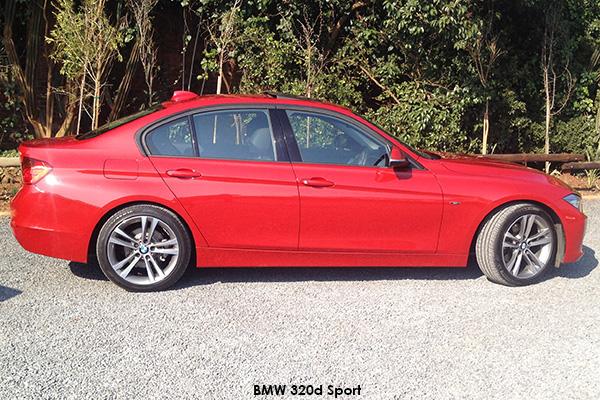

The BMW 320d in its current guise builds on the sales success of this popular smart sedan.
Why is the 320d such a popular choice? A very responsive 2.0 turbo diesel engine is very responsive – for a 2-litre, this car really gets going, with brisk performance accessed easily. The strong 380Nm torque, available across a wide rev range, makes this a lively engine. Long gone are the days where diesels are slow – for the past few years these have been bought partly for their performance. See, a modern turbo diesel lets you scurry off the line and calmly, without needing to break a revving sweat, cruise up a hill and overtake slower traffic.
People also buy diesels for their fuel efficiency. With a recent fuel price drop not lasting long, and a huge increase around the corner, the diesel may well become even more the flavour of fuel to have… and enjoy. Thank the engine’s efficiency – a diesel engine gives you so much: you can use a wide throttle to drive briskly, without the penalties you’ll incur from a turbo petrol engine… even around town, the diesel tank drops remarkably slowly. BMW claims a remarkably low 4.4 litres per 100km in the combined cycle, and an average of 5.4 l/100km around town. On test, the combined figure was just 6.3 l/100km, which included some performance testing and town stop-start driving with many speed humps. On a long-distance round trip, including foot-flat overtaking, at 815km travelled there was still a quarter tank left.
In Eco Pro driving mode, selected by a switch next to gear selector, it makes a difference in dampening the throttle and changing up gear very quickly to save as much fuel as possible – fortunately, being a BMW, it doesn’t then slip into apathy mode, as experienced in some other cars where it feels the fuel supply is restricted.
The engine in this 320d is not the smoothest, though – inside the car the gravelly tone can be quite sporty sounding, but on low revs around town it does feel coarse. It really sounds harsh and clattery, which is not in sync with the smart sedan personality. Part if its efficiency is the auto stop-start, which switches off the engine to conserve fuel such as when waiting at a red traffic light, but then the 320d engine switches back on, and the roughness is felt.
Driving experience? The gearbox is the superb 8-speed automatic, here with the optional Sports Steptronic as an option above the normal Steptronic, so you have a choice of auto or sports-auto, which basically gets you a more responsive (sporty) gearbox, a different shaped gear selector (which fits into the driver’s hand at more of an angled grip) and there are paddle shifters behind the steering wheel. BMW still offers manuals on all its 4-cylinder cars, but the 320d is best with automatic. No doubt. In fact, the 8-speed auto is more economical than the 6-speed manual. At 120km/h in 8th gear it will sit comfortably at just 1800 r/min, which is right at peak torque, and here you’ll really save fuel. The engine-gearbox interaction is so good, and the gearbox so responsive and super-smooth, you’ll simply make effortless progress.
All new F30 3 Series, launched here in February 2012, has the keyless start feature, so no need to turn the key: just press the start button as long as the key is on your person or in the car. It also comes equipped as standard with the high-quality smart screen and the improved iDrive system with menu buttons for Nav, Audio etc. which makes it user-friendly. It is not the touch system with hand-writing recognition of the newer BMWs, but this system works fine. Some other nifty safety features include the bonnet release, which one needs to pull twice to release, to avoid the mistake of accidentally opening the bonnet. All BMW 3 Series sedans are built right here at BMW Plant Rosslyn in South Africa, and quality is world-class high – so good, these are exported across the world.
The test car was specced not in the usual base or popular M Sport package, but with the in-between Sport line. This means some distinctly sporty touches including sport seats, Driving Experience Control with a Sport+ mode, a red-framed key, red lines on the instrument dials, and a satin-red trim finisher running a line through the dashboard and doors, which goes nicely with the black leather with contrast red piping. Sport line also gets its own wheel designs, front fenders with a Sport badge, and door sills greeting you with BMW Sport lettering. Gloss black paint is applied to the mirror housings, bumper inserts, side air breathers (on the front fenders, as per the new BMW trend) and finishing off with the exhaust tailpipes also in gloss black. The Sport line pack adds R 18 500.
Its competitors? BMW 3 Series faces new competition from arch rival Mercedes-Benz, which saw their all-new C-Class launched here last year. The Audi A4 is now old, so is overdue for replacement, and the often-overlooked Volvo S60 has new super-efficient Drive-e engines, priced at R 445 800 for the D4 Excel, and VW CC is an option at R 455 900 for the 2.0TDI, while newer cars from premium Japanese brands are also available: Lexus IS (no diesel option) and Infiniti Q50 (2.2d Premium at R 440 000 or Sport at R 487 000). Later this year BMW will have to face the Jaguar XE, when Jaguar re-enters this market segment. Down to diesel automatics, the BMW 320d, with price starting at R 465 500 for base manual, R 483 500 for auto and R 490 600 for sports-auto, competes against C220 Bluetec at R 482 000 for manual and a nice rounded R 500 500 for the 7G-Tronic auto.
Is the BMW 320d a good performance-economy combo? Absolutely – in a BMW 320d you can, simply put, go fast cheaply. The engine is a bit rough, but as in this smart sedan gives brisk performance and truly low fuel efficiency.