
Alfa Romeo 4C Spider… and now for something special
We review the Alfa Romeo 4C Spider


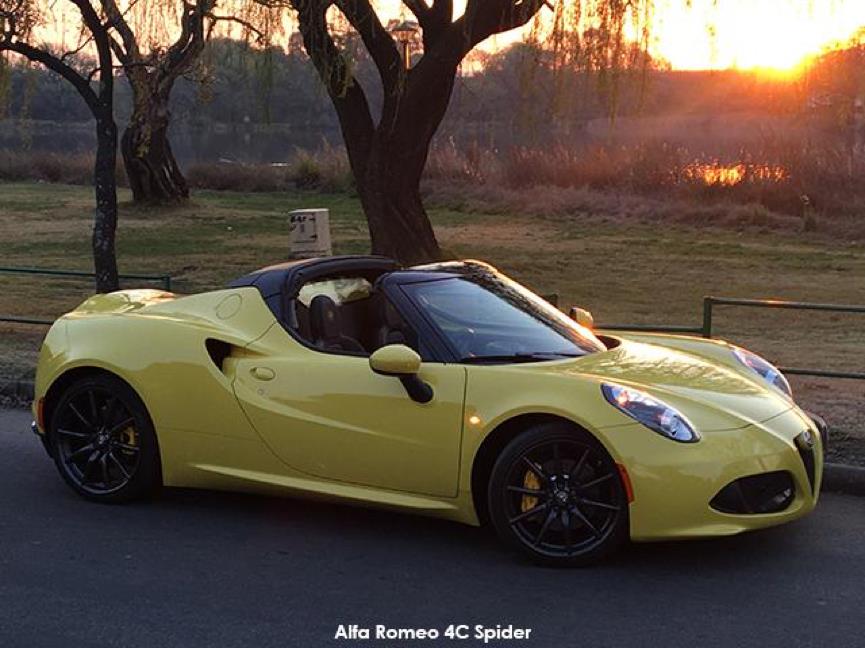
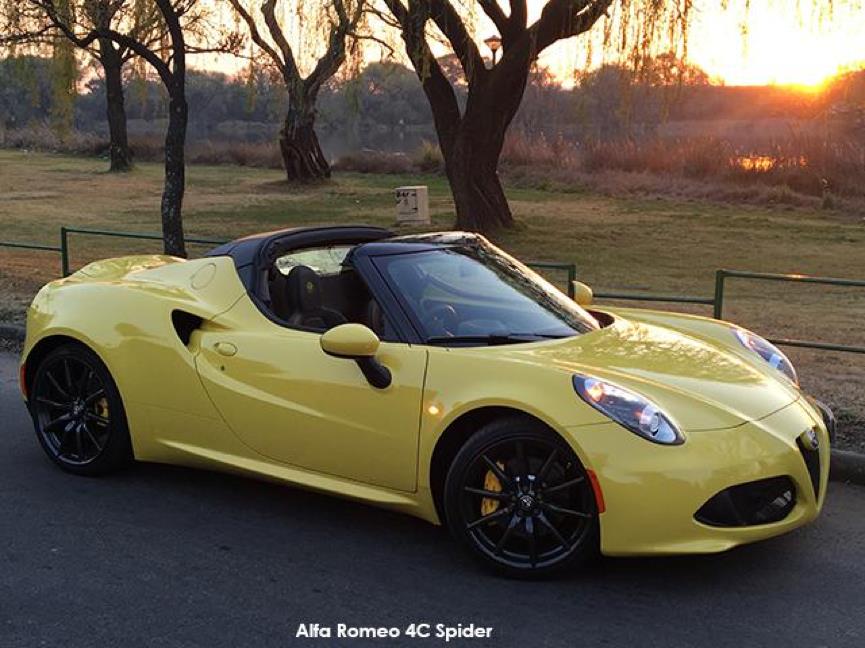
Test cars come and go. Some are soon forgotten… and then there are cars like the Alfa Romeo 4C Spider… now for something special.
As for the Alfa Romeo 4C coupé, the Alfa Romeo 4C Spider is a distinctive design, driven by the quest for simplicity, aeshetic purity and light weight.
The Spider was also designed to stay strictly within these paramaters, meaning the usual addition of body and weight complexity found in other coupé-to-roadster/spider cars are just-on nullified in the 4C Spider.
Prepping
The Alfa Romeo 4C is refreshing, and invites you to drive. Hold on! It needs prepping. It is not a car you simply get in and drive off.
First impression is similar to getting into a dedicated racing car – that the door sill is so wide and the seat so extremely low only add to this perception. You need to have to manoeuvre your legs and torso across the sill and into the cabin (you need to figure out how without looking clumsy) while hoisting yourself down into the seat, avoiding the low swept-back windscreen frame above and the narrow gap between the seat and steering wheel. It is easier with the roof off, as you can support yourself on the windscreen frame, and “slide” in from the top.
Fortunately there is no roll cage or 4-point seatbelt harness to have to deal with, but it still feels like you just got into a race car. Instead of the racetrack pits… you’re in your driveway.
You don’t just switch on the engine and set off – you sit there and look around, trying to (in the excitement) figure out how to get accustomed to this car. Everything feels different to other normal cars of today. Part race car, part small classic sports car, yet built into an entirely modern body and drivetrain.
You need to familiarise yourself first with the extra-low seating, snug cabin, and the out-of-your-comfort-zone way this car fits around you. Clearly this is no Boxster, SLK/SLC, Z4 or F-Type, which are all meant as roadsters with fairly comfortable cabins and some sportiness. Don’t be fooled – the 4C is hardcore sportscar.
4C built for driving
The bare-bones interior is for the purpose of driving. The 4C (coupé or Spider) is not designed to pamper or comfort you – it is simply to bring back the pure experience of just driving.
The centre console hangs off the dashboard, and is angled towards the driver (much more so than in some other modern cars). A single simple row of main controls are in the Alfa-style wide toggle switches.
The exposed carbon-fibre body frame and inner panels and windscreen frame (it is constructed almost entirely of this strong lightweight stuff) make a clear statement that this is no ordinary mass-production car.
Instead of a big instrument cluster with gauges and dials, the 4C is stripped down to a single housing of a digital display in a compact rectangle, straight ahead of the driver. All the required information is distributed well in a condensed display. No distraction from driving by a big centre touchscreen or many buttons.
Metal pedals – proper race-car style pedals – not the metal “look” pedals found in sports-packs of some cars. Peak down to the pedal box and you’ll see the exposed brake booster and some wiring and relays. Not unfinished, but uncovered, to save unnecessary parts and weight. It looks raw.
There is a full-panel metal kick plate on the passenger footwell side, which, as one co-joyrider fan commented, is needed.
Alfa Romeo’s brrrr-y twincam exhaust sound at lower revs (think Sprint, 80s GTV 2.0, Giulietta) is successfully replicated. This Spider also comes standard with the sports exhaust. It is not quiet. Your neighbours will hear you leaving and arriving from 100s of metres away – really.
The turbo and the dual-clutch gearbox make a pair which allows the turbo-pop during gear changes, and with this little Alfa you can play a variety of sounds using the accelerator pedal and gearshift paddles as your musical instruments.
The gear selection is not the usual lever, but the push-button system as found on some Italian cars like the Fiat 500, Abarth, Ferrari and now this Alfa Romeo 4C. Just push the “1” button to select 1st gear and Drive. The TCT gearbox’s gearshifts happen quickly, and can even be quite snappy, or lurch forward… desirable in a true sports car.
The engine is right behind you and not muted away. The exhaust is very talkative. The sensation of speed is amplified as the car is so low not insulated for noise or wind. You cannot possibly fall asleep in this car. No pretence to be a GT cruiser or an all-rounder. Clearly.
Out run
Wanting to get away from the big bad city for the day, the town of Potschefstroom was picked as the destination of choice for an out run – a mix of highway and rural roads, and about an hour-and-a-half’s drive from Johannesburg, without too much traffic. Well, if you had the key to a 4C Spider, a full tank of petrol, and a cap, wouldn’t you? All the ingredients for the motoring equivalent of a biker’s breakfast run, without the need for a helmet or full protective gear, or the risk of falling over midway through a sharp bend.
Overtaking? In this car, most other cars on the road are low-hanging fruit. In almost any gear and at almost any speed, the translation from your right pedal to rushing forward propulsion is addictive. As addictive as your new car computer game, where you stay up way too late at night, just to play “1 more game”. OK, after this one… alright, getting late, but 1 more… and then get up earlier than usual just to get a few rounds in. The 4C Spider is the same game.
Just like a game, there are modes: choose Normal to get acquainted, and as your score and confidence levels rise, hold the DNA switch forward to engage Dynamic mode. You’d better be wide awake – the throttle response is almost over-sensitive, and the tail can quickly break traction even in straight-line acceleration, so you have to have quick reaction times to counter-steer. Dynamic mode is only recommended for advanced players.
There is no power steering in the Alfa 4C. What?! To reduce weight, make the steering more direct, and have fewer parts, the power steering was left out. But as there is just a cover (instead of a bonnet or boot) and some headlights up front, the steering is fairly light for parking.
On the open road, the standard bottom-flat steering wheel comes alive – it is after-market accessory sports steering wheel small – it wriggles and squirms in your hands. Not has this much steering feel been allowed / felt in a car since the original Porsche 911.
Some rural surfaces were so cambered to one side, that one has to hold on and counter-steer to avoid riding the crests in the road. At one point during the joy drive, after about a 100km of driving, the steering feedback on the imperfect road surfaces was so busy and constant, there was a need to stop on the side of the road to check if all the wheel bolts are securely tightened – these were fine, but such is the intensity of the steering.
The one downside in this car is that some other road users think they can challenge you – perhaps they see this is not a Ferrari (or what are they thinking?) then (on 4 occasion from 4 different reckless drivers during the test time) drive right up to your rear bumper, on the highway, for some extremely dangerous tailgating – safest to just get out the way.
The 4C Spider roof
The top section of the roof is a cut-out where a roll-up cloth roof is slotted into place. None of the automatic press a switch stuff, which is convenient but also means adding mechanical and electrical parts like motors and hydraulic actuators and arms, which would have added too much weight and cost.
The roof on this Alfa consists of a single cloth panel with 2 clip-in side supports to attach between the windscreen and roof hoop. The twin-pin inside, in the centre above the rearview mirror, is slotted in or out with a pleasant mechanical feel, and locked into place.
Once lifted off, the roof is rolled up and stored in the boot. To re-attach, place the one end of the roof on one side, clip the support post into place using 2 opposing release pins, then walk around to the other side to pull it straight and lock. The removal/fitment is fairly easy, and can be a one-(wo)man job, though it is easier and quicker with a helper.
During the open-road trip, the roof-less drive saw some buffeting at certain speeds, as the rear is not fully open, causing some cabin turbulence, and there is no wind deflector.
When attaching the top, any speed above about 110km/h gets wind into the leading edge, causing the roof to start bulging and lightly flapping, giving some concern that the roof is going to fly off. For comfort, the 4C coupé is the better option, though for visual and open-air experiences, the 4C Spider is the one.
Italian finesse style
The angle and reach of the windscreen is so wild, your forehead is just under the edge of the screen frame. Therefore the 4C Spider has the smallest slithers of sun visors quite possibly ever fitted to a car… but they work to block out a low-hanging sun, and add to the character and Italian finesse style.
Other nice touches include a small red tab on the edge of the black roof – it didn’t need to be there, but it is just to add a bit of style.
The fuel filler cap is not just a plain black plastic inner cover, but detailed to show part of the Alfa Romeo logo, so the person filling up will see the Alfa snake.
Keeping it small is part of the appeal. It is just 3.99 metres short and 1.19 low. Looks like a supercar, but is the size of the now-classic 60s sports cars. The original Alfa Romeo Spider comes to mind.
Quick spec
0-100km/h in 4.5 seconds, which would probably be even faster if all the power could be directly put down through the rear wheels, as these quite often break traction on hard pullaways and even on some on-the-go acceleration bursts.
The 4C uses Alfa’s familiar 1750cc engine as used in the Giulietta 1750TBi Quadrifoflio Verde. The output is unaltered – no need to – at 177kW. Torque is a bit higher at 350Nm, which you get (and feel) from 2200-4250. Quite how one gets this much off-the-line and overtaking acceleration from such a small engine astounds almost all your passengers, and you too, probably. Here’s why: the 4C coupé has a quoted kerb weight of 895kg, while the 4C Spider is at 999kg.
Sure, xenon lights and dual airbags are standard, as are items like ABS and must-have stability control. The Alpine audio system is from the 80s, with tiny fiddly illegible buttons. Not much use once on the move, anyway. Chuck it out.
Pack light
As part of the weight-saving, there is no storage in the front. People will ask you where to open the bonnet. Erm, there is no bonnet. But there are shut lines, so there must be a bonnet. What is under the bonnet? There is no bonnet (it is just a moulded panel fitted in the factory) and there is nothing underneath it.
Inside, there is nowhere to put your phone or other loose items, other than keeping these in your clothes pockets. There are zero console storage spaces or door pockets. Your wallet you’d have to put safe in the small flip-top pouch between the backrests of the seats. Where the cubby hole would have been is a flat strapped pocket which can hold maybe 1 document or a cable – nothing else.
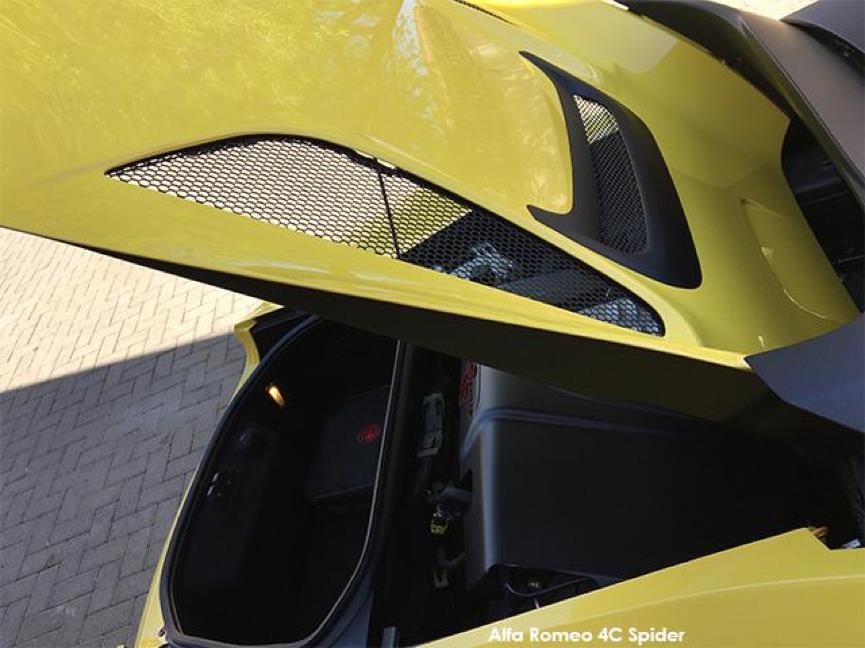
The boot is only the space behind the engine, which also houses the folding roof panel and the tyre compressor bag. So, you and your lucky loved one would be able to go away for a short weekend, throwing in your and her/his soft overnight bag, and that’s about it. Leave the laptop, iPad and suitcase at home. Like the simple old days.
A design flaw which makes loading impractical is the rear decklid – it cannot be opened from the outside rear, so when you have handsful of shopping, you have to first open the driver’s door to pull the release handle, then go to the back. The lid is fairly heavy, and has no gas struts to help lift or keep it up. A bit of a struggle. Weight-saving taken too far. A simple electric switch at the back would help a lot.
Alfisti approve
A nearby neighbour owns a 156, GTV (the 90s wedge), Brera V6 and MiTo (that qualifies one as an Alfisti, for sure) did not want to have a closer look, saying he’d be too tempted to spend more money on another Alfa if he got close to the 4C Spider.
Alfa Romeo owners and fans (Alfisti) passing by seemingly feeling a proud connection to this true-to-form Alfa, and need to signal their appreciation and approval by a wave, thumbs-up, hoot, whistle, flash lights… in which other car, apart from a Defender or the classsic Mini, do you get this?
Into semi-supercardom?
Observing the 4C Spider low sports-car stance, the mid-engined layout and those single big round taillights extracted comments on how this looks like a baby supercar… a baby Ferrari.
It sits somewhere between other soft roadsters on the road, and the full-on supercar. This car has instant future classic status.
At R 1 340 900 it is by far the cheapest way into semi-supercardom. Don’t compare these to the aforementioned roadsters nor any sports car or supercar – the 4C is a unique proposition. A Lotus Elise might be closest in concept, but that feels soft against a 4C.
The Alfa Romeo 4C Spider is undoubtedly no regular sports car. It is no daily driver, though it is not intimidating to drive (just not easy to get into and out of, or see around in daily urban traffic).
Alfa Romeo realises this is no daily driver – the inclusion of a standard-supplied Alfa Romeo branded car cover is testimony to this special-occasion driver’s car, kept in storage for the other days.
The Alfa Romeo 4C Spider… and now for something special.