
When can a car battery leak?
When can a car battery leak?


By Chad Lückhoff
The majority of car batteries used in our cars are of the lead-acid variety. These batteries have a series of lead plates, suspended in a solution of sulphuric acid and water. The chemical reaction sees the negatively charged plates give off electrons, creating a charge. This charge is used to start your vehicle and help power the electronics. The by-product of this chemical reaction is the release of oxygen and hydrogen gas and should this gas escape, you will need to top up the battery with distilled water.
It's because of the acid and hydrogen that we strongly remind you to wear gloves and eye protection when working with a battery. The acid is corrosive and will eat into clothing and skin while the hydrogen is a volatile gas that is highly combustible, so keep it away from naked flames and sparks.
When would a car battery leak?
It is very seldom that a car battery will just start leaking of its own accord but should you notice some strange wet spots or odours, you will need to check your battery for the following.
Because of the wet nature of the battery cells, a car battery should always be installed level and on a tray of sorts. Batteries installed at angles other than level may cause the electrolyte (acid-water solution) to spill over the partitions in the battery and possibly even out from one of the vent holes/filler caps. Installing a battery at an angle will eventually cause the cells to dry out and short, drastically reducing the lifespan and efficiency of your battery.
Should the casing of the battery be cracked, the electrolyte solution will leak out. This battery should be replaced immediately. It's worth checking your battery for damage on a regular basis (like when you check your oil), as something in the engine bay may have shifted and ended up rubbing against the casing.
A swollen battery is the indication of a gaseous build-up inside the battery and the battery should be disposed of correctly as soon as possible. Caution must be exercised to ensure that the battery doesn't burst open, spilling the hazardous acid and hydrogen. Swelling is sometimes caused by over-charging a battery.
Should you need to charge a battery, always use a dedicated car battery charger with a protection circuit that will prevent over-charging to avoid such issues.
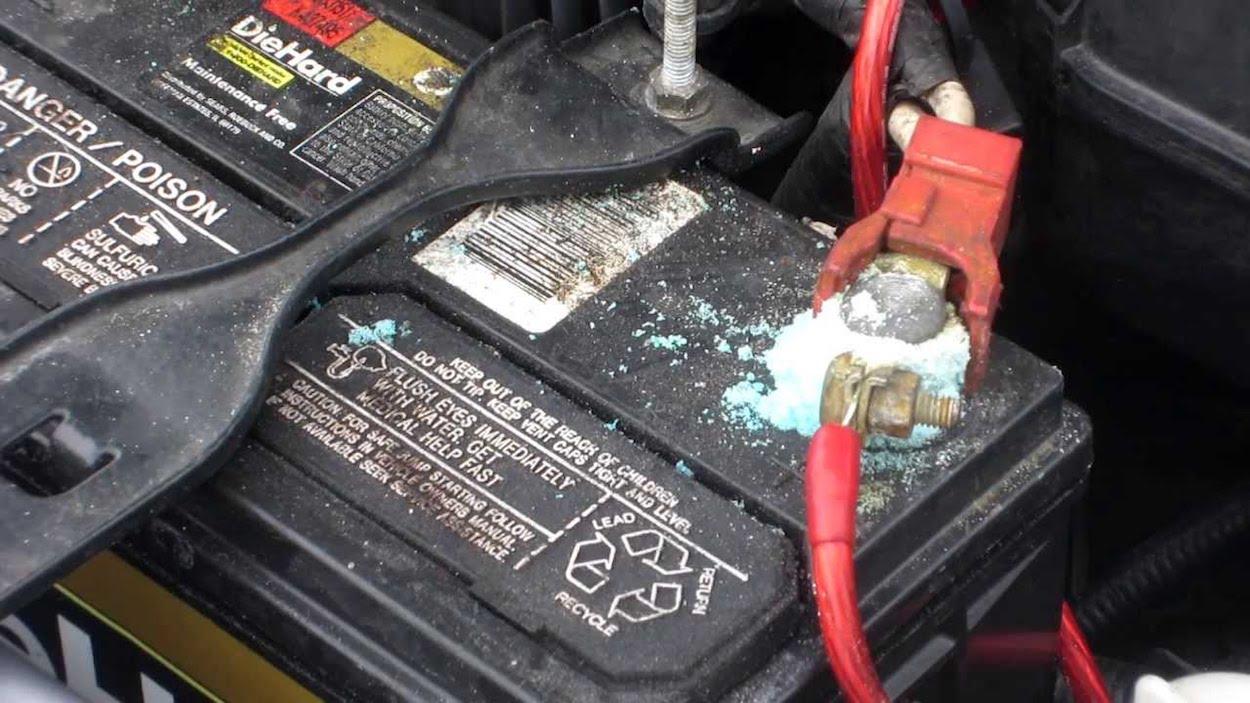
The presence of a damp spot on the top of your battery may indicate that one of the refilling caps is not sealing properly, allowing some of the electrolyte to escape. Rinse the top of the battery off with a weak solution of warm water and bicarbonate of soda before wiping away excess moisture with an old rag (remember your gloves). You can then use a large flat-head screwdriver to tighten the filler caps or check for cross-threading.
It's a good idea to check the battery water level while you have the caps open. The water level should be just enough to cover the top of the plates. Too little and you run the risk of having your plates damaged and shorting out while too much will only lead to more leaking.