



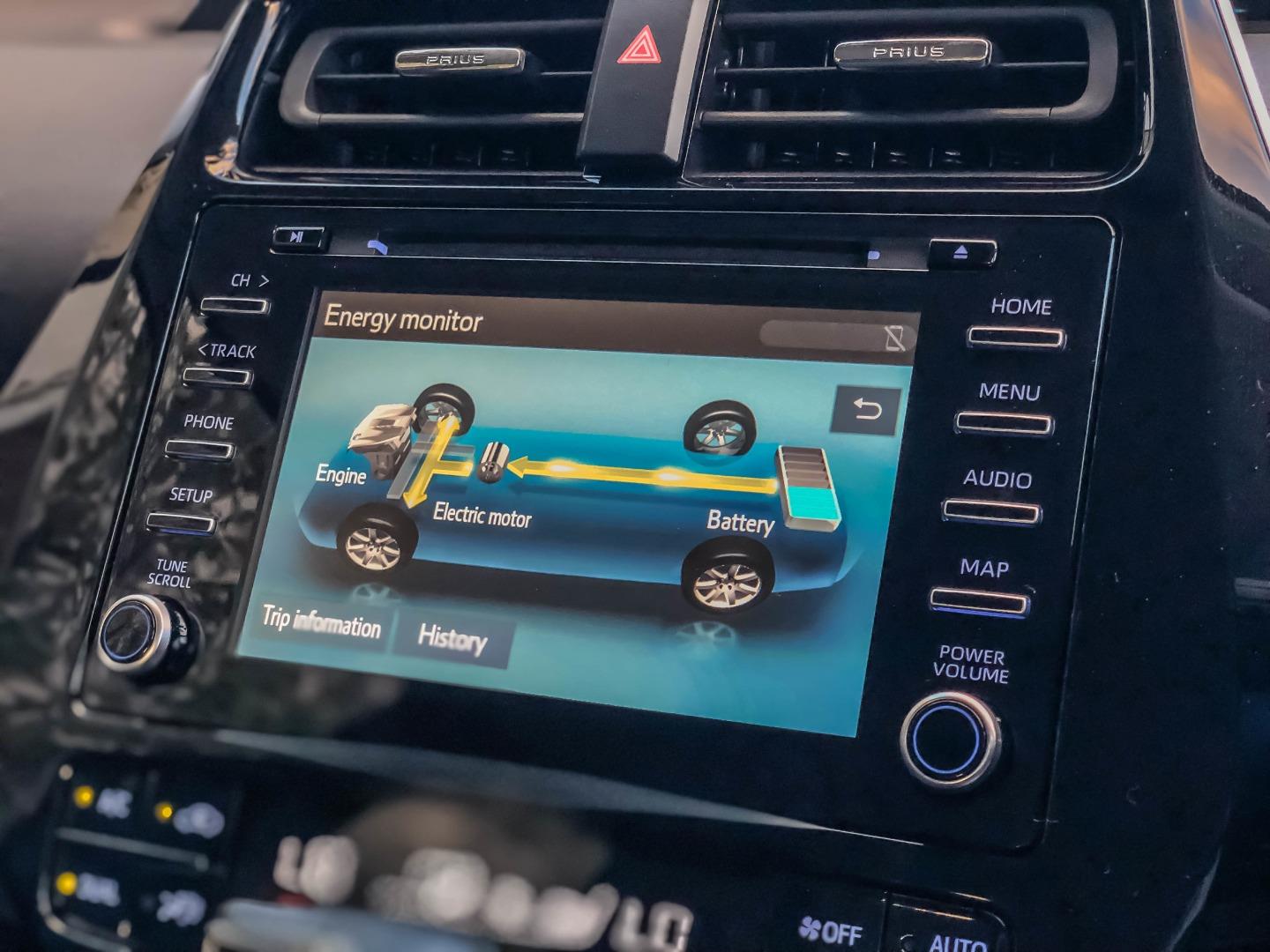
It’s a fair question with a short answer: If it’s a Toyota Prius, you fill it up with petrol, not diesel. It may come as a surprise to some readers that the Toyota Prius is only available with a petrol engine. But hold on, that should be amended to “a petrol engine and an electric engine,” because the Prius is famous as the world’s first volume-produced Hybrid car. This means its motive power comes from a petrol engine and an electric engine synched together to provide reasonable performance and very low fuel consumption.

How the Prius operates
Prius’s have always been fitted with petrol engines to provide the main source of power, with an electric motor giving secondary power, ideal for low-speed operation in “electric-only” mode in dense traffic. That’s pretty much how the latest Prius operates today, although the latest models are far more fuel-efficient than the first Prius examples to arrive in South Africa.
A potted Prius history
The Toyota Prius first went on sale in Japan in 1997 and globally in 2000, and created a stir, especially amongst Hollywood celebrities who all wanted to show up at Red Carpet functions in a Prius to prove they were “greener” than their peers. That celeb endorsement helped the Prius to become an instant hit, and sales very soon passed the million mark. Today that number is more than 6-million.
It took until early 2005 before the Prius was introduced to South Africa. And at first, you could not buy one here, but only lease it for four years, as Toyota wasn’t sure how it would stand up to rugged African conditions with all those electronics on board.

South African Prius track record
The first Prius we saw here was in fact, a second-generation car. Initially, it was lauded for its technology, but there was also some scepticism. While overall consumption about town saw the Prius average about 6,5 litres/100 km, on long trips that could rise to as high as 7 litres/100 km if there were lots of up-hills involved.
This was because the Prius married its engine with a CVT gearbox, and at highway speeds, especially on up-hills, the little 82 kW petrol engine would rev hard and annoyingly constantly. And it had quite a high overall weight to lug around, at around 1300 kg.
The next-generation (third-gen) Prius arrived here in 2009, and it was much better on fuel consumption and performance. Since 2016 the fourth-gen Prius has been on sale here, and consumption has been reduced to about 4,5 litres/100 km.
How does a hybrid’s battery get re-charged
Since the success of the Prius, most other manufacturers in the world have introduced their own hybrid models. While the Prius is a hybrid that uses its petrol engine and regenerative braking under deceleration to recharge its large battery system for the electric motor, many other hybrids are now so-called plug-in hybrids. Plug-in hybrids operate like the Prius, on both petrol and battery power, but the battery can additionally be charged at home, at the office, or at a special charging station. This has enabled plug-in hybrids to deliver greater distances on electric-only mode for zero emissions. It also enables them to deliver greater performance from the electric motor, which can now draw much more current from the battery when really needed for electric assistance to the petrol engine.

Why no diesel hybrids?
It is not entirely true that there are no diesel hybrids. Peugeot has offered a 5008 diesel hybrid that has been enthusiastically received overseas, and Mercedes-Benz has recently launched a plug-in diesel hybrid in its E-Class range Europe. Volvo also offered a diesel-electric hybrid before committing to moving towards all-electric power for its car range. But generally, it is felt that diesels are too expensive to marry with an electric engine. Petrol engines are generally about 15 % less expensive to produce than diesels.
Another factor is the torque curve of a diesel. A diesel produces most of its torque between about 1 500 and 3 000 rpm. Most engineers feel that a petrol engine, which has less of a torque swell at low revs than a diesel, and can rev much higher than a diesel, can be better matched to an electric motor, which produces maximum torque from zero rpm. So you use the electric engine for initial thrust, and then the petrol engine takes over at higher revs.
A third factor is all the negative press that diesel as a polluting fuel has received in the past 5 years in Europe. Interestingly, however, Mercedes-Benz remains convinced that diesel as a fuel has a future.
What about a used Prius?
As for buying used, you will be very fortunate to come across a pre-owned Prius in your area. Speaking to an owner, he said that most Prius fans tend to hang onto them for decades rather than years. His opinion was borne out by the fact that recently there is just 1 example of a Toyota Prius in our New & Used cars for sale section.
If you do take the plunge, check out the condition of the main battery that powers the electric engine. These are known to be very expensive to replace, so factor this in, when making an offer on a used Prius. The latest price we received was just under R30 000 for a replacement Prius battery! At the launch of the Prius here in 2005, Toyota said the battery would last 10 years with zero maintenance.
My Prius-owning friend bought his 2006 model some five years ago and has had absolutely reliable service from the car since then. However, at the time of taking delivery, his car-trader friend kindly threw in a new battery as part of the price.
Recommended next:
Expert Toyota Prius Car Reviews