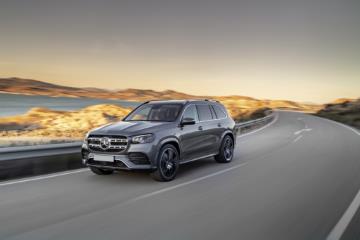
The Mercedes-Benz GLS is the S-Class of SUVs and as such offers more space, more comfort and more luxury than you will find with most of the products in the German marque's SUV ranges. The latest iteration of the GLS made its way to market in 2020 and as can be expected from a vehicle of this class, comes with all the latest safety and comfort features wrapped in a timeless design.
While we can go on and on about the up to 2 400-litres of luggage space, the safety systems and the nine airbags or the clever MBUX rear-seat entertainment system, in this article we would like to focus on the two engine options offered in the Mercedes-Benz GLS range. Mercedes-Benz gives the customer a choice between an inline-6 diesel motor and V8 petrol.

Powertrains
To better understand where each of the two engines trumps the other, let us do a quick side-by-side comparison.
| Mercedes-Benz GLS400d 4Matic | Mercedes-Benz GLS580 4Matic | |
| Engine | 2.9-litre, turbocharged, inline-6 diesel | 4.0-litre, turbocharged, V8 petrol |
| Transmission | 9-speed automatic | 9-speed automatic |
| Power | 243 kW | 360 kW + 16 kW electric boost |
| Torque | 700 Nm | 700 Nm |
| 0-100 km/h | 6.3s | 5.3s |
| Top speed | 238 km/h | 250 km/h |
| Fuel consumption | 7.9 L / 100km | 10.0 L / 100km |
| CO2 emissions | 208 g/km | 223 g/km |
*This table was compiled with information sourced from www.duoporta.co.za and was correct at the time of writing this article.

Verdict
After comparing the two engines side by side, we can see that the biggest differences are in the acceleration, top speed and the combined fuel consumption figures. Whereas the petrol engine can achieve a higher top speed and faster acceleration, the diesel motor return a much more frugal fuel consumption figure, 2.1 L / 100 km less than its petrol counterpart.
Seeing as both offer identical torque figures, we can assume that both will be very capable in off-roading situations. Thus, if the higher top speed and faster acceleration are key considerations for you, the petrol motor will serve you much better. However, if you just want a luxurious SUV that still returns excellent performance for the size, the diesel-powered model will prove ample.
In terms of pricing, at the time of writing this article, the GLS400d comes in at R 190 320 less than its equivalently specified petrol counterpart and is the winner in this comparison and in for us, is the one to have.