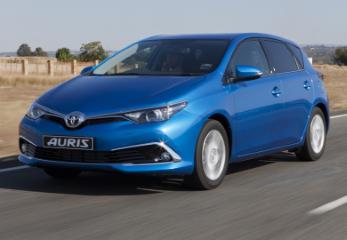
As the successor to the popular Run-X, the Toyota Auris had big shoes to fill when it was introduced in 2013. Despite reasonable sales, the Auris failed to live up to its predecessor, however, an updated model was released in 2016, which now make for a tempting used proposition.
The local Auris range consisted of six models, with three engine options, a 1.3-litre naturally aspirated petrol engine, a 1.6-litre naturally aspirated petrol and a hybrid. In today’s comparison, we determine which engine is the most efficient by using the claimed fuel consumption figure of each model.
1.3-litre naturally aspirated petrol
Outputs: 73 kW and 128 Nm
Claimed Average Consumption: 5.8 L/100 km
The 1.3-litre engine powering the entry-level Auris model forms part of the Toyota NR (1NR-FE) engine family which has been fitted to a variety products including the Corolla, Auris, Yaris and even Daihatsu’s Sirion. While the engine isn’t big on performance, it is efficient and has a reputation for bulletproof reliability.
1.6-litre naturally aspirated petrol
Outputs: 97 kW and 160 Nm
Claimed Average Consumption: 6.2 L/100 km
The ubiquitous 1ZR-FAE engine has been fitted to numerous Toyota models since 2007 and continues to power a few models. The engine provides a healthy blend of efficiency, reliability, and respectable performance. In the comparison, though, it is the heaviest on fuel.
Hybrid
Outputs: 100 kW/142 Nm (+e)
Claimed Average Consumption: 4.0 L/100km
The Hybrid model is powered by a 1.8-litre naturally aspirated petrol engine that is paired with an electric motor, meaning that the vehicle can be driven at low speeds in all-electric mode, and at higher speeds the electric motor assists the petrol engine, providing better performance and indeed, incredible claimed fuel returns.
Verdict
Looking at the figures, the Hybrid model within the Auris range comfortably wins the efficiency change, recording an average fuel consumption figure some 1.8L/100k lower than the next best Auris engine, the 1.3-litre 1NR-FE