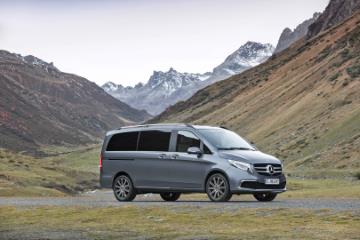
The Mercedes-Benz V-Class was first introduced in 2015 and took on the highly contested MPV segment. In 2019, the model received a facelift, which made it an even more popular choice amongst its competitors. However, the German automaker has expanded its range to include the flagship V 300 d models and aims to dominate the segment.
Related: Mercedes-Benz V 300 d (2020) review: The ultimate luxury people-carrier
The updated model features a new front bumper, an updated grille, and revised front air intakes on the exterior; however, this is not where the updates stop. Now featuring prominently in the 6-, 7- or 8-seat configured interior is the brand's latest MBUX infotainment system on a 10.25-inch screen. The system is also Android Auto and Apple Carplay compatible. While the V-Class offers a lot in terms of luxury and comfort, how does it do for performance and frugality?

Engines
Although the V-Class is now offered in four class derivatives, all four feature the same motor; however, each delivers different performances. Let us take a closer look.
| Mercedes-Benz V 220 d | Mercedes-Benz V 250 d | Mercedes-Benz V 300 d | |
| Engine | 2.0-litre, turbocharged, 4-cylinder, diesel | 2.0-litre, turbocharged, 4-cylinder, diesel | 2.0-litre, turbocharged, 4-cylinder, diesel |
| Transmission | 9-speed, automatic, 9G-Tronic | 9-speed, automatic, 9G-Tronic | 9-speed, automatic, 9G-Tronic |
| Power | 120 kW | 140 kW | 174 kW |
| Torque | 380 Nm | 440 Nm | 550 Nm |
| 0-100 km/h | 10.9s | 9.6s | 7.8s |
| Top speed | 195 km/h | 206 km/h | 220 km/h |
| Fuel consumption | 7.1 L / 100 km | 7.4 L / 100 km | 8.0 L / 100 km |
| CO2 emissions | 182 g/km | 189 g/km | 205 g/km |
*This table has been compiled with information sourced from duoporta.co.za

Verdict
When compared side by side, an apparent increase in power and torque can be noticed as we progress through the V-Class range. Interestingly, the manufacturer claimed that average fuel consumption remains relatively similar for the V220d, V250d, and V300d.
The V300d variant offers the fastest acceleration, 1.8 seconds faster than the V250d and 5.1 seconds faster than the entry-level model. It also continues accelerating to 220 km/h, only 16 km/h faster than the V250d but 39km/h faster than the V200d.
However, this is an efficiency comparison and not a performance shootout; for this reason, we would recommend the V250d as the winner. While the V300d outperforms the V250d model, it is not by much and with the performance figures of the V250d combined with its frugality and lower environmental impact, the V250d strikes a good balance all-round.