Volkswagen T-Roc vs Peugeot 2008 vs Kia Seltos: which one is the best value for money?
Those looking for a crossover SUV that places as much emphasis on practicality as it does style are spoilt for choice in the current market. Today we compare the Volkswagen T-Roc with two of its key rivals to determine which offers the best value for money.


The crossover segment is booming, so much so that there is barely a niche and price point that is yet to be filled by the major automotive manufacturers. Plugging the perceived gap between the T-Cross and Tiguan, the T-Roc finds itself among some strong competition, with the likes of the Peugeot 2008 and Kia Seltos providing stylish, practical packages in this segment
We will be comparing the entry-level T-Roc Design derivative with the 2008 in GT guise and the Seltos in GT Line specification to determine which model offers the best value for money.
The competitors
|
|
Volkswagen T-Roc 1.4TSI 110kW Design |
Peugeot 2008 1.2T GT |
Kia Seltos 1.4T-GDI GT Line |
|
Engine size |
4-cyl, 1.4-litre turbo petrol |
3-cyl, 1.2-litre turbo petrol |
4-cyl, 1.4-litre turbo petrol |
|
Power/Torque |
110 kW/250 Nm |
96 kW/230 Nm |
103 kW/242 Nm |
|
Kerb Weight |
1 235 kg |
1 225kg |
1 398 kg |
|
Gearbox |
8-speed dual-clutch automatic |
6-speed automatic |
6-speed dual-clutch automatic |
|
Airbag count |
6 |
6 |
6 |
|
Driven wheels |
Front |
Front |
Front |
|
Fuel consumption |
6.2L./100km |
6.5L/100km |
6.3L/100km |
|
Price |
R494 300 |
R489 900 |
R495 995 |
|
0-100km/h |
8.4 sec |
9.1 sec |
9.7 sec |
|
Boot volume |
445-litres |
434-litres |
433-litres |
|
Service plan |
5 yr/90 000 km |
3 yr /60 000km |
5 yr/90 000 |
Comparing the trio
Practicality
Looking at the dimensions, all three products are a similar length, width, height and have wheelbases within 20mm of each other, however, the common theme is that the Kia is the bigger car among the three, only losing out to the T-Roc and 2008 in the width category. The kerb weight of two of our rivals is similar, with the Kia being the outlier, at around 150kg more than the T-Roc and 2008 which come in at similar weights.
There’s not much to separate the trio in terms of boot space either, however, it is the Volkswagen with the biggest boot, at 445-litres, however, the Peugeot offers the most space with the second row of seats folded flat, with 1 467-litres. Looking at the towing capacity of each, the Volkswagen wins, with a braked capacity of 1 500kg versus the 1 200kg offered by the Peugeot and 1 100kg by the Kia. We are granting the T-Roc the victory in this department, but it is incredibly close.

Power and performance
Our trio all feature small turbocharged petrol engines and automatic gearboxes that send power to the front wheels.
On paper, the Volkswagen is both the most powerful, the fastest and the most efficient, with 110kW/250Nm of torque from a 1.4-litre turbocharged engine paired with a slick 8-speed dual-clutch automatic gearbox.
The Peugeot is the only entrant with a three-cylinder turbocharged engine, which also has the lowest power output and is paired with a torque converter automatic gearbox, making it the least efficient but second fastest to 100km/h.
The Kia has a very similar set-up to the Volkswagen, with a 1.4-litre turbocharged engine that produces 103kW and 242Nm of torque and is paired with a 6-speed dual-clutch gearbox, however, the Kia’s added weight means that it is both slower and a bit heavier on fuel.

Specification
The models that we have chosen for this comparison are relatively well specified as standard and all have 17-inch alloy wheels, 6 airbags, ISOFIX child seat anchor points, front and rear PDC, roof rails, multifunction steering wheels and infotainment systems with Apple CarPlay and Android Auto functionality.
The Volkswagen loses out to the Peugeot and Kia though, which have items such as front and rear USB ports, cruise control, keyless entry/start, electrically-foldable mirrors, cloth and artificial leather seats(leather in the Kia), LED headlights and a reverse camera. The 2008 gets two additional niceties too, in the form of comfort access and head front seats.
Safety
The 2008 was tested by the Euro NCAP crash test evaluation programme in 2019 where it achieved a 4-Star rating, including 91% for adult occupant safety, 84% for child occupant safety, 62% for pedestrian safety and 68% for its safety assistance systems.
The T-Roc was also tested by Euro NCAP, but in 2017 where it achieved a 5-Star safety rating, with a 96% score for adult occupant safety, 87% for child safety, 79% for pedestrian safety and 71% for its safety assistance systems.
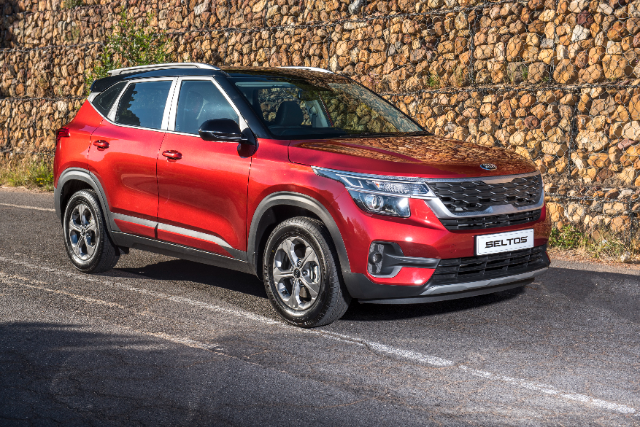
The Seltos was crash-tested by the ANCAP(Australia and New Zealand) crash test programme in 2019 where it also achieved the maximum 5-Stars, including 85% for adult occupant safety, 83% for child safety, 61% for pedestrian safety and 70% for its safety assistance systems.
Warranty & maintenance plan
The trio assembled here all offer standard service plans, with both the T-Roc and Seltos sporting 5-year/90 000km plans while the Peugeot has a 3-year/60 000km plan.
From a warranty perspective, the Kia is the clear winner, with a 5-year/unlimited mileage warranty. Both the Volkswagen and Peugeot have acceptable warranties, at 3-years/120 000km and 4-years/100 000km respectively
Verdict
Looking at the figures, the trio assembled for this comparison are all very impressive products, all worthy of consideration if you are shopping in this segment. There can be only one winner though, and when all of the factors are taken into consideration, the Kia Seltos emerges as the winner, running the T-Roc close in the performance, safety and practicality stakes, being nearly as well kitted as the Peugeot and having the best service plan and warranty.