
Top 4 BMW 8 Series features that stand out from the competition.
The current-generation 8 Series is only the second model in BMW’s history to carry this nameplate: After the first one was discontinued about two decades ago, its gap at the peak of the BMW model hierarchy remained unoccupied until 2018. But what really sets the new 8 Series apart from its competition?


Designed to be the top dog
In the time it took BMW to build a follow-up to their iconic 1990s 8 Series, they sated the appetites of luxury coupé- and convertible buyers with two generations of 6 Series models (themselves a continuation of an earlier flagship model name). Those two generations of 6’s were fine cars indeed, but their nameplates indicated that BMW still had something even better in store for upper-crust customers.
Consequently, the two modern 6 Series cars never quite managed to settle into the role of the pinnacles in their respective generations of BMWs. Instead, they were seen as normal 5 Series cars cloaked in coupé and convertible bodies, and the introduction of the Gran Coupé body style with the last-generation 6 Series didn’t really do much to alleviate this perception – it was clearly the lower, sexier sibling to the 5 Series, but didn’t exactly shout its high-end positioning from the rooftops.

BMW clearly decided that the new 8 Series must avoid this trap, though. The styling is more imposing than before, with enough unique detailing to make it look very different from any other BMW. But, even though there’s plenty of visual distinction on the surface, it’s still based on top-level BMW sedan hardware. That’s not a bad thing, though, as the current 7 Series (and mid-size 5 Series) are technologically advanced and very good to drive.
Related: Get more details about the BMW 8 Series in our launch report.

1. Carbon Core
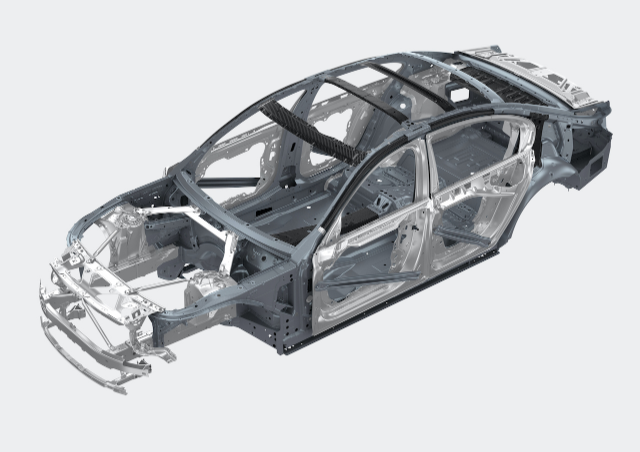
Its name may sound like high-level marketing-speak (which it is), but Carbon Core also brings high-tech construction to the mainstream market. The special ingredient is carbon fibre sections, employed in key areas of the body’s skeleton such as the roof (and roof pillars), to save weight and space without compromising on strength and body shell rigidity.
Carbon fibre isn’t the only exotic element in use, though: strategic structural members are also replaced with aluminium pressings, and further weight reduction is achieved through the use of magnesium castings in some drivetrain- and chassis components. None of these measures can turn a car as big and plush as a BMW 8 Series into a lightweight sportster, but they do allow the engineers to lower the centre of gravity, to the benefit of agility and handling stability.
2. Available in three sizes
The BMW 8 Series is available with three body styles, with varying degrees of practicality. The convertible is arguably the prettiest (especially with its roof down), the coupé looks the most athletic, and the 4-door Gran Coupe looks like a flatter 7 Series but offers useable rear passenger space in compensation.

Of these three derivatives, the Gran Coupe (GC) is the most practical in the range. Not only is its boot (marginally) larger than the already-usable cargo hold of the 2-door Coupé, but there’s an extra 20 cm or so between the front- and rear axles, to liberate leg- and headroom in the rear seating area.
As an unusual bonus, the GC is also slightly less-expensive than the 2-door variant, but it’s also the only derivative that offers a full range of engines (including a blistering M8 version). Opting for a 2-door coupé or a convertible will force you to also take one of the two V8 engines (M850i or full-speed M8), as these body styles aren’t available 6-cylinder power at all in South Africa.
Related: Larger than life – we review the BMW M850i xDrive Convertible.

3. Four different engine choices, and there’s even a diesel in the mix
The 840i is the “entry-level 8 Series”, and the only rear-wheel drive variant on offer (with no AWD option in the local market). Under the bonnet is BMW’s highly regarded B58 3.0-litre inline-6 cylinder single-turbo petrol engine, tuned to produce 250 kW and 500 Nm in this application. Like the rest of the 8 Series range, it’s paired with an 8-speed torque converter automatic to deliver a claimed 0 – 100 km/h dash in 5.2 seconds, a governed top speed of 250 km/h, and average fuel consumption of 7.9 ℓ/100 km (allegedly but highly unlikely).
Next up is the 840d xDrive – the only diesel in the range, and the least-expensive way to put AWD between the gearbox and the drive wheels. It employs a 3.0-litre twin-turbo inline-6 from the “B57” family, good for 235 kW and 680 Nm. It’s marginally quicker to 100 km/h (5.1 seconds) than the 840i petrol, likely on account of its torque advantage and AWD traction, and is claimed to use a whole lot less fuel as well, posting an official average consumption figure of 6.7 ℓ/100 km.

At the top of the “non-M” range sits the M850i xDrive, which features the less-powerful V8 in the range (and unlocks the 2-door body style). In this trim, the 4.4-litre twin-turbo V8 produces “only” 390 kW and 750 Nm, giving the hefty M850i a claimed 0 – 100 km/h sprint in 3.9 seconds. It’s thirsty, though – BMW claims that it will use 10.7 ℓ/100 km on average, but experience has shown this to be wildly optimistic in mixed-cycle driving.
And then we get to the biggest, baddest, 8 Series of them all: the ballistic M8 Competition. Once again available in all three body types, the power shoots up to 460 kW (albeit with the same peak torque value). This drops the 0 – 100 km/h sprint to 3.2 seconds, and lifts the governed top speed to 305 km/h. In spite of the significant power bump, BMW reckons that the M8’s drinking habit should be the same as that of the M850i, also posting a claimed (and equally unlikely) 10.7 ℓ/100 km average in GC spec.
Related: The beast, unleashed – we review the BMW M8 Competition Coupé.

4. Rear-wheel steering
This is the latest Big Thing among premium- and performance car manufacturers, which makes it perfectly logical that the BMW 8 Series will also feature this technology. It’s a nifty trick that helps to hide a large car’s dimensions while parking (because the rear wheels steer in the opposite direction to the fronts at low speeds, tightening the turning circle and thus improving maneuverability), and adds stability at high speeds (by steering into the same direction as the front wheels to quell any tail-wagging antics).
Interestingly, the M8 doesn’t include this feature. M Division’s engineers reckon that it dilutes the purity of the driving experience, although this is a rather moot point: at almost two tonnes and with adaptive suspension, AWD, and a host of driver aids, the M8 will never be a pure sports car anyway...
