
On the go for a month
On the go for a month


By Stuart Johnston
The Datsun Go isn't the fastest kid on the block, but one of its chief attributes for a month spent tootling around Jo'burg is that its can return excellent fuel consumption figures, as long as you drive with a feather-light throttle foot!
A week or so into December 2018 (seems like an age ago, doesn’t it?) the news came that I would be able to use a new Datsun 1.2 Lux for the holiday period, retaining the car into the second week of the New Year.
This past holiday I spent at my home base in the Johannesburg area, and you know what us guys who don’t manage to get away to the coast or the mountains always say about Jo’burg in December: “Man isn’t it a great place to be!”
Well, it probably doesn’t beat jumping up and down in the waves at Ballito or sipping espressos on Camps Bay Drive at 10 am, but Jo’burg in December means that finally, finally, you can get to do some driving you really enjoy.
Aah! Traffic-free roads in Jo'burg!
Traffic gradually thins out to a trickle, and you can actually choose your routes with the express purpose of enjoying the ride rather than racing to another appointment, only to be confronted by the news that yet another truck has overturned at the Van Buuren Road off-ramp.
Hmm, that Van Buuren area is pretty much like Hospital Bend in Cape Town as the N2 hits the city in the vicinity of Groote Schuur. Both these spots are like the Bermuda Triangle of motorways . If a car is going to run bearings, or a truck is going to play Jack The Knife, it will be at one of these spots that are so crucial to the traffic flow of our two major cities.
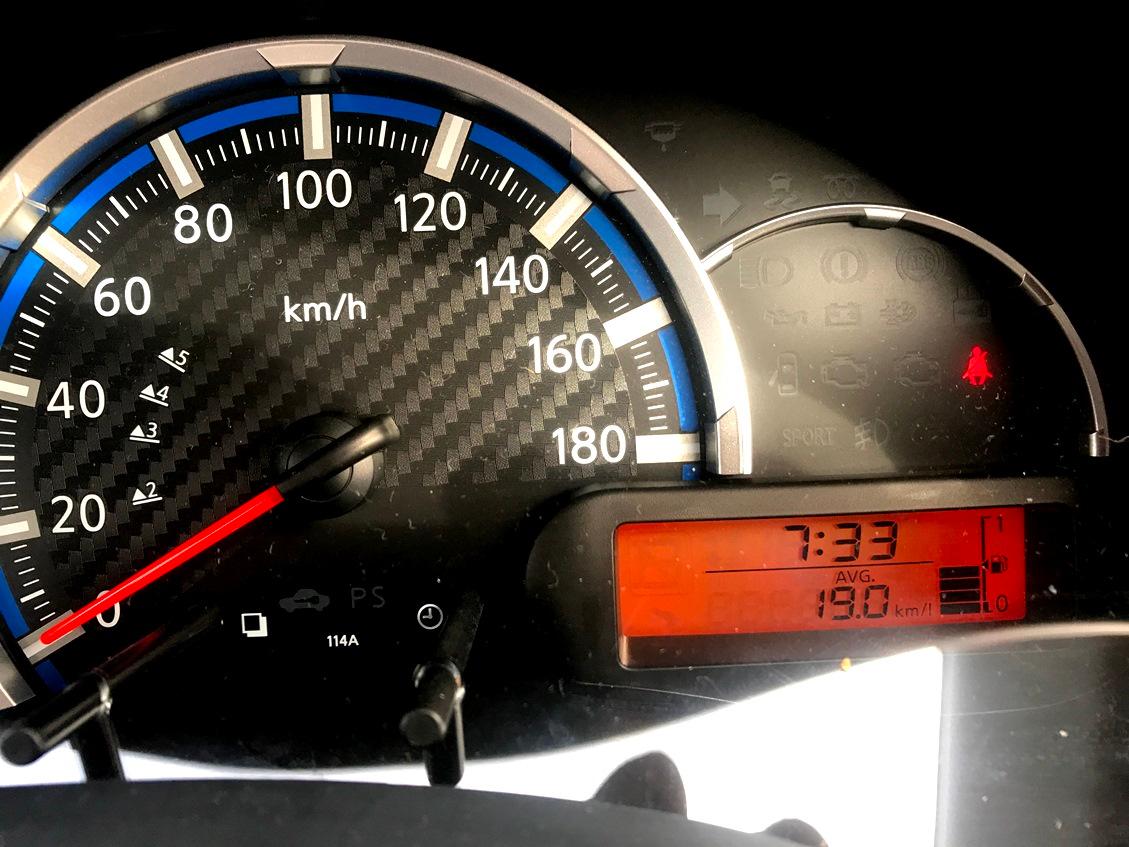
But in late December, off to see a mate of mine to pick up some retro rock music DVDs in Bez Valley, it gave me a chance, on the N3, to improve on the Datsun Go fuel consumption target that I had set myself for the holiday period. The fuel consumption read-out was on about 16,5 km/litre when I received the car, and I worked hard at increasing that figure to the 19,0 bracket.
I actually managed it, and to give you an idea what this means in consumption figures we can all understand, 19,0 km per litre translates to a consumption of 5,27 litres/100 km. That’s a figure that corresponds to exactly what Datsun claims for its Go as an average fuel consumption figure.
To achieve 5, 27 litres/100 km, you have to drive like a granny…
Well, I can tell you that to achieve just under 5,3 litres/100 km I had to drive the car like a granny, and a granny with an exceptionally sensitive throttle foot! (let’s not discuss the clutch foot right now).
This is a long way from my normal driving style, especially on traffic-free roads, but aay, when you are dealt a hand of cards, you play the ones that are strongest. The Go is not going to set any Scooby Dark Rider On Steroids aquiver at the traffic light!
I worked and worked and worked at getting this consumption down. Days, weeks went by, and still I had not had to top up the tank. I mean, what else are you going to do in Datsun’s Go, when the holidays stretch out before you and you are staying put in The Smoke?
To achieve 5,27 litres/100 km I had to shift up to a higher gear at 2000 rpm in every gear. I had to keep my highway speeds down to around 110 km/h, except on the downhills. And I had to search for routes that contained as many downhills as possible. Okay, discard that last bit. I now realise that on any out-and-back trip, the number of downhills are precisely cancelled out by the number of up-hills. But forgive me, I was in holiday mode.
Okay, so what about the car?
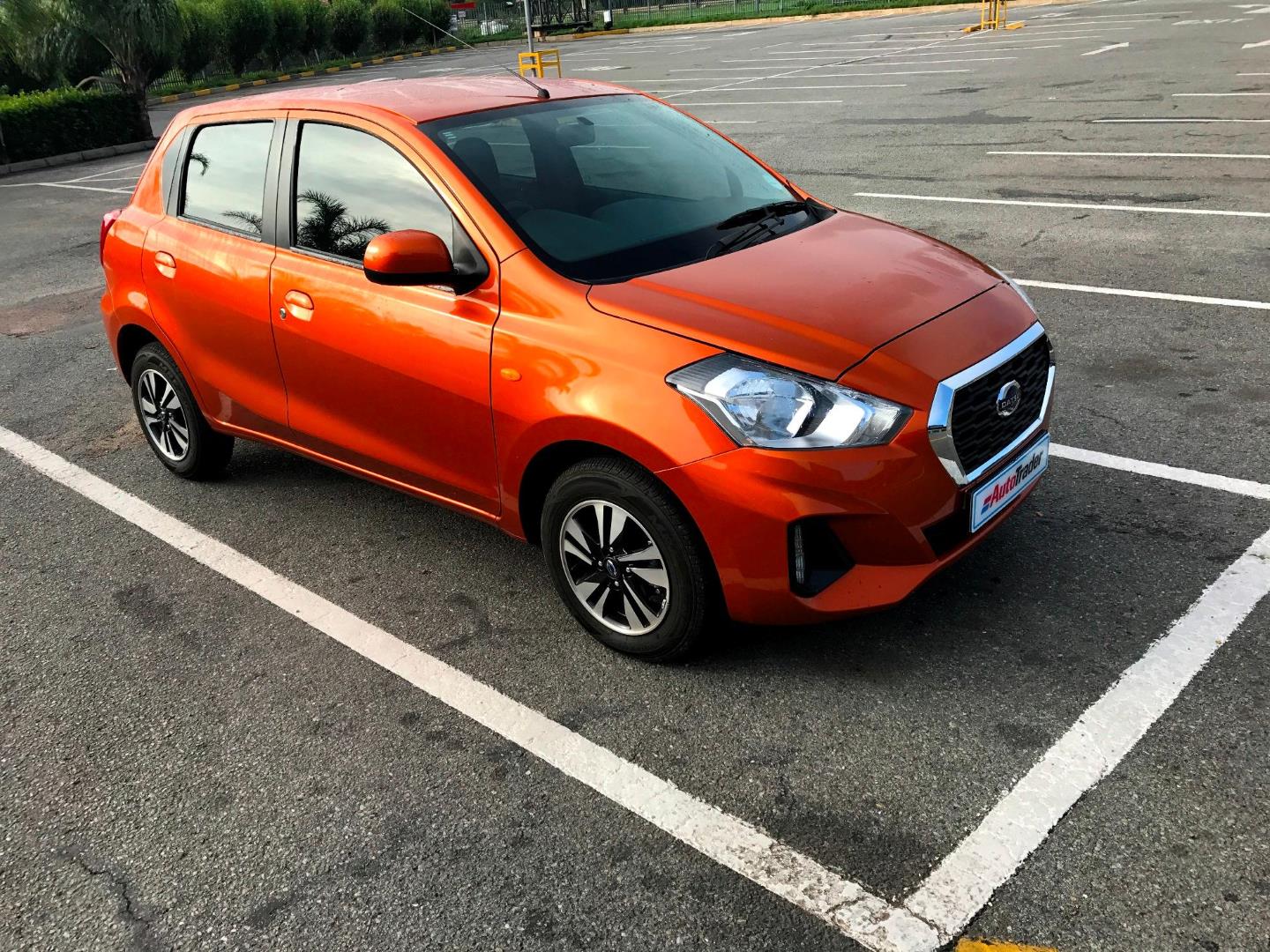
Well, the Datsun Go has been considerably refreshed , following its facelift in November 2018.
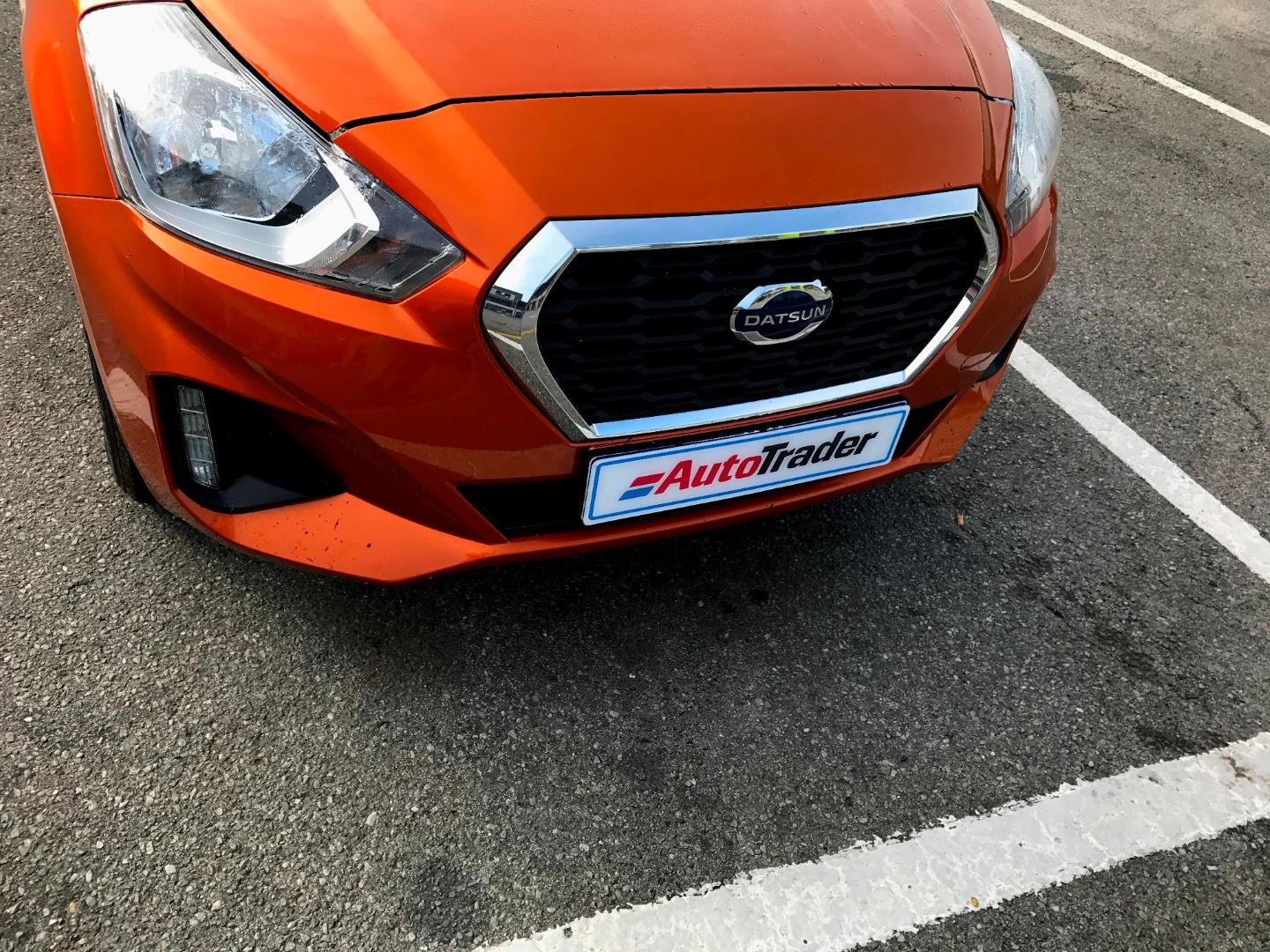
There’s a new grille and bumpers and new alloy wheels if you happen to order the Lux model, the one we drove over December/January.
Most importantly, both models in the range now come with ABS braking and airbags as standard, which was the most controversial point about the Go when it broke cover here four years ago. Airbags weren’t standard, and nor were ABS brakes.
Other improvements inside the car include an infotainment screen which offers Apple and Android connectivity and the appropriate USB ports to plug in your devices. For people who tend to drive cars, rather than use them as an extension of their on-line life, another important change is the fitment of a handbrake in the conventional spot between the seats. And the seats are now conventional bucket seats, unlike before.
Talking of seats, they are covered in a type of synthetic cloth that doesn’t look as if it will retain its smart looks too long. The rear seat cloth had a sort of loose fitting “bubble” that made itself known after a week or so in the hot December sun.
I have read reports where it has been stated that the Go’s gear shift has improved. I didn’t feel as if there was any big improvement here. The gearshift could still be notchy in its selection of first gear if you tried to rush it, and it’s not the car’s most endearing feature. But it is more than acceptable.
Directional stability is okay, as long as you have soft hands
As for directional stability, a concern amongst cars like the Go’s big cheap-car sales rival, the Kwid, well, the Go is definitely more stable at highway speeds than the Kwid. It’s not great, it still feels a bit up on its toes, if you know what I mean, but if you keep soft hands on the steering wheel it will reward you with good lane-keeping manners. For more on the Go vs Kwid debate, read the following .
The 1,2-litre, three-cylinder motor only produces 50 kW and it’s not one of the world’s great power-plants. Other 1,2-litre engines, naturally-aspirated (non-turbo) like the Go’s, produce more power and rev more freely, namely the four-cylinder one fitted to the Suzuki Swift. And they are smoother too.
Which is not to say I dislike the Go’s engine. I actually love the ominous thrum of a three-cylinder engine, and as three-cylinders go, this is definitely not the most un-balanced I have experienced. But I just wish it had a bit more torque.
You see, all these improvements to the Go are all well and good, but, price-wise, they have moved the car into Suzuki Swift territory. And that doesn’t bode well for Datsun Go sales, which have been trucking along very nicely in the 500 to 600 per month region.
“More aspirational”
Datsun says that the changes make the car “more aspirational,” at least that’s what the press release mentioned last November. Unfortunately, what the price increases mean is that the Go Lux costs R165 500, if you really have to have those alloy wheels and the addition of a rev counter.
Fortunately, the Go 1.2 Mid goes for R144 500, and to me it’s the better deal. More importantly it still makes it one of the most affordable cars on the South African market. And that’s what the Datsun Go was always meant to be.
For affordable used examples of the pre-facelifted Datsun Go here, you can find an array of examples if you click here