
Nissan Qashqai vs Hyundai Creta vs Mitsubishi ASX: here's our winner.
Nissan was one of the first manufacturers to reduce their focus on mid-sized sedans in some world markets, and instead slotted a compact crossover into that segment. This was remarkably prescient of the company, as the original Qashqai subsequently rode the swelling wave of SUV-crossover mania which has since swept the world. But is it still a class leader, or has its competition caught up over the years? We pitch the Qashqai against two of its opponents to find out.



We might be tempted to see the Nissan Qashqai as an SUV, but it’s really just a compact hatchback on stilts, or, to state it more politely, a crossover between a hatchback and an SUV - hence the name. That’s not necessarily a bad thing, mind you, because this body style does bring a number of advantages over conventional sedans and hatchbacks. Increased cabin space is one of those advantages, and the ability to handle less-than-ideal road conditions is another. The concept clearly isn’t without merit, and well done to Nissan for noticing this expanding market niche from the outset.
But, as with all good ideas, it didn’t take very long for the competition to catch up, and soon almost every manufacturer released their own interpretation of this concept. We decided to pitch the current-generation Qashqai against two of its opponents, to find out how it measures up against these challengers.

Seeing as we’re living in budget-constrained times, the entry-level Qashqai was selected as a baseline, against which we picked two alternatives around the same price point. All three of these cars are available with automatic transmissions or diesel engines (or both), but those variants are quite a lot more expensive, so these derivatives were ignored for our purposes.
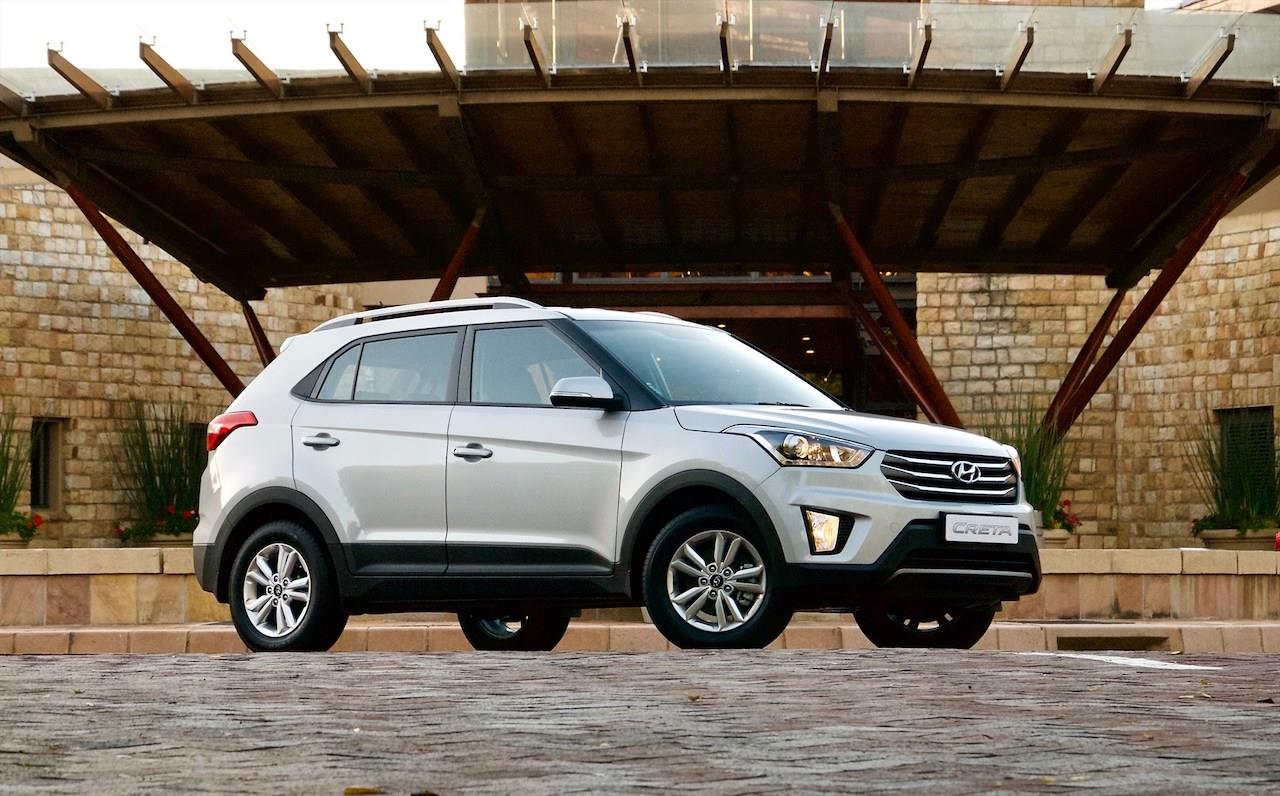
Going up against the Nissan Qashqai 1.2T Visia are the Hyundai Creta 1.6 Executive and the Mitsubishi ASX 2.0 ES. Less than R10 000 separates the least- from the most-expensive offerings here, indicating just how hotly contested this segment is. But before we delve into the details, let’s look at the basic numbers.

Related: Which Nissan Qashqai is best for you, petrol or diesel? We help you decide.
Facts and Figures
|
Engine size (cyl/size/fuel) |
4-cyl, 1.2-litre turbopetrol |
4-cyl, 1.6-litre petrol |
4-cyl, 2.0-litre petrol |
|
Power/Torque |
85 kW/190 Nm |
90 kW/150 Nm |
110 kW/197 Nm |
|
Kerb Weight |
1331 kg |
1210 kg |
1375 kg |
|
Length (mm) |
4 377 |
4 280 |
4 295 |
|
Boot volume (litres)* |
430 |
402 |
442 |
|
Airbag count |
6 |
6 |
7 |
|
Top Speed (km/h) ** |
185 |
168 |
194 |
|
Ave Consumption ** |
6.2 ℓ/100 km |
7.9 ℓ/100 km |
7.5 ℓ/100 km |
|
Warranty |
6 yr/150 000 km |
5 yr/150 000 km (vehicle); 7yr/200 000 km (drivetrain) |
3 yr/100 000 km |
|
Price |
R 355 400 |
R 359 900 |
R 364 995 |
*With 5 seats in use.
**Manufacturer's official figures.
Analysis

These three cars clearly cater for the same market, and they’re very similar in size, but they take different approaches to doing the same job. In this trio is one downsized turbo engine, and two traditional but quite highly-tuned larger engines. And, while they’re all petrol-fuelled and front-wheel drive, both the Nissan and the Hyundai feature 6-speed gearboxes (instead of the Mitsubishi’s 5-speed transmission).
The ASX is the oldest design here, but has benefitted from continuous updates since its first international appearance back in 2010. That regular update approach also applies to the Qashqai (which has been around since 2014) and the Creta (which the newest of this bunch, but has nonetheless received a mild facelift in 2018). But, even though the Mitsubishi is the oldest, it still has a few tricks up its sleeve...

Power, performance, and drivetrains
The Mitsubishi’s first advantage comes from the engine room. Instead of using a downsized turbo engine to produce its power, there’s an old-school, large-ish non-turbo engine. It’s a 2.0-litre unit, good for 110 kW and 197 Nm and enough to convincingly out-power its opponents.
Next up is the Nissan Qashqai, which has the smallest engine here, but is the only one to benefit from a turbocharger. While the 85 kW on offer is roundly trounced by both of the others, its torque output of 170 Nm results in a mid-pack finish. Just be aware that the little turbo mill doesn’t do much useful work unless the rev counter points to the north of 2000 r/min, which could be an irritant when driving in traffic or attempting to pull a trailer.

Taking the middle road between the other two, the Hyundai’s 1.6-litre engine falls exactly midway between those in the Nissan and Mitsubishi in terms of displacement, beats the Nissan on peak power output with its 90 kW, but loses out to both of them on torque, with only 150 Nm on tap. Fortunately, the Creta is also by far the lightest of this bunch, weighing 121 kg less than the Qashqai and 165 kg less than the ASX, but even that isn’t enough to give it any useful performance advantage.
This holds true even in their manufacturers’ performance claims, where the ASX is decidedly faster in a straight line and while accelerating than the others can manage, with a top speed of 195 km/h and a 0 – 100 km/h sprint in a claimed 9.6 seconds (against 185 and 10.9 seconds for the Qashqai and 168 km/h and 11.9 seconds for the Creta).

In the end, the Mitsubishi’s outright displacement- and power advantage hands it a convincing victory in the performance stakes, with the Nissan’s extra helping of torque taking it into second place and relegating the Creta to the third position. In this case, at least, there’s no replacement for displacement.
Economy
Just as the Mitsubishi’s displacement advantage hands it a victory on performance, it also counts against it at the fuel station. It’s the second-thirstiest car in this comparison, but there’s not very much in it between the ASX and the Creta, either – the Hyundai’s official average consumption is only 0.4 ℓ/100 km heavier on fuel, with a figure of 7.9 ℓ/100 km against the Mitsubishi’s 7.5 ℓ/100 km.
In contrast, the Qashqai snatches a convincing victory with an official average consumption of only 6.2 ℓ/100 km. However, it must be noted that the Nissan’s small engine is very dependent on turbo boost to deliver its performance, so if it’s driven hard enough to keep up with the more-powerful Mitsubishi, its real-world consumption will likely be quite close to the ASX’s official figure.

Expect mid-8 ℓ/100 km figures from either the ASX or Creta on real roads, where the Qashqai should still return mid-7 ℓ/100 km numbers. This one is a definite win for the Qashqai, then, with the ASX and Creta in second- and third positions, respectively.
Related: For more information about the Qashqai's Euro-NCAP crash test, click here.
Practicality
At first glance, this looks like another victory for the ASX, but there’s a slight catch: while the Mitsubishi has the largest cargo bay with all seats in use, the Qashqai betters the ASX’s maximum load volume by quite a margin when its rear seats are folded away. This makes sense, seeing as the Nissan casts a marginally larger shadow than the other two.

As a result, the Qashqai has more rear-seat passenger space than the others can offer, and features the second-largest boot when it’s carrying a full complement of passengers. Meanwhile, the poor Creta (smallest overall, with the smallest boot) has to settle for third place. It must however be noted that its luggage compartment is less than 10% smaller than the ASX’s, and is within spitting distance of the Qashqai’s cargo volume. The ASX still wins this section, though, with the Qashqai following very, very closely to end up in second position.
Related: If you'd like to see the ASX's crash test data, this link will show you everything you want to know.
Equipment and safety

There’s only one trim level on offer in the Mitsubishi ASX, while the Hyundai Creta can be had in two (we’re looking at the entry-level Executive trim here). Meanwhile, our featured Nissan Qashqai Visia has the lowest of four available spec levels in its range. Nonetheless, they’re all reasonably well-equipped, with standard features in common including cruise control, multi-function steering wheels, audio systems with Bluetooth- and USB compatibility, air conditioning, and power steering.
However, being the base-model Qashqai, Visia trim doesn’t include a touchscreen infotainment system, alloy wheels or rear parking sensors, all of which are standard in the ASX and Creta. The Mitsubishi is also the only one to offer a panoramic sunroof as standard. In the features race, the ASX thus grabs a narrow victory over the second-placed Creta.In Visia trim, the Qashqai ends up in third position. Of course, higher-trim Qashqais have all these features and a lot more besides, but at a much higher pricetag which would put them outside the scope of this comparison.

Its base-trim specification doesn’t do the Nissan Qashqai Visia any harm in the safety stakes, however, with 6 airbags standard even in the entry-level car. It’s also the only one of this trio to feature stability control, although that is its only real safety trump card. Common across all three contenders are ABS and ISOFIX child seat anchors, with the Creta matching the Qashqai’s count of 6 airbags and the ASX getting one more for the driver's knees.
Consequently, all three cars performed well in crash testing. The Qashqai and ASX both scored 5-star ratings according to the Euro-NCAP protocol, while the Creta scored 4 stars in Latin-NCAP testing – only losing that one star because the car they tested didn’t come with all the safety kit that’s standard equipment in our market.
Suffice it to say that all three of these cars would protect their occupants really well in a crash, but the Qashqai’s standard stability control hands it the victory as far as safety goes. The ASX grabs second place here by virtue of its extra (driver’s knee) airbag, with the Creta following it very closely indeed.

Related: This article explains why the Hyundai Creta only scored 4 stars in its Latin-NCAP evaluation.
Verdict
It’s difficult to choose an outright winner from this fine selection of cars, because they all have their own strengths and weaknesses. However, it’s the Hyundai Creta that has to fall by the wayside first, simply because it is forced to stand in the shade cast by the other two. The Creta is an “almost” kind of car (especially in base spec): it’s neither as nicely finished as the Qashqai, nor quite as well-equipped as the ASX, and it doesn’t really shine in any particular area. It does offer the strongest warranty of these three, but its service plan merely matches that of the Mitsubishi (even if it betters that of the Nissan).
Separating the Qashqai and the ASX is a lot more difficult, though. In base trim, the Nissan just can’t offer quite enough to counter the Mitsubishi’s spec level or performance, which relegates it to second place. Its only real advantage lies in the standard fitment of stability control and its fuel economy under ideal conditions, but it’s trounced in every other area. So, if safety credentials are of primary importance, the Qashqai has to be your first choice.
This leaves the Mitsubishi ASX as our overall winner today. While it is a bit more expensive than the Nissan, it’s much better-equipped, narrowly beats it on general-use practicality, and has a lot more power while almost matching it on safety. Don’t be deceived by its higher quoted fuel consumption – in the real world, there’s actually very little between them. The ASX isn’t a bargain, but in this comparison, it’s the best choice between three strong contenders.

* Pricing was accurate at the time of writing, but may change without prior notice.
Want to know more about these three crossovers? Check out these related links:
Our review of the Qashqai 1.2T can be found here
Find out more about the current Nissan Qashqai range here.
Get more information about the Hyundai Creta's 2018 update here.
Looking for a new or used Nissan Qashqai? We have them all listed for you here.
If you're interested in a new or used Hyundai Creta, just click this link to see them all.