New vs used Datsun Go+: What are the top 4 differences?
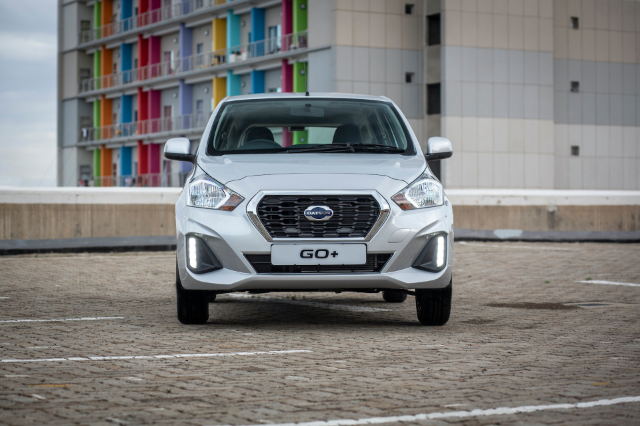
The Datsun Go+ (and Go) received a comprehensive update late in 2018, with obvious improvements all round. It’s still one of the least-expensive new 7-seaters on our market, but, if it weren’t for the fact that they look almost identical, you’d hardly believe that the two eras of Datsun Go+ are related at all. Let’s explore the top 4 differences between a new (facelift) Datsun Go+ and a used (pre-facelift) one.



Just about the only things that stayed unchanged with the mid-term facelift were the drivetrain and (most of) the styling. It’s still powered by a 1.2-litre, 3-cylinder, non-turbo petrol engine with 50 (or 57) kW and 104 Nm, so performance is predictably casual: the 0 – 100 km/h amble is dispatched in a claimed 13.3 seconds with a manual gearbox, and it’s supposed to run onto a top speed of 161 km/h.
Best not test that latter claim, though, because high-speed stability is still not a strong suit for slab-sided Go+. The redesigned bumpers and daylight running lights (DRLs) makes it look a bit more modern, but it’s never going to be an aesthetic marvel. But, with all that said, there are some definite leaps ahead for the facelifted Go+, when compared to its predecessor.
Related: The 7 cheapest new 7-seaters on the market.

1. Redesigned cabin
There’s no other way to say this: the early Datsun Go (and Go+) interiors were pretty awful places to spend time. Indian-market-preference colour co-ordination, variable build quality, and a front bench seat all conspired to make a pre-facelift Go+ cabin a lot less pleasant than it could have been.
This has been rectified with the facelift, however, because the new car has an entirely new interior, with a much nicer-looking dashboard, proper individual front seats, and a floor-mounted parking brake. It’s made of nicer plastics and screwed together much more tightly, as well. This alone could really be reason enough to rather get a later-model Go+, if your budget allows.
Related: Budget 7-seater safety shootout – Datsun Go+ vs Toyota Avanza vs Suzuki Ertiga.

2. Improved safety features
The early Datsun Go family came in for heavy criticism regarding its safety credentials: not only did it perform very poorly in crash tests, but it was also very low on safety equipment. It launched in 2014 without any airbags or ABS, later gaining a driver’s airbag (which pushed the crash test rating up from zero to one star), but the real advances only occurred with the 2018 facelift.
All variants of the latest Go+ (and Go) now have ABS and dual airbags as standard, while Datsun also says that they reinforced the car’s body structure for better occupant protection. The chances of a low-speed mishap while reversing should also be reduced, courtesy of the rear parking sensors. Once again, the advances are significant enough to justify shelling out extra for a newer Go+.
Related: Get all the information about the Datsun Go and Go+ facelift in 2018.

3. Added luxuries
Not only does the facelift Go+’s interior look nicer and sturdier, but it’s also much better-equipped. All variants now get electric windows all round, electrically-adjustable rear-view mirrors, and a colour touchscreen infotainment system with smartphone mirroring.
Opting for the high-spec “Lux” basically adds a tachometer and some silver trim bits inside, so going for an entry-level “Mid” trim doesn’t really exact too much of a comfort penalty. Even the older Go+ has the bare essentials, mind you, with power steering and air conditioning standard across the board.
Related: The top 4 Datsun Go features that stand out from the competition.

4. Available automatic transmission
The most recent addition to the Go/Go+ range is the available constantly variable transmission (CVT). The CVT can only be had in Lux trim, and makes for easier city driving if not stirring performance. In spite of a power hike from 50 to 57 kW, the self-shifting Go+ is definitely a more-leisurely option than the manual one.
Consequently, it will work best for those drivers who really hate operating a clutch pedal, or have to deal with congested traffic on a regular basis. Still, fitting a CVT is better than not having an automatic option at all, so it has to count as another of the facelift Go+’s upgrades.
Related: Datsun Go automatic faces off against Suzuki Celerio and Renault Kwid.