
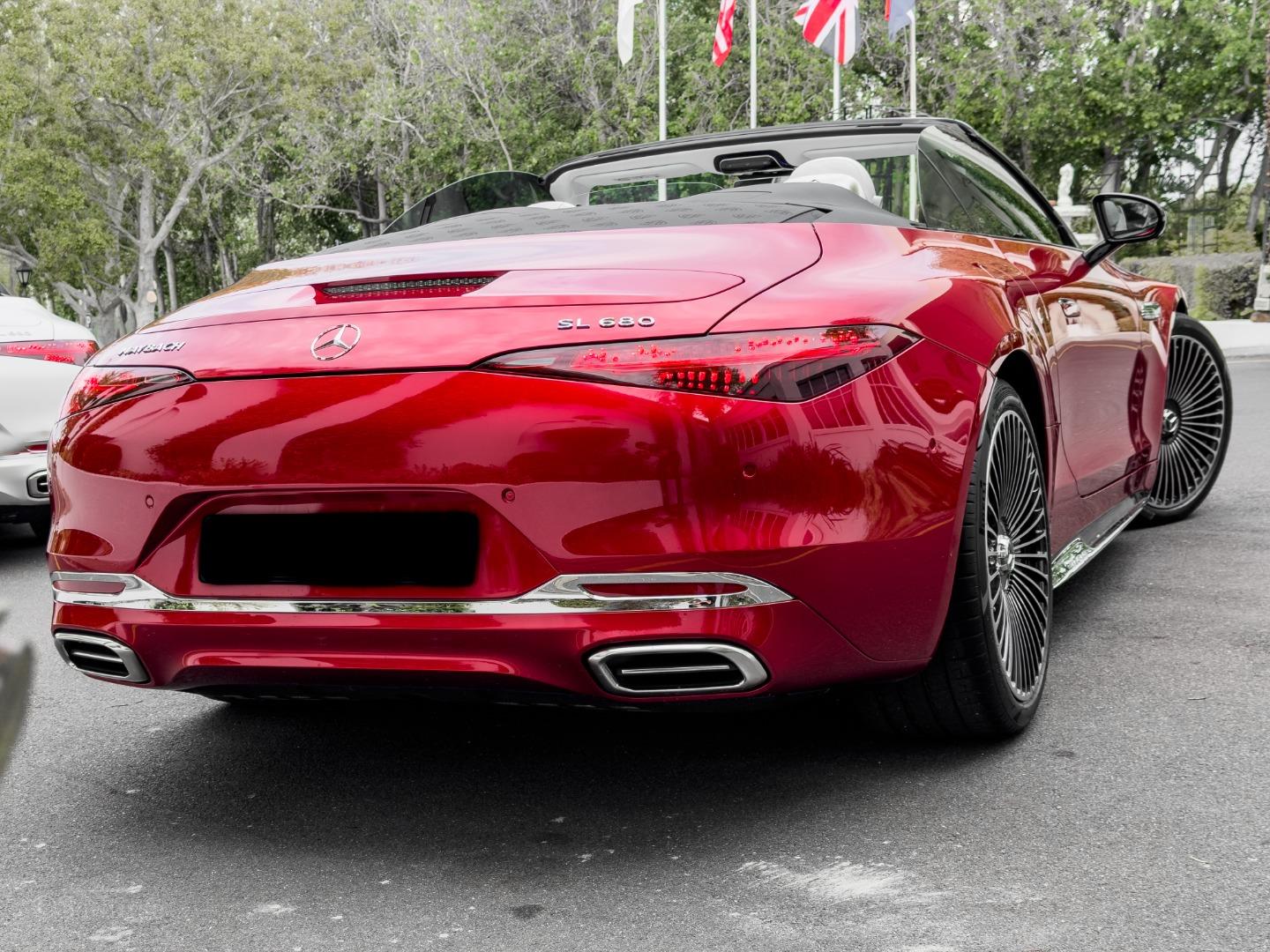
I travelled to the Western Cape to get behind the wheel of Mercedes’ ultimate expression of open-top driving, the Maybach SL680. Designed to blend wind-in-your-hair grand touring with double-M prestige, this flagship trades Affalterbach’s raw track aggression for boulevard elegance. But does slapping a Maybach badge onto AMG’s performance roadster create a luxury cabriolet worthy of cruising the most exclusive suburbs? I also drove its rowdy sibling, the Mercedes-AMG SL63, to find out how the performance and ultra-luxury variants stack up on South African roads.
Related: Mercedes-Maybach GLS600 (2025) Review
Exterior styling
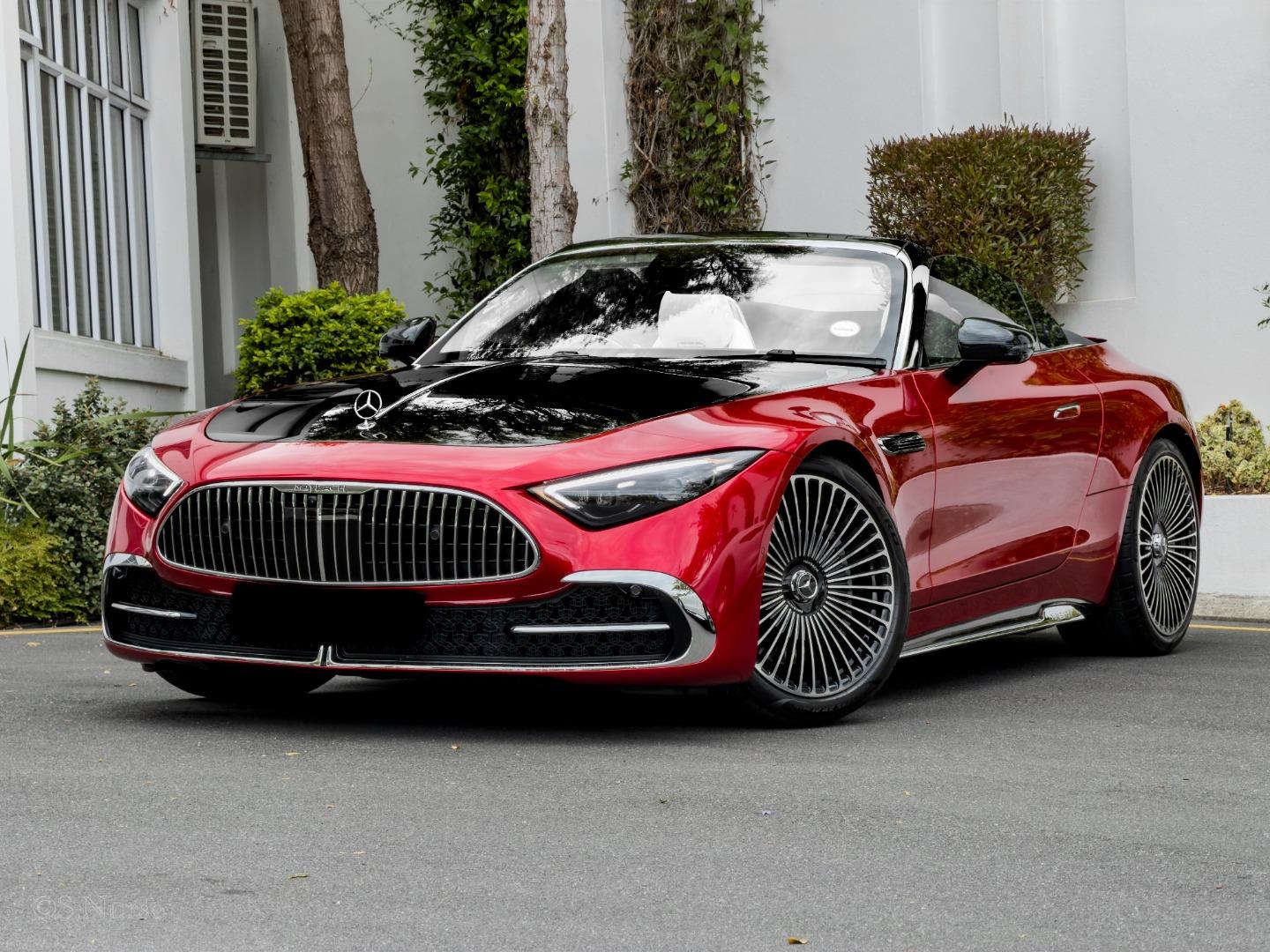
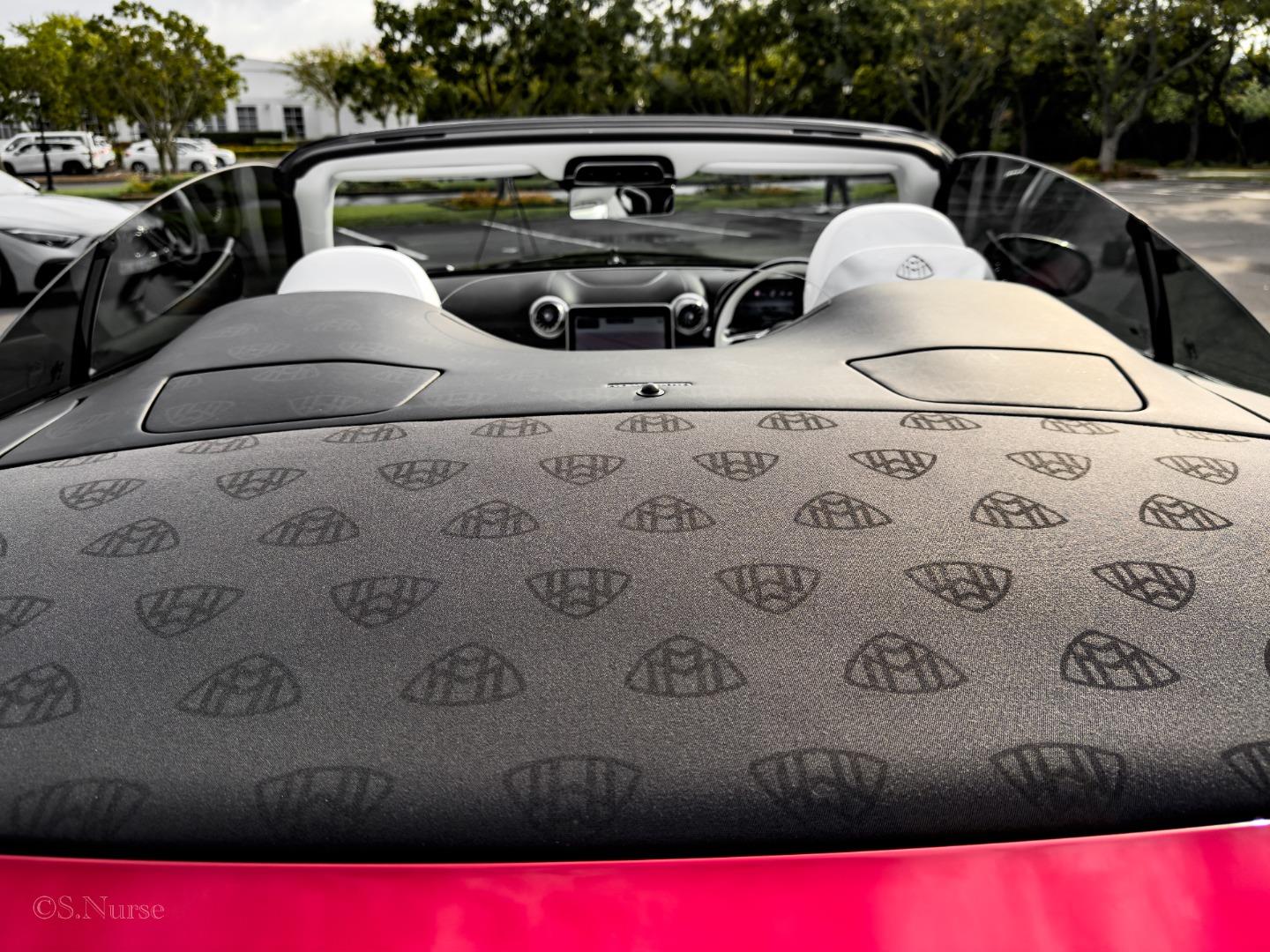
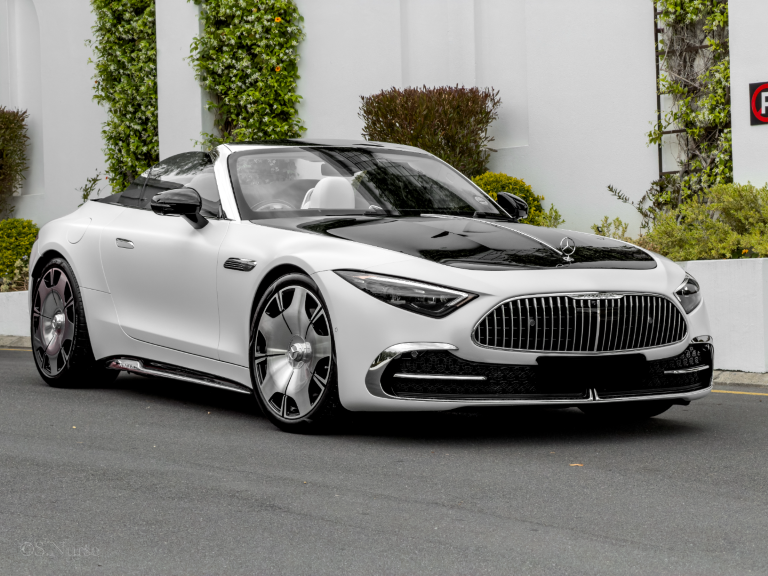
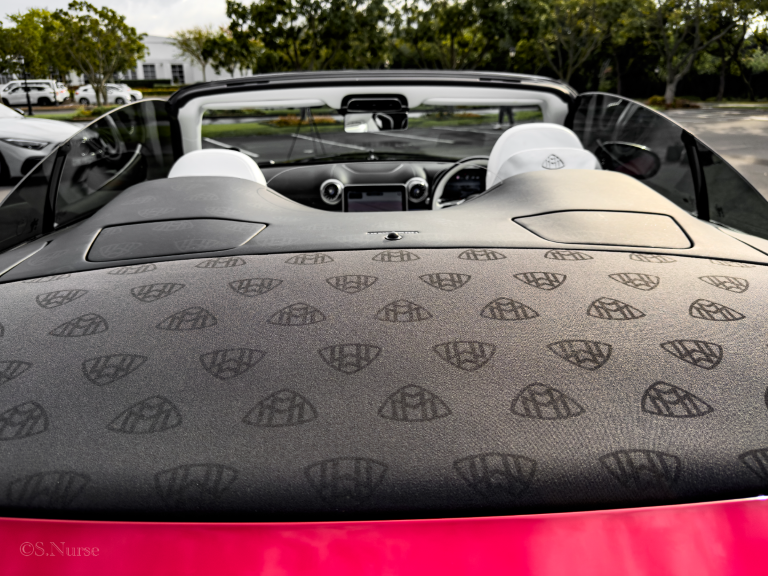
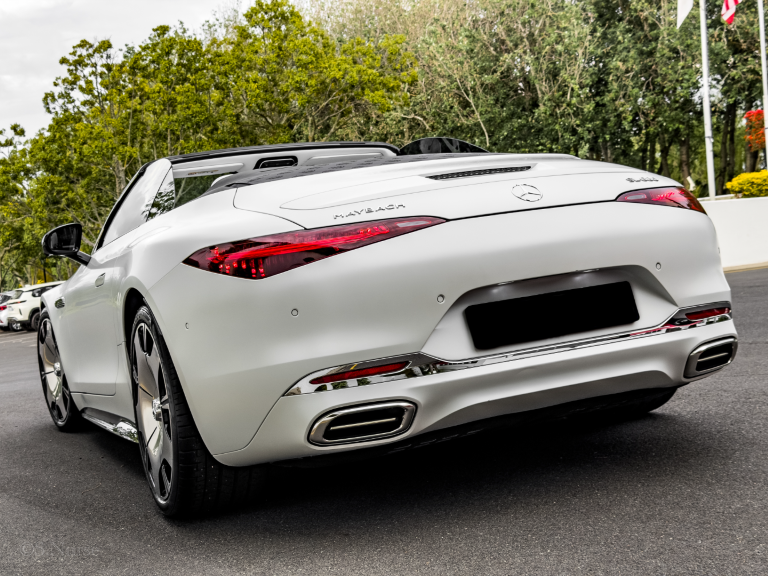
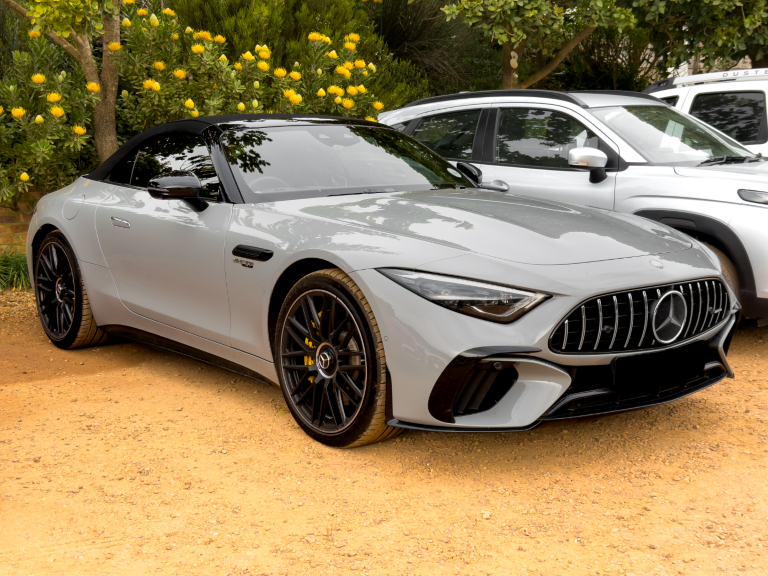
Visually, the SL680 leaves no doubt about its Maybach treatment. The front end features an illuminated Maybach-specific chrome radiator grille and a bonnet adorned with an upright Mercedes star. The bonnet can also be ordered in a contrasting black finish infused with subtle Maybach logos. The fabric soft top is covered in Maybach logos, just in case you weren't aware of what you're looking at.
Chrome accents outline the windscreen frame, side sills, and lower front air intakes, paired with bespoke 21-inch multi-spoke alloy wheels wrapped in 275/35 front and 305/30 rear tyres. Around the back, Maybach-specific exhaust tailpipe trims and tail-lamp signatures set it apart. It is an unabashed expression of wealth, designed for coastal routes rather than blending into traffic. There was a red and a white example at the event, and the white car, with its Monoblock wheels, is impossible to miss, and whether you interpret that as ostentatious or not depends entirely on your own taste, which is why Maybach models are all bespoke to their owner.
Drivetrain & performance
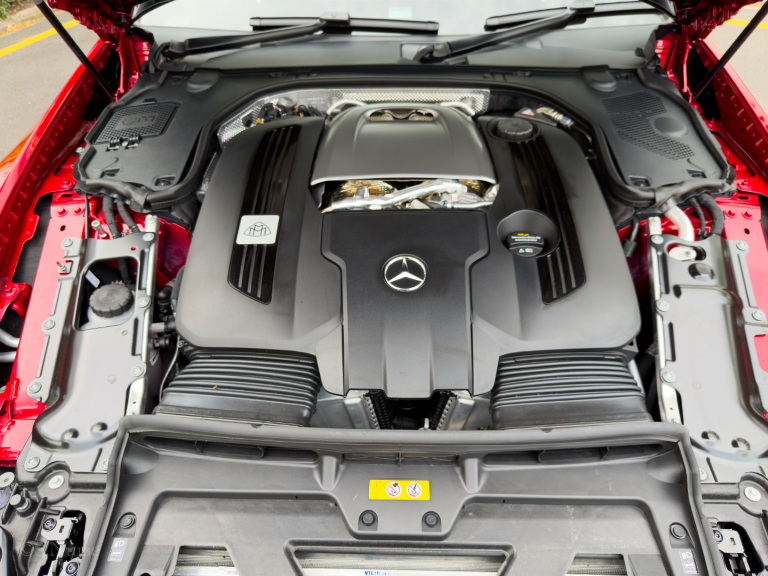
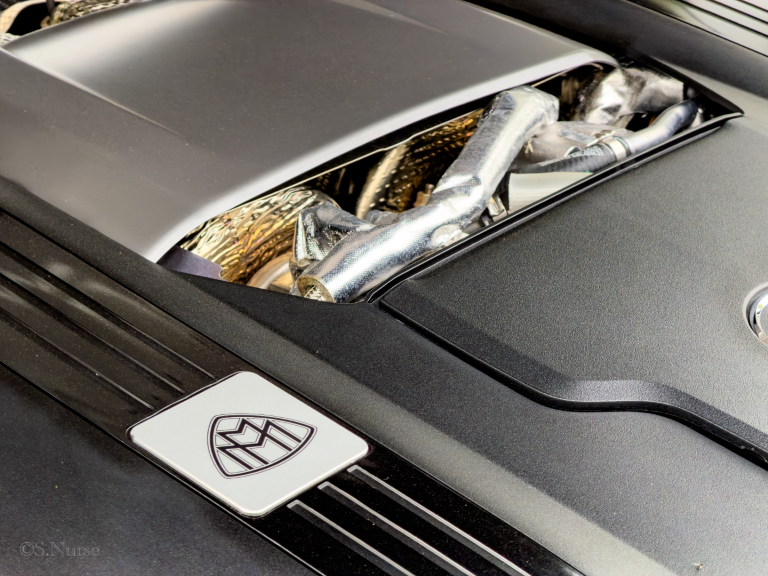
Under the long bonnet lies the familiar 4.0-litre twin-turbocharged V8 engine paired with the AMG Speedshift MCT 9-speed transmission and 4Matic+ all-wheel drive. While it shares core hardware with the SL63 AMG, its powertrain calibration is distinct.
Maximum power is rated at 430 kW with 800 Nm of torque. However, pedal response, gear-shift logic, and engine mapping have been smoothed out to deliver linear acceleration rather than aggressive neck-snapping launches.
Power Output: 430 kW
Torque Output: 800 Nm
0–100 km/h: 4.1 seconds
Top Speed: 260 km/h (electronically limited)
Interior ambience
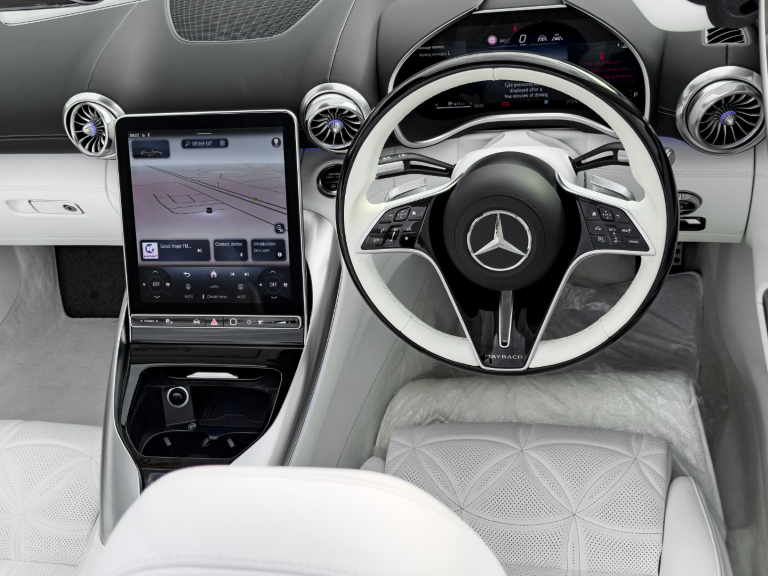
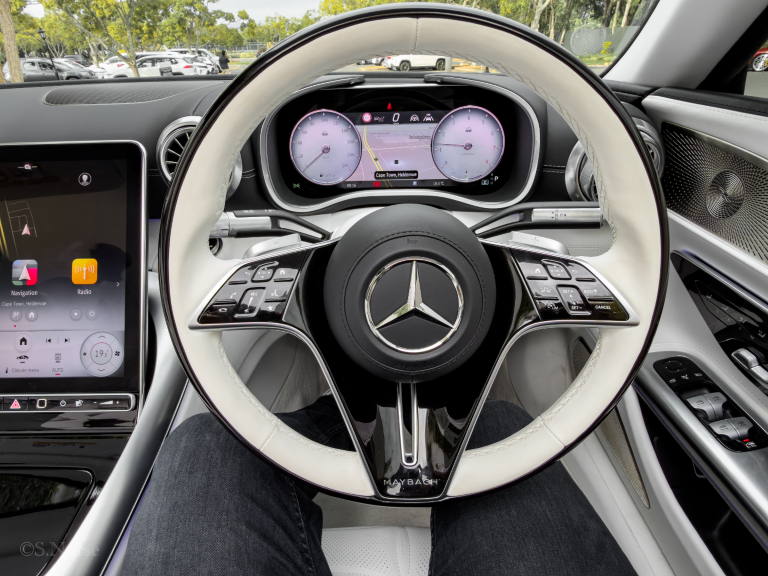
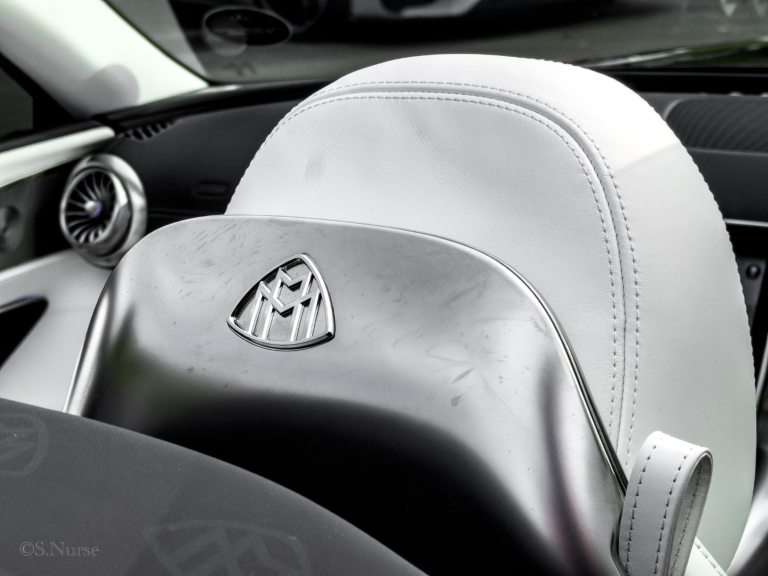
Step inside, and the Maybach treatment transforms the standard SL's cockpit into the automotive equivalent of Louis Vuitton luggage. Unlike the standard SL’s 2+2 arrangement, the Maybach SL680 deletes the tiny rear seats in favour of an exquisitely upholstered leather rear deck, converting the car into a dedicated two-seater.
The entire cabin is wrapped in supple Nappa leather, covering the door panels, dashboard, steering wheel rim, and multi-contour active seats that feature heating, ventilation, and massage functions as standard. Additional acoustic insulation, noise-optimised exhaust tuning, and tailored soft-top insulation keep the Western Cape's buffeting winds at bay. The boot volume stands at a usable 240 litres, enough for a pair of luxury weekend bags. One area I found irksome, as I do in many new cars, is the prevalence of gloss-black plastics, which age poorly and don't feel like a luxury.
Driving impression
Cruising the coastal roads in a windy Western Cape, the first thing I noticed was how little the SL680 wanted to be hurried. I had hopped out of its AMG sibling, and what was immediately clear was the improved cabin insulation, softer ride quality, and more measured power delivery. The adaptive suspension soaked up expansion joints without fuss, and the ride stayed composed even where the road surface got rough.
The standard rear-wheel steering is the car’s best trick on tight ground. At 1 975 kg, the SL680 is never going to feel light, but on some winding coastal road, the rear wheels tucked the long bonnet in more than I expected. Manoeuvrable for its size, yes. Sharp, not like an AMG. I first realised this during a fast change of direction, where I could feel the slightly more numb steering and wallowy suspension making the weight transition more pronounced. On the plus side, over bigger elevation changes and imperfect roads, the 680 is far more composed and enjoyable than the 63.
Push it, and the 4.0-litre twin-turbo V8 delivers power in a muffled swell rather than a bark. Acceleration arrives in a steady wave, with no exhaust pops and no aggressive downshifts. When I first opened the taps, there was a discernible lag, and I realised I was in Maybach mode, which softens every response. When Sport mode was selected, it became more dynamic but notably less eager than the AMG. As a drop-top Camps Bay cruiser, this is about all you'd ever want.
How does it compare?
Having driven the Mercedes-AMG SL63 on the same roads, the contrast between Affalterbach's sports-car approach and Maybach's boulevard philosophy is stark despite sharing so much mechanically:
| Mercedes-Maybach SL680 | Mercedes-AMG SL63 | |
| Engine | 4.0L twin-turbo V8 | 4.0L twin-turbo V8 |
| Power | 430 kW | 430 kW |
| Torque | 800 Nm | 800 Nm |
| 0–100 km/h | 4.1 seconds | 3.6 seconds |
| Top Speed | 260 km/h | 315 km/h |
| Seating Layout | 2-Seater (Rear Leather Deck) | 2+2 Seater |
| Kerb Weight | 1 975 kg | 1 895 kg |
| Price (from)* | R5 127 931 | R3 982 166 |
*Includes 5-year / 100 000 km Maintenance Plan
While both cars share much of their mechanicals, does the superior noise isolation, bespoke interior, softer ride tuning, and added visual presence justify a price hike of R1.1 million before options? Personally, I would say no, as the AMG variant is more than enough for me, but in the world of automotive bragging rights, the Maybach's presence is undeniable.
Verdict
The SL680 is not a sports car chasing lap times, and it isn’t just an SL63 with extra badges. Maybach has taken AMG’s taut platform and retuned the suspension, quietened the exhaust, and re-crafted the interior into a modern luxury roadster. If you want open-top grand touring that feels expensive rather than aggressive, this is the one. If you want to drive hard on a Sunday, buy the SL63. Either way, it's just wonderful that we can still buy a V8 roadster in 2026.
The price is steep, and each car is built to order, so you’ll need to speak to an online configurator or a local dealer. But for buyers who want open-top grand touring with exclusivity and presence, the SL680 makes a convincing case.
A brief history of Maybach
The Maybach name spans more than a century, moving from aero-engine engineering to the summit of ultra-luxury motoring.
Wilhelm Maybach, formerly technical director at Daimler, founded Luftfahrzeug-Motorenbau GmbH in 1909 with his son Karl. The Friedrichshafen firm built heavy-duty engines for Zeppelin airships, placing it at the frontier of early aviation.
After the First World War, the company, by then renamed Maybach-Motorenbau, turned to cars. It debuted the W3 in 1921, and its V12-powered Maybach Zeppelin DS8 became a status symbol for the global elite and royalty. Car production ended with the Second World War, but the brand’s association with bespoke luxury dates from this period.
Daimler-Benz acquired Maybach-Motorenbau in 1960. For much of the following decades, the name lived on mainly through heavy diesel engines, and the car badge lay dormant.
Mercedes revived Maybach as an independent luxury marque in the early 2000s to challenge Rolls-Royce and Bentley. The Maybach 57 and the ultra-long 62 offered reclining rear seats, champagne flutes, and electrochromic glass roofs. However, they struggled to distinguish themselves visually from the S-Class on which they were based, and sales never matched the ambition.
The brand returned in its current form in 2014, when Mercedes-Maybach was unveiled as an ultra-luxury sub-brand rather than a standalone company. The S-Class was the first model to go on sale in 2015. The line has since expanded to the GLS, the EQS SUV, and now the SL roadster. The approach is to take Mercedes-Benz engineering and add craftsmanship and luxury on top.
A brief history of the SL
The Mercedes SL has spent more than seven decades moving from the racetrack to the boulevard.
The 300 SL Gullwing (W198) arrived in 1954. It grew out of Mercedes’ motorsport success, and its upward-opening doors and later Roadster version set the template for the super-sports car. It was fast, expensive, and immediately legendary.
The “Pagoda” SL (W113), built from 1963 to 1971, marked a shift toward safety, elegance, and effortless style. Its concave hardtop gave it the nickname, and it became a favourite of Hollywood stars.
The R107 was produced from 1971 to 1989. Known for its tank-like build quality, it stayed in production for nearly two decades and cemented the SL’s reputation as a grand tourer rather than a lightweight sports car.
The R129 (1989–2002) was defined by its safety engineering, including an automatically deploying roll bar, and by its large V8 and V12 engines. It set the standard for luxury open-top motoring in the 1990s.
The R230 (2001–2011) introduced the Vario folding hardtop and ABC active suspension. In AMG form, it was remarkably quick, though its complex electronics now pose challenges for restorers.
The R231 (2012–2020) was lighter and stiffer, with an aluminium body. It was increasingly overshadowed by SUVs and mid-engine supercars, and it quietly bowed out while Mercedes reconsidered the badge’s future.
The Mercedes-AMG SL (R232), launched in 2022, was developed entirely by AMG. It returned to a fabric soft top, standard all-wheel drive, and 2+2 seating, aimed squarely at performance sports cars. The Maybach SL680 is the latest chapter.