
Mercedes-AMG G63
Mercedes-AMG G63



By Martin Pretorius
For something that started out as a military vehicle, the Mercedes-Benz G-Class has transcended its humble origins to a remarkable degree, to become as aspirational among the nouveau riche as it is revered among serious off-roaders. The Geländewagen has always been a very capable 4x4, but while it still serves in various military forces across the globe, it’s also attained a near-mythical status among the fashion-conscious as one of the ultimate accessories.
Of course, Mercedes-Benz was happy to give the people what they craved, and gradually moved this tough off-roader upmarket through the introduction of progressively more-powerful engines and evermore luxurious cabin appointments. Pretty soon, the G-Class’s original purpose faded from the public consciousness, as it slid into its new role as one of Mercedes-Benz’s most exclusive (and perhaps also one of their most outrageous) cars.
Essentially hand-built in limited volumes in Graz, Austria, the G-Class has always been very pricey. But far from putting the “G” at a marketing disadvantage, the lofty pricetag has simply made it more desirable to those who could afford it. To better cater for this market segment, a succession of brawny V8 engines were introduced in the late 1990s, with the first AMG derivative arriving in 1999. And it’s been a relative smash hit ever since, to the extent that the AMG G-Class makes up the bulk of civilian sales volumes for this model range.
It’s all-new, but you probably won’t realize it.
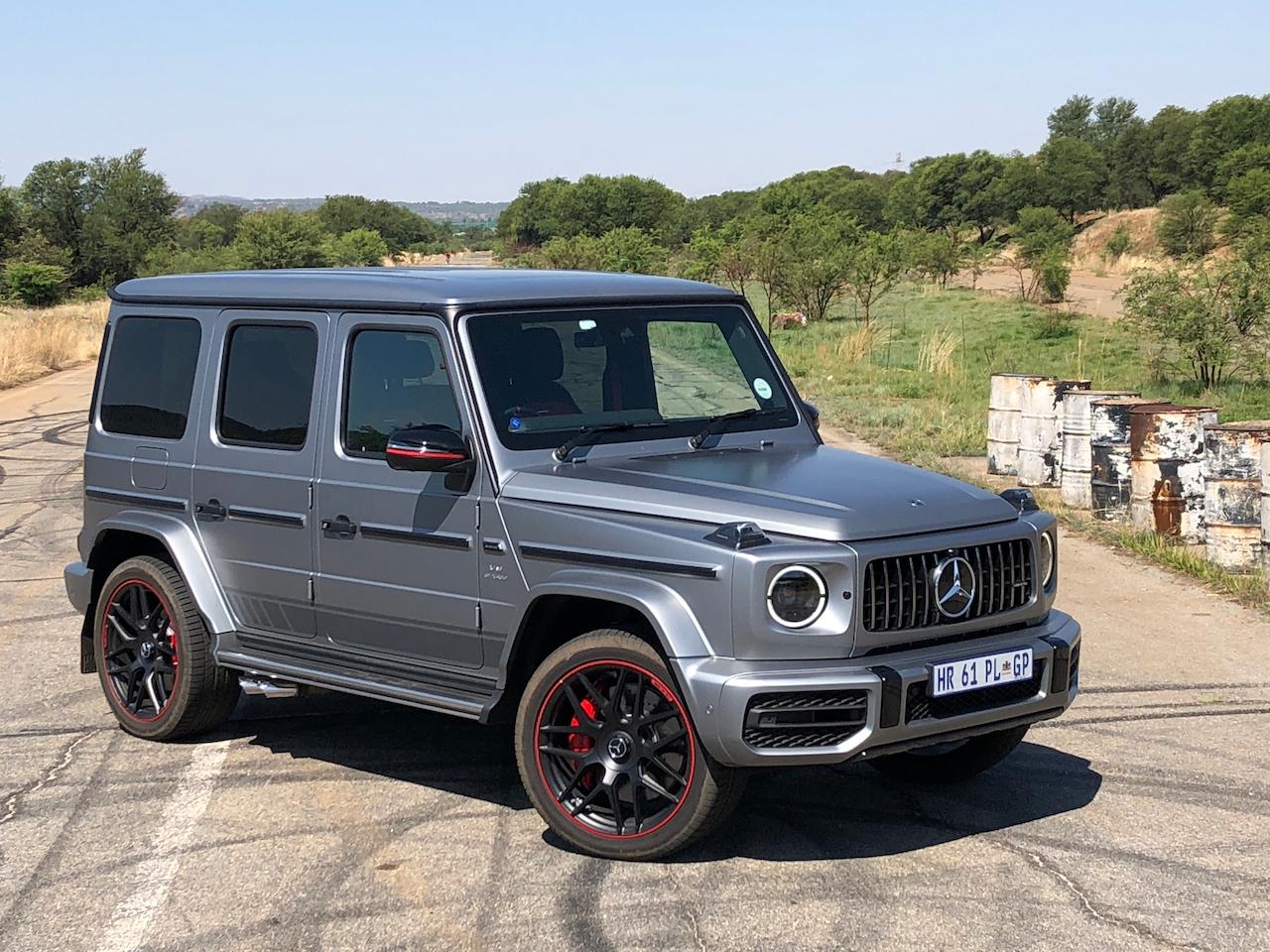
Because the G-Class has become such a style icon over the years, developing a new model couldn’t have been easy for the stylists. In the end, they settled for a refined design which looks almost identical to the old one, only with some of the rougher creases smoothed out. Casual onlookers may need to see the old model next to the new one to recognize the changes, but that’s exactly how Mercedes wanted it, given the car’s four-decade-long history.
There are, however, some tell-tale signs that the latest G-Class shares nothing with its predecessor, the most notable of which is the smoother integration of the bumpers into the flared wheel arches: towards the end of its life, the previous-generation car sprouted some protruding bumpers which didn’t really line up with the fender extensions.
In addition, the DRLs are now integrated into the headlight units, and the radiator grille has a new tapering shape with upright bars in the style of the latest AMG products. On the new car, these components fit together as a homogenous unit, and lead into flanks which are slightly sleeker in shape than before.
Of course, the term “sleeker” is applied very loosely here, because the new G-Class retains its trademark boxy styling cues, with upright roof pillars and porthole-like side glass. Keen eyes will notice that the door now have rounded corners, and this may be the easiest way to quickly tell the new apart from the old, while the tail lights’s corners are also slightly rounder. It’s also longer and wider than before, giving increased (and welcome) improvements in cabin space, but because the proportions remain unchanged, the size increases aren’t all that obvious. Other than that, it’s business as usual.
Thundering V8 and a chassis to exploit it.
As before, there’s a twin-turbo V8 engine roaring away under the G63’s bonnet. But unlike before, it’s a downsized (!) 4.0-litre unit, derived from the one doing duty in the other “63” badged AMGs. For this application, it’s tuned to send 430 kW and 850 Nm to all four wheels via an upgraded version of Mercedes’s 9-speed automatic gearbox. Predictably, and in spite of the G63’s prodigious curb weight of 2 560 kg, performance is rousing: the standing-start sprint to 100 km/h is dispatched in only 4.5 seconds, and the top speed is electronically restricted to 220 km/h (240 km/h with the “Driver’s Package” option selected). Make no mistake, the Mercedes-AMG G63 is almost violently quick, to the accompaniment of an amusing selection of roars, pops and burbles from those side-mounted exhaust pipes.
Just like the old one, then? Not even remotely. For starters, the engine’s character is a bit different than that of the old 5.5-litre monster. There’s a bit more power and a lot more torque (up by 30 kW and 90 Nm, respectively), but the old engine’s immediate throttle response isn’t quite there anymore. Instead, there’s a slight delay before the afterburners light up, but when they do, the heavy wagon catapults itself towards the horizon even more ferociously than ever. In-gear acceleration is equally stunning, as the automatic transmission imperceptibly gets the engine on song while the active front/rear torque distribution (with a new 40/60 rearward bias) ensures that every bit of power reaches the tarmac as effectively as possible.
But, even though it’s faster than before, it’s nowhere near as terrifying to drive. See, the old G-Class still used a solid axle in front, and even with the stiff springs, big wheels and fat tyres necessary to get that power to the ground, it couldn’t really handle the engine’s onslaught. It’s easy to understand why, because at a basic chassis which originally had to cope with at most 120-ish kW, those speed merchants in Affalterbach (home of AMG) threw in more than three times as much power. It simply couldn’t cope with any measure of grace.
Now, thanks to a much stiffer ladder-frame chassis and all-new independent front suspension, the old car’s jittery ride, vague steering, and directional instability have all been banished. A new, much more direct steering system and adaptive dampers add to the new-found sophistication, leading to a vehicle which deploys its oversized stable of war horses with devastating effectiveness. It handles well, with surprising road grip and far more resistance to understeer than before, and remains stable over pockmarked roads and mid-corner undulations. In short, it’s so very much better to drive than it’s ever been.
Just as impressive is the overall system integration, because the G63 finally feels like it was developed as a complete package, not just like a cart-sprung truck with a beastly engine and rock-hard suspension.
Economy dreams are unlikely to come true.
Even though the new engine is smaller and lighter, and boasts efficiency-enhancing gizmos such as cylinder deactivation and direct injection, it’s extremely unlikely that any driver will ever approach Mercedes’s claimed average consumption of 13.1 litres/100 km. But, while realistic average consumption figures closer to 16 litres/100 km are more likely (provided there’s a conservative driver behind the wheel), even these scary numbers are significantly better than the old car’s horrendous thirst.
That said, it’s unlikely that anyone who could afford to shell out around R2.6-million for bragging rights of this caliber would be too concerned about the fuel price. In fact, the mere fact that they can afford to feed such a brute probably counts as an added attraction...
How good is it off-road?
To be honest, I really couldn’t say. The worst conditions we encountered on our launch drive entailed corrugated dirt roads and some small gravel patches – where the new suspension did give a reasonably compliant ride quality. Included in the basic specification is a low-range transfer case and differential locks on both axles as well as for the centre diff, so off-road ability forms part of the overall package.
How often these 4x4 abilities will be used is another matter, of course – even though the paintwork is scratch-resistant, the shallow tyre sidewalls and those big alloy wheels will probably discourage buyers from venturing too far into the bush. Nonetheless, the new car boasts improved ground clearance and better approach- and departure angles, as well as a wading depth of up to 700 mm.
Plush and high-tech.
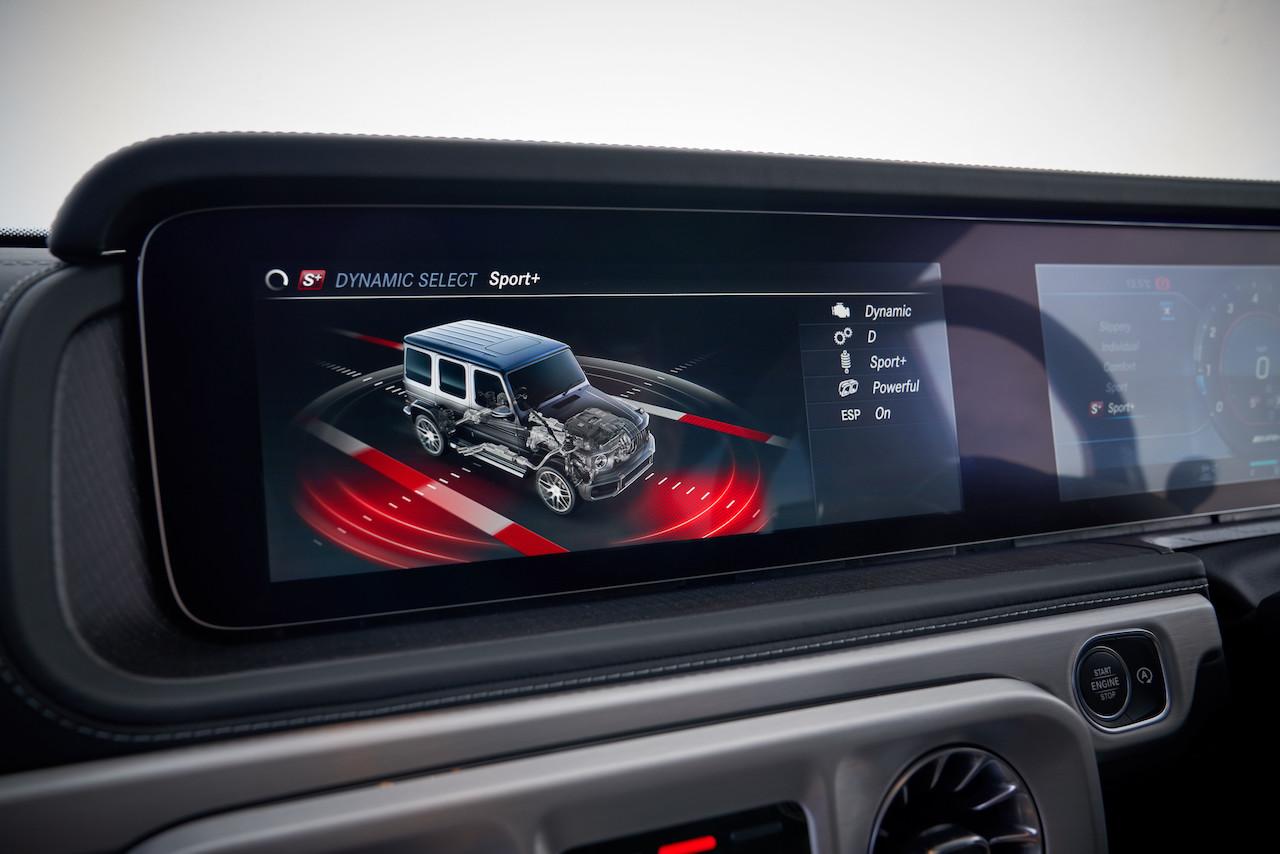
Taking its digital dashboard from the S-Class, the new G63 is loaded with modern technology and plenty of driver aids. In fact, most of the things you’d find in the S-Class can be had in the G63 as well, right down to adaptive Multibeam LED headlights, adaptive cruise control, Pre-Safe, Active Brake Assist, Lane Keeping assistance, blind spot monitoring, and traffic sign recognition – certainly a far cry from its Spartan predecessors.
Luxury trim is a given, and the general cabin ambience is enhanced by niceties such as those rotating air vents, and heated and cooled, electrically-adjustable front sports seats with memory. At an additional R300 000 price premium, the G63 Edition 1 (which will only be available for a limited time) adds 22-inch cross-spoke alloy wheels with red pin-striping (which is repeated on the side mirror caps), red seat trim inserts and stitching, matte stickers down the flanks, and gloss-black trim pieces outside. Yes, it’s expensive, and no, buyers won’t care about the price.
Do-it-all extravagance.
It must have been a mammoth task, but the engineers at Mercedes-AMG have done a remarkable job of finally turning the G63 into something truly deserving of that AMG badge. Yes, it’s still extravagant and ostentatious, but with its unique sense of occasion, backed up by genuine abilities on and off the beaten track, storming performance, and iconic styling, there really is nothing out there like the latest Geländewagen.
It may have strayed from its workmanlike origins, but in its latest iteration, the G-Class oozes more appeal than ever. The glitterati will love it just as much as ever, serious off-roaders will appreciate its abilities, and speed freaks will finally feel safe when the accelerator pedal meets that plush carpet. It’s a win all-round, then – as it should be, at that price...
Mercedes-AMG G63 Prices:
| Mercedes-AMG G63 | R2 613 644 |
| Mercedes-AMG G63 Edition 1 | R2 913 644 |