But the question remains: Can a bakkie with a plug be a game-changer for a market so deeply devoted to diesel? We drill down into the numbers, the capability, and the sheer practicality of Ford's electrified workhorse.
Ford Ranger PHEV performance
South Africans demand capability from their bakkies, and the hybrid Ranger appears to offer some serious performance. The 2.3-litre EcoBoost turbocharged petrol engine is paired with a 75 kW electric motor with an 11.8 kWh (usable) battery pack, delivering 207kW and 697Nm of torque.
That 697Nm makes it the most torquey production Ranger ever, eclipsing the 3.0L V6 diesel's 600 Nm. This is a crucial metric, ensuring that the PHEV maintains its 'no-compromise' claim:
The electric motor’s instant torque is a boon for low-speed urban driving, off-road crawling, and even launching from a standstill when towing a heavy load. It delivers the grunt the market expects, but with a new level of refined quietness.
Can it Beat Diesel at the Pumps?
This is where the PHEV makes its strongest case for the average urban-based South African driver.
Ford quotes a phenomenal official fuel economy figure of around 2.9 L/100km (WLTP combined cycle). While real-world mileage will always vary, especially depending on driving style and road conditions, the potential savings are undeniable.
The key to this efficiency lies in the battery. The 11.8 kWh pack offers an estimated electric-only driving range of up to 49 km. Many South Africans who use their bakkies for the daily commute or short-haul work duties can complete those trips on electricity alone, using virtually zero petrol.
The operational savings over time could be substantial for business owners and fleets, provided the initial cost of the bakkie isn't significantly higher than an equivalent diesel model. Compare that to the 2.0-litre Bi-turbo diesel's combined figure of around 7.2 L/100km, and the efficiency delta is massive, provided the vehicle is regularly charged. When the battery is depleted, the Ranger reverts to a traditional petrol-electric hybrid, retaining range and performance.
Mobile generator
The Pro Power Onboard system is a true game-changer that has resonated globally. The Ranger PHEV effectively turns into a massive mobile generator, offering up to 6.9 kW of power output via onboard outlets.
This feature is transformative for the contractor on a remote site, the camper, or anyone needing to power equipment during load shedding. It allows you to run high-draw tools, fridges, lights, or even a small home setup directly from the bakkie’s battery.
Is South Africa ready for a bakkie with a plug?
The biggest hurdle for the Ranger PHEV isn't its capability; it's the market's perception and infrastructure. BYD has seen impressive slaes numbers for its Shark 6, which has a similar hybrid set-up, so a locally-produced model, provided it is priced well, should sell well in the lifestyle segment, still here are some key hurdles.
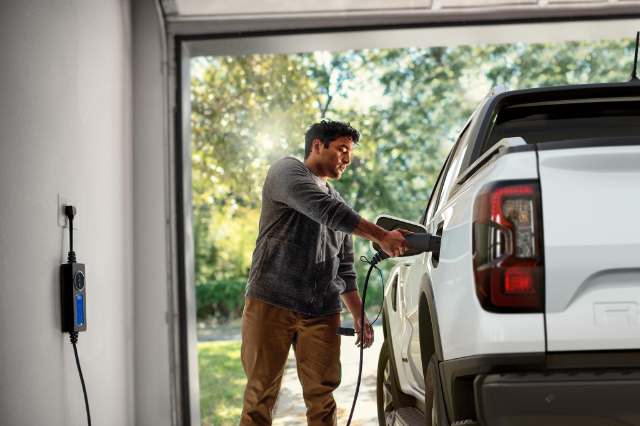
1. Charging Infrastructure: While the charging network in South Africa is growing, it’s far from widespread, especially in remote areas. However, this is less of a concern for a PHEV than for a pure EV. The Ranger PHEV’s petrol engine and large fuel tank eliminate range anxiety. The 49km EV range offers a large, fuel-saving bonus for local driving. Charging can easily be done overnight at home using a standard three-pin wall socket in under seven hours, or faster with an installed wallbox.
2. Loadshedding: Ironically, the PHEV's design mitigates the instability of the Eskom grid. If the power is out, you can run the bakkie as a hybrid, and crucially, the Pro Power Onboard function can provide power back to tools or your home essentials.
3. The Diesel Mindset: The South African love affair with the diesel bakkie is well documented, with these engines having provided many reliable service. Concerns about the petrol engine’s consumption on long, high-load trips (when the battery is flat) must be overcome. Initial reports suggest highway consumption can be comparable to a V6 diesel, but a full local test will be the decider.
The Verdict
The Ranger PHEV is not just a new model; it’s a sign of a shift in the market. By building it locally, Ford South Africa has secured a crucial piece of its manufacturing future and signalled a shift towards New Energy Vehicles (NEVs) in a segment that has been slow to move.
The South African bakkie market is evolving, and with the Ranger PHEV arriving—backed by the assurance of local production—it is less a question of if the market is ready, and more a matter of how quickly they embrace an alternative.





 Ford Ranger Buyer's Guide (2011-2022)Looking at buying SA's most popular used car? Here's our handy Buyer's Guide for the Ford Ranger from 2011 to 2022!
 Ford Ranger XL upgrade pack availableThe XL is the value leader of the Ranger lineup, and now the brand offers a new accessory pack for the double cab variant.
 Ford Ranger safety recall: brake boost and ABS module issueFord Motor Company of Southern Africa (FMCSA) has issued another recall for Ranger models. The issue pertains to the brake boost and ABS module. Here's what you need to know.
 Ford SA announces multiple safety recalls for Ranger, Everest, Mustang, and moreFord Motor Company of Southern Africa (FMCSA) has issued several safety recall notices affecting various models and production years, including popular vehicles like the Ranger, Everest, and Mustang.