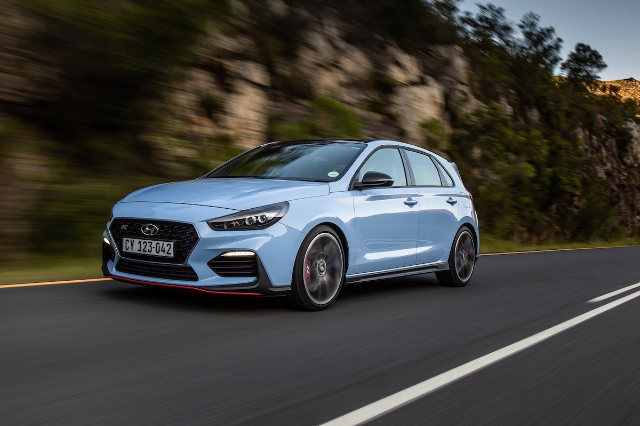
You don't have to remind us that the Hyundai i30N is expensive, we know. The pocket-rocket Korean hatch has been the talk of the town since its release at the start of the year, mostly due to its hefty price tag. We drove it and we loved it, especially the way it drove. But when you're not blasting around and ten tenths with your hair on fire, you'll want to settle down and enjoy the creature comforts that it has to offer.
Related: Hyundai i30 N (2020): First Drive Impression
There are certain expectations in place when one spends over R500 000 on a hatchback, and one of those is that it must have a comprehensive infotainment system. It's a staple in virtually every car these days, from the budget-friendly city commuters to the sports cars and luxury limousines.
Here's how the Hyundai i30N stacks up against the evergreen Volkswagen GTI and competent Renault Megane R.S. Cup.

Hyundai i30N
R679 900
Our rating: 3.5/5
The Hyundai i30N comes equipped with a dashboard-mounted 7-inch touchscreen infotainment system that will, for the most part, look and seem familiar to anyone who has experienced a Hyundai infotainment system in the last few years. This crisp and clean setup is easy to use and has a clean and clear display that is relatively intuitive with large, bright icons and user-friendly switchgear.
This system supports AM/FM, Bluetooth, USB, and AUX input for audio streaming and radio station selection. You will be able to mirror your mobile phone thanks to included Apple CarPlay and Android Auto functionality while wireless charging is a standard feature on the i30N.

The tactile interface consists of two rotary knobs and 7 physical push buttons for shortcuts and system control, such as track skipping and Home. It's complemented by the multifunction steering wheel that will allow for volume control, track skip/search and mode selection. Voice control is also included as is a reverse camera setup when backing up.
The i30N system has the added feature in the N Mode screen that allows the driver to customise the configurable N driving mode as well as access several graph screens for torque/power output, lap timing, G-meter and other driving dynamic parameters.

We found the system easy enough to use but would have liked a slightly higher resolution and faster response to inputs.

Volkswagen Golf GTI
R589 600
Our rating: 4/5
The Volkswagen Golf GTI is a perennial favourite and the best-selling VW Golf in South Africa. As standard, the GTI is fitted with the Composition Media interface consisting of a full-colour 8-inch touchscreen. This system offers arguably the highest resolution of the three compared here and the slickest OS of the lot. Its menu hierarchy is relatively intuitive but does require some time to adjust to as certain settings tend to tucked away in obscure locations. The proximity sensor that enlarges certain areas of the screen is a useful addition and allows for a cleaner menu and home screen layout.
Related: Fan Review - 2017 Volkswagen Golf GTI 7.5
This system will allow for AM/FM, CD, Bluetooth, USB and Aux input with voice control as standard. It is equipped with Apple Car Play and Android Auto for seamless screen mirroring.

Interaction with the system is in the way of the touchscreen, two rotary knobs for volume and seek or a bank of touch-sensitive button areas on the glass face for shortcuts and primary functions. The multifunction steering wheel allows further interaction for basic audio control.
One has the option of upgrading to the Discover Media system at an additional cost of R16 500 that will see the system include navigation and additional mobile phone functions.

Renault Megane R.S. Cup
R614 900
Our rating: 3/5
In a radical departure from the rest, the Megane features a large, 8.7-inch full-colour touchscreen embedded into the dashboard in portrait orientation. This is the latest Renault R-Link 2 system. This layout offers seemingly more real estate compared to the conventional landscape design and allows for easy access to all corners of the screen.
Featuring a primary home screen and three additional user-configurable home screens, users are able to customise the system to give them access to their favourite or most frequently accessed function in a large, tiled display. A finger swipe in a way similar to tablet functionality, allows users to access the various screens.
Related: Renault Megane R.S. Cup (2020) review: How the French lost the war.

This system accepts input from USB, AUX, and Bluetooth with AM/FM radio functionality. Apple CarPlay and Android Auto functionality are included as standard. One also gets the R.S. Monitor, a display of various vehicle systems that can relay information about acceleration, braking, steering angle, temperatures and pressure amongst others, in real-time.
The slightly grainy graphics, opaque screen and lack of a physical volume control interface (6x touch areas and the multifunction steering wheel are the only ways of interacting and controlling the unit) see this system drop-down in the ranks when compared to the other two.
To sample the R-Link 2 system, Renault has a handy simulator for you to play with here: R-Link 2 Simulator.
Recommended next:
The Volkswagen Golf GTi TCR is on its way!
Volkswagen's new Golf GTI Mk8: Top 3 things to look forward to!
Honda Civic Type R vs Hyundai i30 N vs Golf R –which is the best value for money?