
Handover Day - Suzuki Swift controls
Handover Day - Suzuki Swift controls


By Stuart Johnston
If you are a first-time car buyer, or even an experienced driver taking delivery of a new car that is a different model from your previous ride, getting used to all the controls can take a while. This article is a memory-aid to act as a refresher after that magical hand-over moment at the dealership.
The Suzuki Swift is one of those delightful small cars that just seems to get better with each rendition. The latest model was introduced earlier in 2018 and features some big improvements, notably a much larger boot. One of the things that appeals to us about the Swift is its smart but non-nonsense approach to interior design. Here is a check-list of all the major controls you need to make friends with, in the new Swift.
Suzuki Swift controls
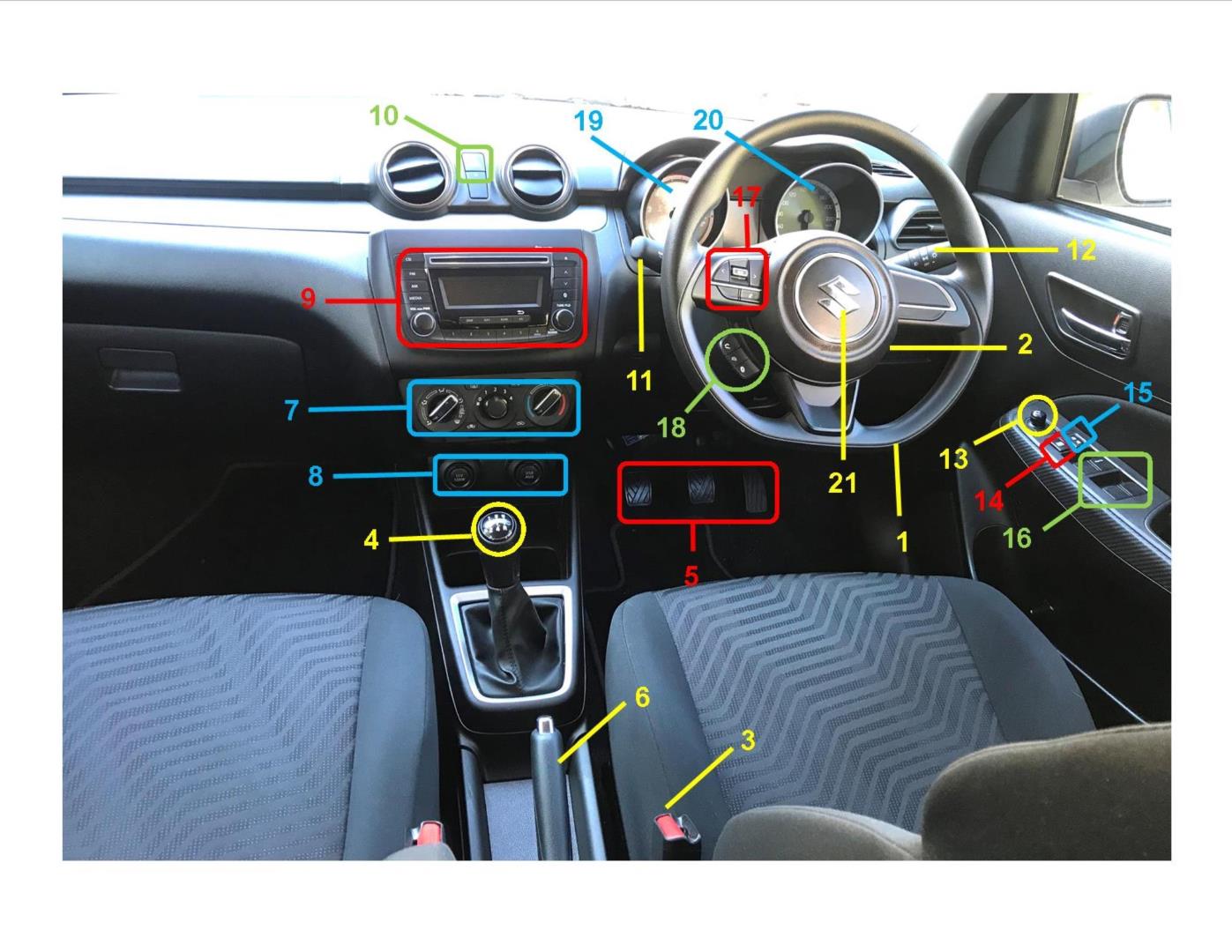
1. Steering wheel. The steering wheel is the control every young boy and many tiny girls have been familiar with since they graduated from a pram to a tiny push-car styled like a Ferrari! To go left you turn the wheel anti-clockwise, to go right you turn it clockwise, and to go straight you keep it steady with the spokes in a horizontal position.
2. Ignition key. The Swift uses a conventional key, and the slot for this is on the steering column on the right hand side, hidden behind the wheel rim in the picture.
3. Safety belt retainers. You need to slide the belt tong into the retainer slot before you set about driving, preferably before you even turn the car on. Safety belts, in conjunction with airbags, save lives and serious injuries in the event of bad accidents.
4. Gear lever. The Suzuki Swift featured here is a manual transmission car. It has five forward speeds and one reverse gear, so follow the pattern on the gear lever to select the appropriate gear – first for pulling off, and the rest for faster speeds. The punchy little engine enables you hold fifth gear in most highway situations.
5. There are thee pedals on the Suzuki, as it is a manual-transmission car. The one on the left is the clutch, and you need to push down on this before engaging first gear, then let it our gradually as you pull away, while simultaneously applying a small amount of engine power. The pedal on the right is the one you need for controlling engine power, commonly known as the accelerator pedal. The one in the middle is the brake, which you press to slow down. You also use the clutch when shifting gears – release the accelerator, press in the clutch, shift gears, then release it smoothly.
6. The Swift uses a conventional handbrake, located between the front seats. Pull-up to activate, release to disengage. To enable both functions, press the little button on the tip in, as you are pulling up or releasing the lever. You use the handbrake to secure the car while it is parked, and also when pulling away on a steep incline. As you feed in the clutch and accelerate, you simultaneously release the handbrake to prevent the car from rolling back.
7. Climate Control-fresh-air controls. These are all neatly grouped in a bunch and are easy to use. You can increase heat in the car, direct fresh air to various parts of the interior, boost the fresh air by increasing the fan speed and push a button to enable air-conditioning.
8. USB and 12V power outlets. These are handy for enabling the playing of music on auxiliary devices, and for supplying a 12 volt power supply for other electric items, using a suitable cable.
9. Audio and infotainment centre. Radio and CD operation, as well as other media functionality, are accessed here. Consult your owner’s handbook for more detail.
10. Hazard warning light switch. Pushing this causes all four indicators to blink, signalling a hazard. Use it if your car is stopped in a hazardous spot, to warn motorists behind of cars slowing dramatically, or unexpectedly stopped in front of you, and other hazards. It has become a custom here to thank slow-moving vehicles who move to the side to for make overtaking easier, by signalling thanks with a quick blink of the hazard lights.
11. Wiper operating stalk. This is located on the left side of the steering column.
12. Lights and indicator stalk. This is located on the right side of the steering column. Push the stalk up to indicate a left turn, pull the stalk down to indicate a right turn. The lights are activated by twisting a knob on the end of the stalk. Push the stalk forward for bright lights, pull back for dim lights.
13. Electronic wing mirror adjustment. This is located on the right door panel. Twist the knob anti-clockwise to activate the left wing mirror. Then twist the knob clockwise to activate the right mirror. Toggle the knob to achieve the right angle of each wing mirror.
14. Window lock. This prevents anyone other than the driver from lowering the windows, when it is in the locked position. Handy when transporting young children.
15. Door lock. Pushing this locks all four doors simultaneously, preventing any unwanted intrusion while you are in the car.
16. Window switches, front and rear. These switches electrically raise or lower all four windows in the car. Front and rear passengers have their own activating switches, but these can be disabled by pushing the “window lock” switch.
17. Remote controls for audio system. These enable you to adjust volume and change the radio station of your audio system while keeping your hands on the steering wheel.
18. Mobile phone control. Hands-free operation for your paired mobile phone, via these switches.
19. Rev Counter. This dial shows you how hard the little Swift motor is revving. The engine has a cut-out at 6 000 rpm. The lower the revs, the better the fuel consumption, so keep those revs down by shifting to a higher gear when possible.
20. This shows you how fast you are going. Obey indicated speed limits, they are generally there for a good reason.
21. The hooter. To be used responsibly, to warn people of your car’s presence. Try not to use it in anger when other road users misbehave.