
Handover day: Isuzu KB 300 D-TEQ double cab LX
Handover day: Isuzu KB 300 D-TEQ double cab LX


By Stuart Johnston
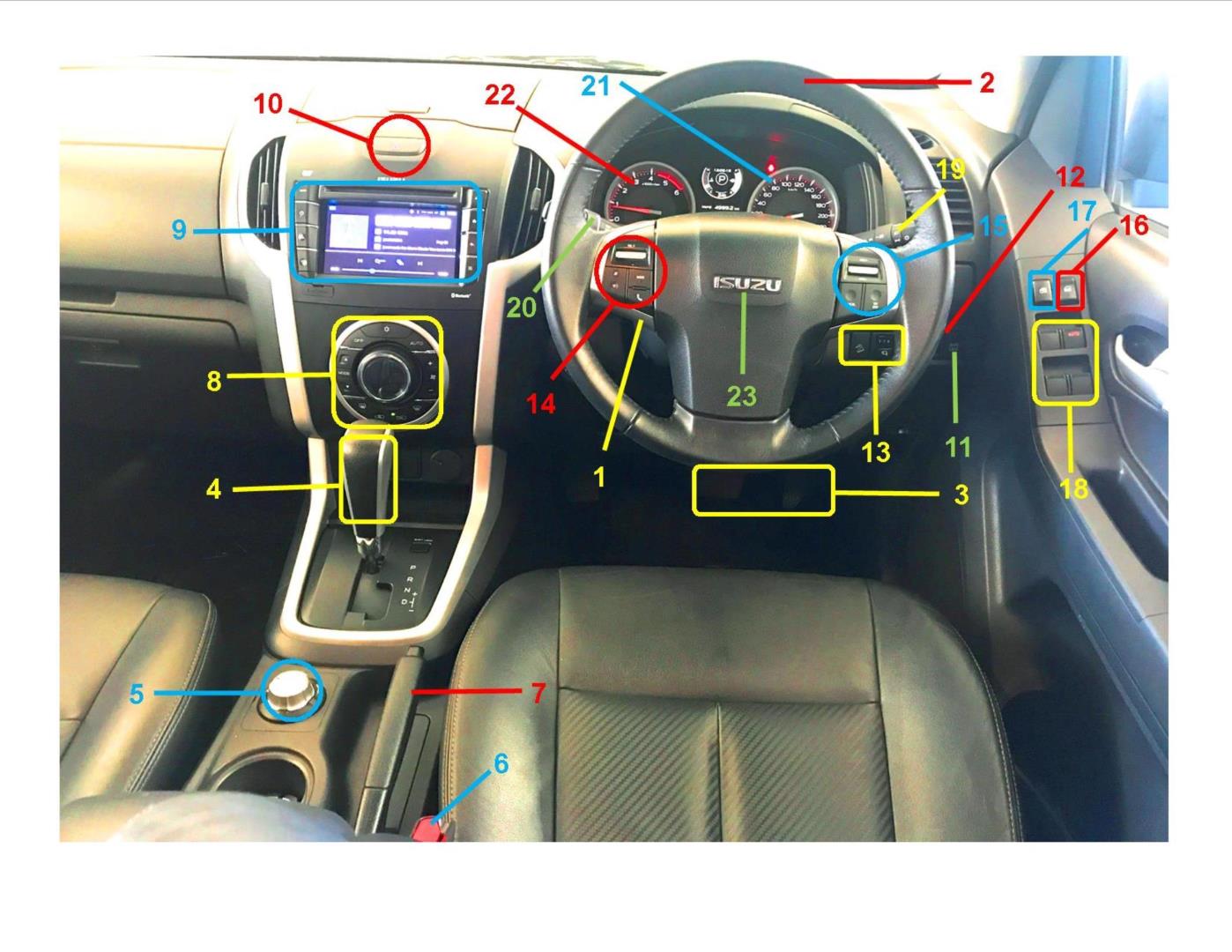
It’s a special moment: You are about to drive away in your brand new KB 300, and hopefully you paid attention to the salesperson’s run-through of all the controls, which take some getting used to. Just in case you didn’t, here is AutoTrader’s refresher course.
The new car we are taking a look at here is actually a double-cab pick up. The Isuzu KB 300 D-Teq LX is one of the more popular double-cabs on the market. Some of the controls we itemise will be commonplace to you, but we include them for the sake of uniformity and clarity. Some of the obscure controls found within the infotainment system, for example, are not included. Here you will need to refer to the owner’s handbook.
1. Stop-Start button. This one is in fact not that easy to spot at first glance! It is located on the dashboard behind the left-side of the steering wheel rim, a little distance below the rev-counter dial. The KB has a keyless go system, so the idea is to place the key-fob in the console, put your foot on the brake pedal, ensure the car is in park, and then push the button to start. You follow the same procedure to switch off the engine.
2. Steering wheel. The most familiar control in the car, its purpose being to maintain or change direction by holding it in the straight-ahead position, or by turning it. The steering wheel is adjustable for height via a lever on the underside of the steering column, so adjust it to your preference before driving away.
3. As this KB 300 LX is an automatic, there are just two pedals. The left-hand side one is the brake and the right-hand-side on is the accelerator.
4. Gear lever. On this automatic model, the lever should be in P for park when the car is at rest. Once the car is switched on, keep your foot on the brake and pull the lever in a rearwards direction, selecting R for reverse gear or D for Drive. You can manually shift the forward gears by drawing the lever to a slot on the right, and pushing forward to shift up, or pull back to shift down.
5. All-Wheel-Drive selector. This rotary control should be selected to the 2WD selection for all normal tar road use. 4WD High should be used for slippery dirt road conditions or slippery tar conditions, such as in a heavy thunderstorm. 4WD Low should only be used for serious off-roading, on trails, in thick sand, and over obstacles.
6. Safety belt location stalk. Develop the vital safety habit of buckling in the belt before even switching the car on. The same should apply to all your passengers.
7. Handbrake. The KB has a conventional pull-up brake, which is very appropriate for this type of vehicle.
8. Climate control cluster. The Isuzu KB300 has a nice large cluster for climate controls that makes it easy to use while on the move..
9. Audio and infotainment control centre. Refer to the owner’s manual for finer operating details.
10. Hazard light switch. To be used when your car has a problem and may be blocking the road, when cars up ahead or slowing suddenly and the drivers behind may not be aware of this, and in very poor visibility situations. South African’s tend to use this switch as a “thank you” when slower cars move out of the way.
11. Diff Lock. This one is hidden behind the lower right side of the steering wheel. A diff lock should only be used in extreme off-road conditions, where wheel-spin is a problem. Using a diff lock on normal tar roads will cause the vehicle to handle strangely and may damage mechanical components. Refer to your owner’s manual on this one.
12. Wing mirror controls. We find it strange that Isuzu has tucked these oft-used controls away behind the steering wheel. Wing mirrors should be set up for an individual driver before driving off.
13. Hill-descent speed control. This is only to be used in off-road conditions where steep drop offs may be encountered. Enabling this switch limits how fast the vehicle may travel down a steep descent (at very low speeds). Refer to the owner’s manual on correct usage.
14. Remote or “active” controls for audio and telephone. This enables you to adjust radio volume, station selection, and operate a mobile phone without taking your hands off the steering wheel, or have your eyes stray far from the straight ahead position, where they always should be focussed!
15. Cruise control switches. For use on long trips on open roads. Refer to the owner’s manual for specific operation.
16. Window lock switch. This switch is used to lock all the windows. Useful for preventing young kids from playing games with the window lifts from the back seat!
17. Door lock switch. This switch locks all the doors from inside the car, useful when traversing crime-ridden areas.
18. Electric window switches. All the windows can be raised and lowered by the driver, using these switches. Passengers have their own switches to achieve the same, but this can be over-ridden when the driver enables the window lock switch.
19. Light switch and indicator stalk, on the right side of the steering wheel. The Isuzu is old-school in this respect, in having the light switch and indicator operations combined in the stalk to the right of the steering wheel.
20. Windscreen wiper control stalk. Controls the wipers and screen washer.
21. Speedometer. Tells you how fast you are going
22. Rev-Counter. Also (and more correctly) known as a tachometer. Lets you know how fast your engine is spinning.
23. The hooter. Use this sparingly, warning people of your car’s presence, rather than in retaliatory anger.