
By Stuart Johnston
Ford Everest new vs used: Top 10 differences
Ford Everest new vs used: Top 10 differences



Ford’s Everest is the Blue Oval’s main contender in the large SUV range here. At the end of April 2019 a large number of refinements were introduced, including new engines and gearboxes for the top models.
Ford introduced the fully-imported Everest SUV in late 2015 and it was well-received as a viable contender to the top SUV seller in the country, the Toyota Fortuner. The next big step in the Everest’s evolution here came after local production began for this luxury SUV in late 2016. For a review of the 2016 Ford Everest, click here.
Being built alongside the highly successful Ranger market at Ford’s Silverton plant outside Pretoria has meant that new improvements to the Ranger are carried over very quickly to the Everest. Thus in late April this year Ford announced a raft of refinements to the Everest that had also been included earlier this year on the Ranger.
Are you going to go new or used with your Everest?
When considering a Ford Everest as your next SUV, and deciding whether to opt for a new or a used vehicle, it is handy to know the differences between the latest model and the one it supersedes. They are very similar in appearance, but there are some visual and mechanical clues to help you differentiate between the new and the older models.
At this point you might like to browse our listings of over 200 used Ford Everests, by clicking here.
Our Top 10 Differences between old and new Everests
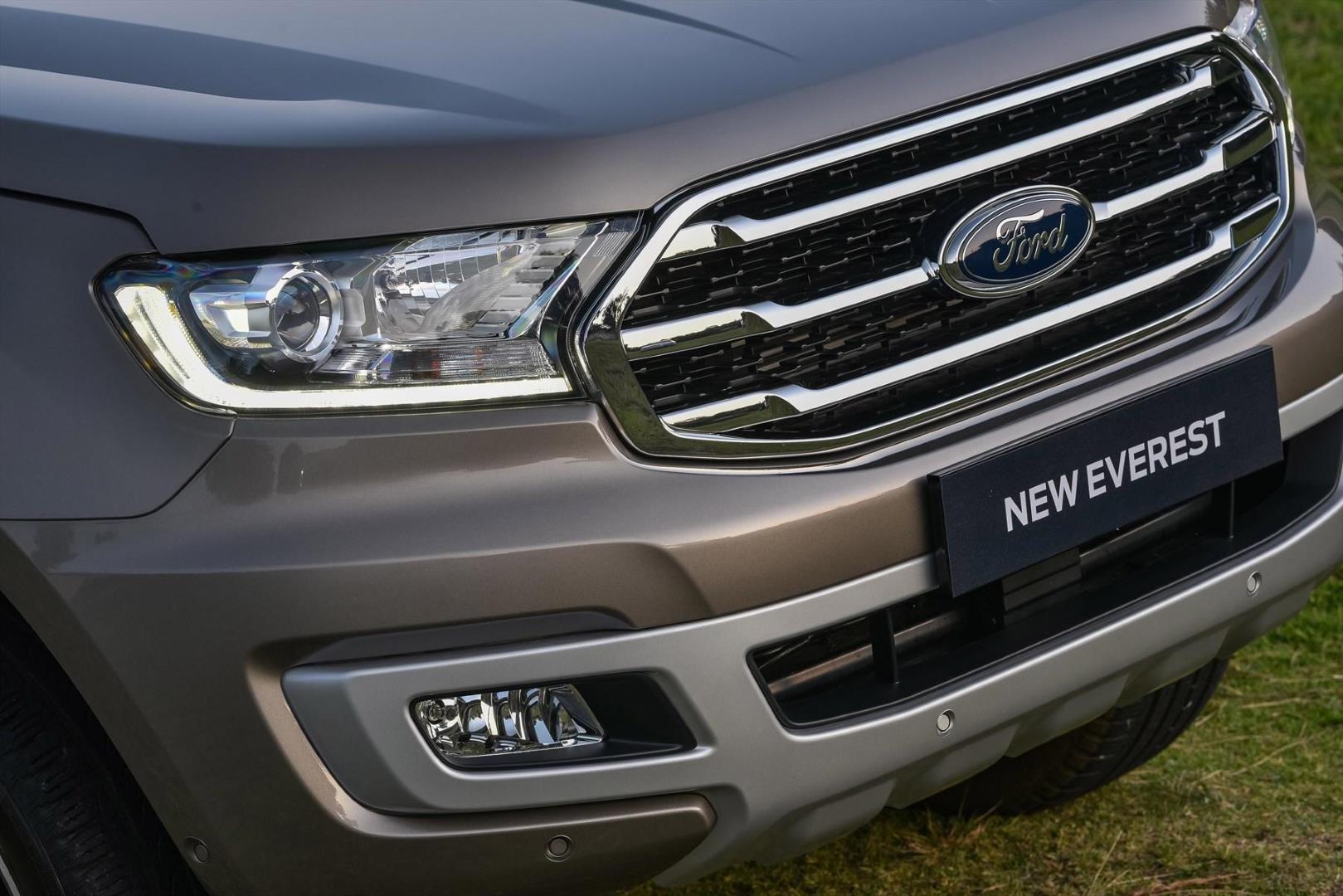
1. The new grille. This is the easiest way to identify the Everest on sale here after late April, 2019. The new grille has three distinctive chrome bars, and a gloss black finish between the bars. The front bumper has also been re-designed, with a reshaped horizontal beam below the grille area.
2. New wheels are fitted to the top Everest Limited model. These are very attractive 20-inch wheels with 12 spokes and contrasted with new gloss black paint.
3. New engines are fitted to the Everest. The top models in the Everest range, the 4WD XLT and the 4WD Limited now get the 157 kW Bi Turbo engine. This has a 2,0-litre capacity and four cylinders, and develops 500 Nm of torque. A new 2,0-litre Single Turbo motor, also with four-cylinders, is available on the XLT rear-wheel-drive model. This produces 132 kW and 420 Nm of torque. The previous-gen turbodiesels, the 2.2 DTDCi four-cylinder, and the 3.2 litre five-cylinder turbodiesel, the 3.2 TDCi, are still offered in the Everest range.
4. The new 2.0 Turbo and 2.0 Bi Turbo motors are mated to an all-new 10-speed automatic gearbox in the Everest. The previous-gen 2.2 TDCi and 3.2 TDCI models, still in the line-up, use a six-speed automatic gearbox, as before.
5. The new 10-speed gearbox used in the 2,0-litre Everest models is identified by a chunky new gear lever in the cabin.
6. New gloss black interior trim highlights feature in the latest Everest line-up, which Ford calls an “Ebony Environment”.
7. An extensively revised front suspension system gives the new Everest a superior ride and sharper handling. The biggest change has been to remount the stabiliser bar (anti-roll bar) behind the axle line. This has enabled softer springs to be fitted for improved ride, while the dampers have also been re-calibrated.
8. The suspension improvements, limiting body roll, have enabled Ford engineers to reduce the recommended tyre pressures from 240 kPa to 210 kPa, further improving the ride quality.
9. Passive entry and starting has been introduced to the Everest. The driver can now gain entry and start the car via the start button while still keeping the key in a pocket or handbag. To start the car the driver merely presses down on the brake pedal and pushes the starter button.
10. In addition to the Adaptive Cruise control, a forward-collision alert function has been added, which now also recognises pedestrians.