
First drive: The never-ending 911 story just got better!
First drive: The never-ending 911 story just got better!



By Stuart Johnston
Porsche’s 911 has been honed to near perfection over a period of 55 years. In this new model report on the latest 911 in Carrera S and Carrera 4S form, we examine what changes have been made and how they bring the new Porsche talisman ever-closer to sports car nirvana.
If you have had any experience of the previous-gen Porsche 911 built between 2011 and October 2018, you may well think that any changes to that car could well run the risk of being counter-productive. How do you improve on a car that already enjoys:
* A superb balance of nimbleness and stability?
*Power delivery that is never brutal but still exciting enough to get your heart racing even as you open the driver’s door?
* An unmatched mix of reliability, practicality and race-track sharp purpose, enabling you to enjoy its wide range of charms all-day, every day?
Bigger wheels
One of the answers to those questions was the fact that Porsche decided to fit bigger wheels to the new car, front and rear. Bigger in diameter, and wider too. What’s more, the rear wheels are 21-inch in diameter, while the front wheels are 20-inchers.
It sounds simple, but to effect this change properly, Porsche had to re-design and re-style virtually the entire body. And while Porsche engineers were at it, they introduced a raft of improvements that have moved the car’s dynamic parameters a significant step forward in other areas.
Looks – a better visual balance
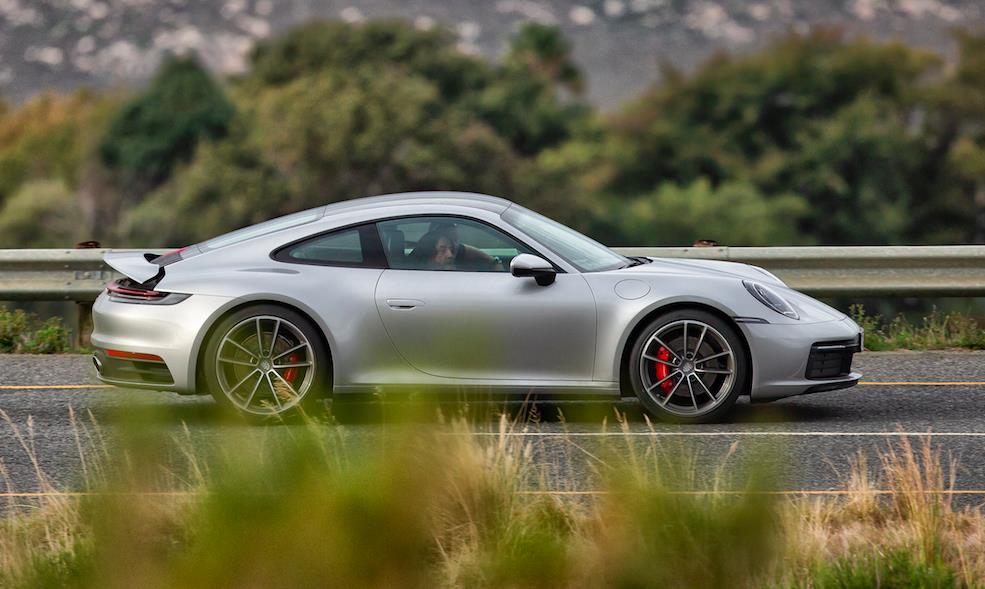
What those bigger wheels mean in terms of looks is that the new body has a better visual balance than before, especially when the car is viewed from side-on, or from the three quarter front or rear angles. The wheel-arches have been enlarged, and filled to capacity by the new large wheels, which means that there is proportionally less sheet metal to behold in relation to wheel-size. Now the more prominent forged alloy wheels take your breath away, wrapped in wider rubber with the tiniest of sidewall profiles.
The tyre sizes, by the way, are 245/35 R20s at the front and 305/30 R21s at the rear.
Wider fenders.
The fenders have naturally been widened to accommodate the wider track (45 mm front and 45 mm rear) , and the re-style has been so gracefully achieved that the flaring of the wheel arches blends seamlessly into the flanks. There is no hint of muscle-bulges indicating a stylistic afterthought. It’s as if the 911 has grown into its new solidity through the benefits of good DNA and hard manual labour, rather than a cosmetically-motivated pumping of iron at the gym.
And of course, every car nut today knows that when it comes to DNA, the 911 has a direct body-shape lineage that goes back further than any other motorcar currently in production.
Straight line stability
According to Toby Venter, Managing Director of Porsche South Africa, what those large wheel sizes have brought to the 911 dynamically is a significant increase in high-speed, straight-line stability. “There is a bigger rubber contact patch on the road, and you can feel that right up to top speed,” says Venter. “The steering at very high speeds is also less reactive over road undulations, so the new car tracks straight and true in effortless fashion.”
A 308 km/h top speed
Top speed may seem like an afterthought in our country where the national speed limit is 120 km/h, but in countries like Germany where there are still long stretches of autobahn with no speed limits, it is important that cars like the 911 behave properly at 300 km/h-plus. And this new 911 easily manages that, being stable right up to its new rated top speed of 308 for the Carrera S and 306 km/h for the Carrera 4S
Significant engine changes
The new car has been given a significant power increase, the re-worked 3,0-litre flat-six engine employing a new system of twin turbocharges that rotate in a mirror image of each other, to smooth out pulses of intake charge on either side of the engine. New piezo-controlled multi-pulse injectors have also been added. The engine also has different valve opening timings for each of the two inlet valves in each cylinder. The one valve has moderate duration and lift while the other has a more “radical” lift and duration, giving the best combination of cylinder filling at both low and high rpm.
And a substantial power increase
The result of all this hard work is 331 kW, 530 Nm of torque and a 0-100 km/h time of 3,7 seconds for the Carrera S and 3,6 seconds for the Carrera 4S. That’s a gain of 22 kW over the previous Carrera S models, and a substantial few 10ths of a second knocked off the 0-100 km/h time.
Driving the new Carrera S, you soon realise the throttle response from lower down in the rev-range is now instantaneous, perhaps more progressive from lower revs yet with a stronger shove in the back at the top end!
New eight-speed dual-clutch gearbox
Part of that quicker acceleration response is due to a new gearbox. All this extra punch is now mated to an all-new eight-speed dual-clutch gearbox, replacing the previous seven-speed item. Porsche were the first manufacturer to develop double clutch manual gearboxes, and this new ‘box comes with paddle shifts that rotate with the steering wheel, as well as a newly-shaped stubby console lever. The gearbox has a lower first gear ratio which explains the quicker response and all the ratios have been revised, the gaps between ratios closer.
You will still be able to order the new 911 with a manual gearbox, and I must confess I am generally very partial to the extra interaction a driver achieves with his car via a manual gearbox. But having said that, this new Porsche dual-clutch gearbox is so good, so immediate in its responses, that it is becoming increasingly difficult to argue the case for a manual gearbox here, given its extra effort required in boring stop-start traffic.
Interior layout
The new dashboard is designed with a crisp, concise, yet substantial sweep of instrumentation and information that extends across a good portion of the dashboard. What is particularly enjoyable is that there are no “add-on” information binnacles that look like after-thoughts in many of today’s cars (such as in the current Mercedes-Benz A-Class). The Porsche comfort and driving dynamic options are all laid out in logical fashion on the screen, and in addition there is a row of buttons below the screen for instantly calling up oft-used functions.
Central to the instrument pod right in front of the driver is a rev-counter red-lined at 7 500. This rev counter also contains a digital speed read-out. The rev-counter is flanked by an analogue speedo that reads in 50 km/h increments and a gauge on the right indicates relevant coolant temperatures for oil and water, oil pressure, electrical charging systems and other vital signs.
Driving it like you own it
The first thing you notice when entering the new 911 is that it has electronically-operated pop-out door handles. Once “popped” via the key fob, these handles grant access to a cockpit that is at once new and also very familiar in layout. It’s not difficult to get comfortable behind the wheel of the 911. And despite its low height, the 911 is easy to get in and out of, even for tall drivers. The seat squab is manually adjustable fore and aft, but there are all sorts of electric adjustments for backrest angle and support.
On the media launch this week in Cape Town and surrounds, we drove both the new 911S and the new 911 4S model, which has all-wheel-drive. In partially damp conditions I appreciated the extra stability imparted by the 4S’s all-wheel-drive system, and I also enjoyed the all-wheel-drive 4S more when braking hard from high speeds, as this system imparts more directional stability.
Special “Wet” mode
It should be mentioned here that the new 911 also incorporates a special wet-weather driving mode that introduces more downforce on the pop-up rear spoiler (located just behind the engine lid). This Wet mode also prevents the actuation of special tail-happy performance-plus driving modes that are available in the S and 4S, and in fact gives a more gentle throttle-response map to the engine.
But most of all
But most of all, I loved the all-pervasive sound of the engine that fills the cockpit when you are hard on the throttle. There is a high-pitched soulful sound to a 911 flat-six that is unmatched by any other engine today. In the new 911 the sound is far from muted. If you select Sport mode, which introduces more exhaust noise, you can forget about selecting your favourite radio station or music playlist. There is no music anywhere that matches a Porsche flat six as it approaches 8 000 rpm!
A snap, crackle and pop
What’s more, on the over-run, when you back off the accelerator from high revs, there is a delicious snap, crackle and pop from the exhaust that evokes images of race-spec 911s braking for the Esses at Le Mans at sunset. All generations of the 911 have been honed on the great race tracks of the world since the 1960s, and Porsche’s engineers are very much aware of this priceless heritage. What’s more, they know how to introduce this essence into a modern 21st century, road-going supercar!
In addition to that exhaust pop, on downshifts the engine is also given a delightful blip that sets the hairs on your neck a-quiver. Porsche reminds you once again that constant tactile and audial interaction between car and driver is one of the main reasons for owning a car like the new 911.
Have there been any compromises?
With the new wheel and tyre combo, high-performance-orientated drivers may bemoan the fact that the steering is now slightly less communicative than it was before. It’s in no way dead and muted, never disconnected, just perhaps a touch less reactive in its responses. It is never stolid; rather the overall feeling is just more solid!
Personally I found the solidity very much in keeping with this new car, which also feels more rigid in terms of chassis torsional strength. Yet it is more compliant over bumpy roads thanks to revised damper rates on the suspension which can be adjusted by selecting various modes ranging from Comfort to Sport Plus. The steering is in fact quicker thanks to a revised, more direct ratio, so although it feel less reactive to, say, road camber changes, it in fact makes the car’s reactions just as quick to inputs, despite the addition of more rubber-contact to the road.
This quicker steering ratio was probably also needed to counteract the greater grip at the rear end, thanks to those larger 21 inch wheels and fatter tyres.
Price
All this refinement, extra power and much better appearance does, however, come at a price. The new car from Porsche has in fact been price-listed by Porsche for a few months now, for a while being listed side-by-side with the previous-gen 991-series Carrera S models. Comparing the old to the new Carrera S and 4S, there has been a substantial increase of R130 000 for the Carrera S and R100 000 for the Carrera 4S.
The latest prices for the new 992-generation car are R1 708 000 for the Porsche 911 Carrera S and R1 797 000 for the Carrera 4S. The price includes a comprehensive three-year/100 000 km maintenance plan.
You might also like to click here to read about the Porsche