
First Drive Impression: BMW 3 Series returns to class dominance
First Drive Impression: BMW 3 Series returns to class dominance



Martin Pretorius
BMW puts great emphasis on the technology available in its new 3 Series sedan (codenamed G20). This is indeed the most advanced 3 Series ever made, with lots of influence from the high-tech 5- and 7 Series models. You can even check some option boxes to specify your 3 Series with semi-autonomous driving features, which will enable the car to move without any driver interaction – true hands-off driving, albeit only for short distances at a time.
Why anyone would want to do this, when the new model is pretty fantastic to drive, is an open question, though. Because here’s the thing: even with all of its high-tech gadgets and available self-driving thingamabobs, the G20 3 Series is a brilliant driver’s car, just as much as it is a flag-bearer for sophistication and refinement.
Evolutionary appearance
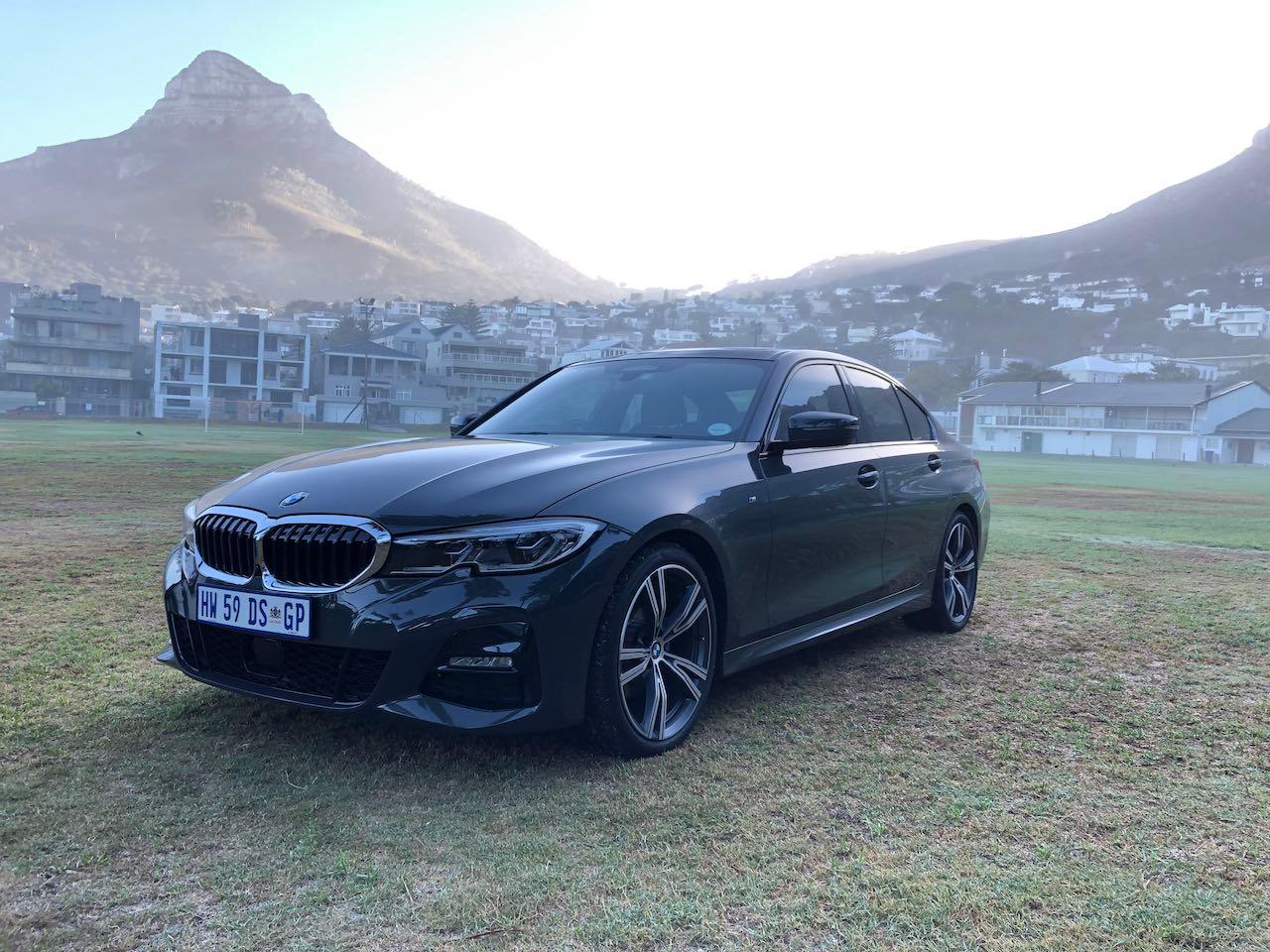
The new 3 Series looks instantly familiar from the moment your eyes first take in the ever-growing kidney grilles. Fortunately, the G20 still escapes the exaggerated electric razor-like visage which will soon feature on all of the brand’s models, but in this iteration, those kidneys are already very noticeable indeed.
But, while the overall appearance looks quite evolutionary, it’s an altogether sharper design, with simplified details and cleaner surfaces than before. The headlight design features a jagged lower edge line, in a flashback to the ghosts of 3 Series past.
Where the outgoing model could look a bit droopy-faced in its lower-trim variants, the new one looks sharp and alert, even when fitted with the simplest bumper- and headlight options. This applies down its flanks as well, where sharper creases and an elongated window line lends it a much sleeker appearance. Of course, BMW’s new design language is familiar by now, having first appeared on the latest 5 Series, but it is applied to the new 3 Series in an even more satisfactory manner.
The only real surprise lies in the rear view, where the tail lights have interesting three-dimensional, lenses to shield their LED light units. However, the L-shaped red elements and flattened outline recalls the current Lexus design language, perhaps mixed with some Audi A3 sedan for good measure. No matter, because the rear-end design elements combine to form an attractive, homogeneous whole, which is likely to age gracefully as well.
It’s all-new under the skin
The G20 casts a slightly larger shadow than its predecessor, being 76 mm longer and 16 mm wider, although its height is almost identical. However, the engineers saw fit to increase the wheelbase by 41 mm (bringing a great benefit to cabin space), and increase the track widths by 43 mm in front and 21 mm in the rear (leading to much-improved handling abilities).
In fact, there’s a clear sense that those engineers expended a huge amount of effort to make the new 3 Series good to drive. Detail refinements stretch to increased use of lightweight materials, giving a weight reduction of up to 55 kg, and a stiffer body shell, as well as an ideal 50:50 front-to-rear weight distribution.
The suspension also debuts a new damper system, which uses clever two-stage shock absorbers in front and sophisticated bump stops in the rear, to smooth out sharper corrugations more effectively. This vastly improves body control during enthusiastic cornering, and even manages to give a 3 Series with the optional 19-inch alloy wheels and M Sport suspension a decent ride quality over all but the worst tar surfaces.
These under the skin refinements may not seem like much at face value, but in combination with items such as the new variable sport steering (part of the M Sport suspension packages) and stiffer suspension subframes all round, they add up to a major advancement for the 3 Series.
Other available tasty tidbits include an M Sport differential (for 330i and 330d variants), M Sport brakes (with larger discs and blue calipers), and a refined development of the optional adaptive suspension.
Thanks to that increase in size, the new 3 Series is a bit more spacious than the outgoing model, with rear-seat passengers deriving the most benefit from the new car’s growth spurt. Shoulder- and head room all round is improved, there’s more leg- and knee room in the rear, and the larger door apertures make it easier to enter and exit the cabin.
Advancing the electronic arts
Featuring BMW’s newest operating system, and paired with the latest digital cockpit hardware and infotainment systems, the new G20 is a veritable tech fest inside. The digital instrument display is particularly impressive: with high-resolution colour graphics and an attractive, simplified user interface design, it’s a genuine pleasure to peer through the steering wheel rim.
The infotainment is similarly impressive, with crystal-clear display quality and a much-simplified iDrive interface, combined with a responsive touchscreen input to complement the console-mounted rotary controller, touchpad, and gesture control.
Being a BMW, you can also have a host of added gadgets, such as the BMW Intelligent Personal Assistant (which is supposed to respond to a “Hey BMW!” command, but ignored all my attempts to rouse it from its slumber), as well as the expanded Connected Drive. We’ll reserve judgement on the user-friendliness of these gadgets until we’ve had more exposure to them, but they sure looked very impressive in the demonstration videos...
The list of technological advancements doesn’t end there, either: the optional head-up display now has a 70% larger display area than before, and adaptive LED headlights are standard (with BMW Laser headlights as options). The Parking Assistant Plus (again, optional) won’t just steer you into an open parking bay, but it can also reverse up to 50 meters all by itself, precisely tracing the same route as the driver used when driving into, say, a congested parking area. 360-degree cameras and all the latest safety features are obviously available as well.
Launch range
For now, buyers will only have the choice between two 2.0-litre 4-cylinder engines in the 320d and 330i variants, both exclusively mated to an 8-speed automatic gearbox, and both with an introductory price of R649 000 before options or trim packages. While these engines are closely related to the units in the outgoing model, extensive revisions have resulted in reduced fuel consumption, improved refinement, and wider power bands.
The 320d now features a sequential twin-turbo arrangement (instead of the old single-turbo setup), and while it produces the same 140 kW and 400 Nm as before, the torque comes on song sooner and the top-end power delivery is more consistent. The 330i (still with a single twin-scroll turbo) receives a small power boost and a chunk of extra torque for new peak values of 190 kW and 400 Nm.
From the third quarter of 2019, a 320i with 135 kW and 300 Nm will join the range, as will the 330d, which uses a 3.0-litre turbodiesel to produce 195 kW and 580 Nm. Also under consideration is a 330e Hybrid (if there’s enough demand), but a sure-fire certainty is an all-new M340i xDrive (with all-wheel drive and every possible chassis trick), which, given its outputs of 275 kW and 500 Nm, should be an absolute beast.
What’s it like to drive?
I had opportunity to drive both the 320d and 330i during the launch event in Cape Town. These cars were near-identical in specification, with the M Sport package and optional 19-inch alloy wheels (17-inch wheels are standard), but without the fancy differential or adaptive suspension.
Within the first kilometer or so, it became obvious that the new 3 Series is a thoroughly-engineered machine which represents a solid step forward from its predecessor. This is apparent in things like the control weighting (even those of the minor switchgear), engine- and gearbox programming, suspension tuning, and overall refinement levels, all of which present substantial improvements on the old car’s efforts.
First off, the 320d
After driving a 280-ish km route around the Cape Peninsula, with plenty of dense traffic, some freeway cruising, and lots of twisty roads, we returned the 320d with around three-quarters of the fuel tank still remaining, so less spirited driving should easily net a 1000 km fuel range in normal use. The 320d is very frugal indeed.
It’s also very good to drive. With a torque band starting before 1500 r/min and that slick-shifting gearbox (also updated for the G20) keeping the engine in its optimal range, performance is pretty amazingly rapid for a 2.0-litre turbodiesel. Actually, it’s pretty rapid, full stop. The 0 – 100 km/h dash is dispatched in a claimed 6.8 seconds on the way to a top speed of 240 km/h, and the seat of the pants sensations suggest that these figures could be quite accurate.
The suspension tuning in M Sport trim, along with those sexy 19-inch alloy wheels and very low-profile tyres, made for prodigious grip, and while the ride is quite harsh over broken surfaces, comfort levels are generally good. Sensible buyers might want to forgo the firmer suspension and settle for smaller rims, however, as the ride quality in that trim should be much more compliant. As it is, however, the comfort levels are far superior to the old car’s efforts in similar configuration.
But, along with the firmer ride comes a finely tuned handling balance, which encourages enthusiastic driving. Body motions in corners are particularly well-controlled, and the sheer grip on offer makes for great resistance to both under- and oversteer. The steering is nicely weighted as well, and feels significantly more accurate than before. All those chassis changes and clever dampers really do work a treat.
As for refinement, occupants are seldom aware that there is an oil-burner under the bonnet, unless they open a door to hear the clatter – such is the standard of noise insulation built into the new car. Gearshifts are quick and unobtrusive, especially with the Sports Automatic gearbox with its steering wheel-mounted shift paddles. Not that you need to use them often, mind you - the gearbox is programmed to be both well-behaved and intuitive.
And the 330i?
This one is a bit of a flyer as well. In fact, this is easily the quickest car to ever wear this nameplate, and will probably shame the full-fat M3 of 15 years ago. The 100 km/h marker zips by in a claimed 5.8 seconds, with a limited top speed of 250 km/h. Again, subjective impressions suggest that these figures should be quite accurate, but even more impressive than that is the nature of the power delivery.
Peak torque arrives at 1 550 r/min, and the power only drops off after 6 500 r/min, giving a very wide power band and a rev-happy nature. Driving the 330i over the exact same route as the 320d on day two of the launch event, the power difference from the lower-rung variant became clear.
The same cautions arose from the identical suspension tuning, of course, but the same advantages also applied in spirited driving. Everything just happened so much quicker in the 330i, but that same built-in athleticism was present and accounted for. Speaking from a personal perspective, the excellent handling almost justifies the firmer suspension...
Redesigned cabin
The redesigned interior deserves an honorable mention as well. The control layout and appearance are both nicely simplified, and the material quality is generally of a high standard. Both of the sampled cars wore leather seat trim and soft-touch upper dash and door cards, all black in colour.
Blue stitching provided some discreet contrast, but in the end, only the attractive aluminium switches and discreet brightwork accents kept the cabins from looking too somber. Adventurous buyers could always look at some of the customizable trim options in the order book, of course.
Verdict
The G20 3 Series moves its nameplate along very nicely indeed. It’s more comfortable and better to drive than its predecessor, and more spacious and quicker as well. And, with redesigns of its competitors still years in the future, the chances are that it will continue its predecessors’ dominance in the compact executive saloon market for quite a while. This brings us back to the original question: in a car this nice to drive, do you really want a computer to do any of it for you?