Citroën has always been a quirky brand, delivering products that don't fit the current design or style aesthetic, choosing instead to march to its own beat and bring oddball vehicles to market. This is not a new plan, and over the years, we've had some interesting motors to discuss. The first of many Citroën industry firsts was the Traction Avant, which introduced three revolutionary features still in use today: a unitary body without a separate frame, four-wheel independent suspension, and front-wheel drive. Next up was the 2CV, pioneering a very soft, interconnected suspension. This car remained in production with only minor changes until 1990 and was a common sight on French roads until recently; 9 million 2CV variants were produced from 1948 to 1990.
Related: Citroen C3 – A leaf from Cactus, A brush from Picasso
1955 saw the introduction of the DS, the first full use of Citroën's hydropneumatic self-levelling suspension system, and then there was the CX in the early 1970's, with its Spaceship dashboard and rotating drum speedometer in Series 1. Over the last decade, we've had some truly oddball models like the diminutive C1 and the bold C4 Cactus. All this history leads us to today, where Citroën is once again pulling a weird and wonderful rabbit out of its hat, introducing a coupe-style version of the popular C3 Aircross. This is the Basalt.
Citroen C3 Aircross (2024) First Drive Review

Styling

Engine and Drivetrain
Under the bonnet is the familiar Puretech 1.2-litre turbo engine coupled to a 6-speed automatic transmission. The combination delivers 81 kW and 205 Nm of torque from 1 750 r/min. It’s a 3-cylinder, so there is a slight thrum and vibration at idle, but once the turbo kicks in, it pulls strongly. While most cars in this segment use standard dampers, the Basalt features Citroën’s Advanced Comfort Suspension. It utilises Progressive Hydraulic Cushions (PHC). Unlike a traditional suspension that uses mechanical stops to limit travel, Citroën adds two hydraulic stops on either side, one for compression and one for rebound.

Technology
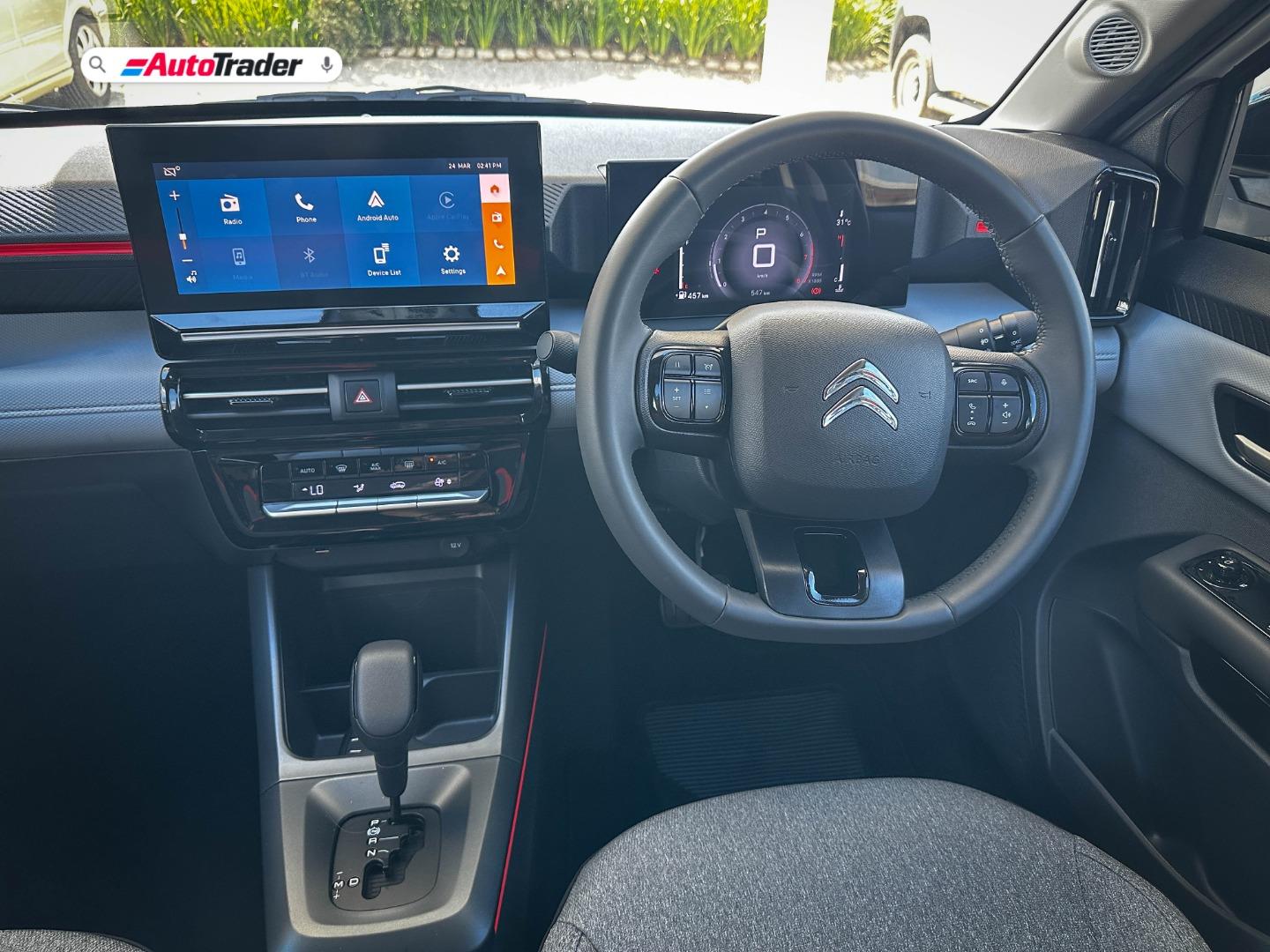
Inside the Basalt, you will find a lot of the same tech that you get in the rest of the Stellantis range. It's all high quality and falls easily to hand.
• 10.0-inch Citroën Connect floating touchscreen
• Wireless Android Auto and Apple CarPlay
• 7.0-inch digital instrument cluster
• Cruise control with speed limiter
• Keyless entry with proximity sensing (Proxi-Sense) and push-button start
• Electric windows all round
• Electrically adjustable and folding exterior mirrors
• Practical interior storage solutions
• Automatic air-conditioning with rear vents

Safety
The Basalt scores highly in the Bharat NCAP, pulling 4 stars in the Indian rating system, which is on par with Global NCAP and #SafercarsforAfrica. The Basalt retains that score because of the following:
• High-strength body structure
• Six airbags as standard
• Electronic Stability Programme (ESP) and Hill Hold Control
• Tyre Pressure Monitoring System (TPMS)
• Rear parking sensors
• ABS with Electronic Brakeforce Distribution
• Two ISOFIX child-seat anchor points

The Drive

Models and Pricing
Citroën Basalt PLUS 1.2 Turbo 6-Speed AT | R 354 900.00 |
Citroën Basalt MAX 1.2 Turbo 6-Speed AT (as tested) | R 369 900.00 |
The Basalt comes with a 4 Years / 60 000 km Service Plan and a 5 Years / 100 000 km Warranty

Verdict
The Basalt is a comfy drive if you prioritise ride comfort and road presence above all else. It feels more expensive to drive than its price suggests because of the stellar suspension, but if you want a sunroof, 360-degree cameras, or a ventilated seat experience that rivals the Korean or Chinese competition, you may be a little disappointed. It’s a driver’s car for those who value mechanical comfort over digital luxury. We are looking forward to spending some proper time with the Basalt in the future, so keep an eye on our reviews section.