
Car Comparison: Volkswagen Arteon vs. Audi A5 vs. BMW 4 Series
Car Comparison: Volkswagen Arteon vs. Audi A5 vs. BMW 4 Series




By Martin Pretorius
Notwithstanding the fact that the definition of a coupé has been twisted beyond recognition over the past decade or so, there's still a certain cachet to the term – even if it is applied to a spacious car with four or five doors. Product planners were quick to jump at the opportunity to roll out four-door versions of their sportier mid-range coupé offerings, and then giving them sexy-sounding names. Take today's two challengers as an example: the fastback, four-seater Audi A5 (related to the A4 sedan) is called a Sportback, and BMW's fastback, four-seater 4-Series (related to the 3-Series sedan) is called a Grand Coupé. Nice.
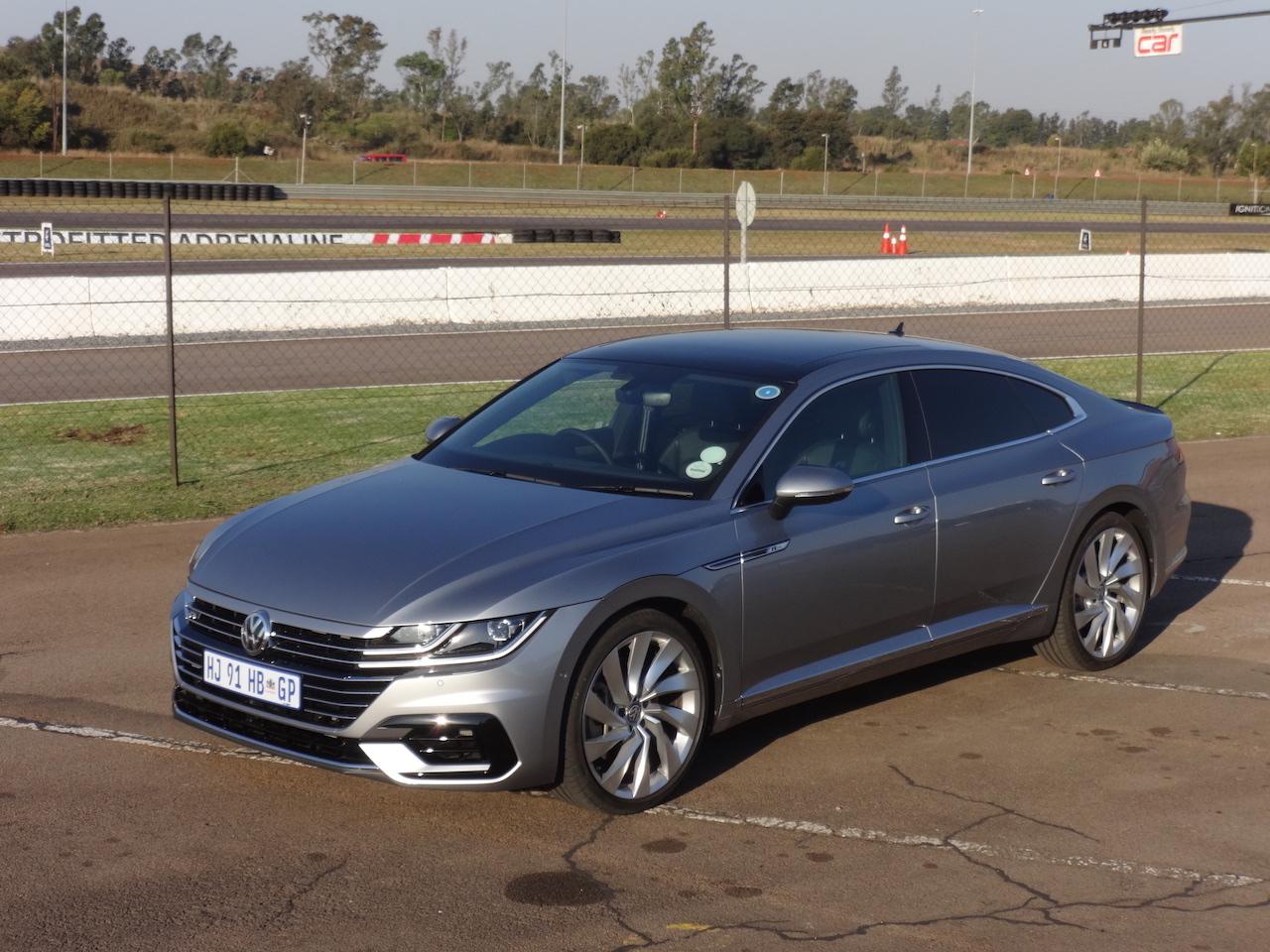
Volkswagen was probably even more audacious, though. Rather than call their new offering (related to the Passat sedan) a coupé, they've decided that their Arteon is really a Grand Touring car. But guess what? It's still really a four-door coupé, with fastback styling and four comfy seats and everything. But, even with its slightly grandiose name, the Arteon poses a serious challenge to both the Audi and the BMW. We've selected the top-spec Arteon 2.0TSI 4Motion R-Line, and we compare it to the BMW 430i GC M-Sport Auto and the Audi A5 SB 2.0 TFSI quattro Sport.
|
Arteon 2.0 TSI 4Motion R-Line |
A5 SB 2.0TFDI quattro Sport |
430i GC M-Sport Auto |
|
|
Engine size |
4-cyl, 2.0-litre, turbo-petrol |
4-cyl, 2.0-litre, turbo-petrol |
4-cyl, 2.0-litre, turbo-petrol |
|
Power/Torque |
206 kW/350 Nm |
185 kW/370 Nm |
185 kW/350 Nm |
|
Kerb Weight |
1 716 kg |
1 535 kg |
1 540 kg |
|
Length (mm) |
4 862 |
4 733 |
4 638 |
|
Wheelbase (mm) |
2 841 |
2 824 |
2 810 |
|
Airbag count |
7 |
6 |
6 |
|
Ave Consumption * |
7.3 ℓ/100 km |
6.2 |
5.5 ℓ/100 km |
|
Warranty |
3-yr/120 000 km |
1-yr/Unlimited km |
2-yr/Unlimited km |
|
Price |
R 699 900 |
R 764 000 |
R 769 839 |
*Manufacturer's official figures.
Analysis
The bare specifications tell much of this story: The Arteon is the biggest of these three, with the most power, and it costs the least. But once you dig a little deeper, some other facts will grab your eye. Both the Arteon and A5 SB are equipped with permanent all-wheel drive, while the 430i GC is only available in rear-wheel drive configuration on the South African market.
But, just because the A5 and Arteon come from the same manufacturing group (VWAG), doesn't mean that they use the same hardware. In fact, their platforms are completely different, with the Arteon using the MQB platform (shared with the Golf, among others) with its transversely-mounted engine and Haldex-based AWD system. The Audi rides on the MLBevo platform (as used in the A4 and Q7), which uses a longitudinally-mounted engine and “genuine” quattro AWD. So while they're related, that relationship is rather distant.
The Volkswagen Group products show two interesting discrepancies: The Arteon is significantly heavier than the other two, even though it uses a (theoretically) more weight-efficient layout, while the A5 SB is in turn just about as light as the RWD BMW, even with the added weight of the Audi's AWD system. This difference cannot be due to their engines, however, as they all employ 2.0-litre turbo charged petrol 4-cylinder mills.
The Audi and BMW have identical power outputs (185 kW), with the Audi's engine giving slightly more torque than the BMW (370 Nm vs 350 Nm). The Arteon has a healthy power advantage, though: its 206 kW comfortably out-muscles the other two Germans, even if it just matches the BMW on torque output. Unfortunately, much of that advantage will undoubtedly disappear under the Volkswagen's 180 extra kilograms of body mass.
As a result of its weight disadvantage, the Arteon's performance should just match the others, partly thanks to its 7-speed, twin-clutch gearbox. There's a similar transmission hidden inside the A5 SB as well (although it's of a completely different design), while the BMW 430i GC trumps them both in the gear count with its 8-speed torque converter automatic gearbox.
Shift paddles are of course present in all of them, but the BMW's more-conventional gearbox just misses out on the quick gearshifts of both the Volkswagen and the Audi. The BMW should prove to be significantly more frugal, however, and its official consumption claim shows the advantage of having only two drive wheels rather than four, together with (barely) the lowest kerb weight of this trio.
As far as equipment goes, the Arteon matches and passes the other two, with features such as a panoramic sunroof, VW's digital dashboard, and advanced LED exterior lights coming as standard at this trim level. As with all German cars, some option boxes need to be ticked to get the nicest things (such as the head-up display), but there's no doubt that the basic Arteon carries more equipment than the other two does. It's also significantly more spacious inside, and has a much larger boot than either of the others as well.
And then we get to the price: with the Arteon (just) squeezing in below the R700 000 mark, it represents a lot better value than the Audi or the BMW. It's better-equipped, more powerful, roomier, newer, and a lot less expensive. The only downside to choosing an Arteon over an A5 SB or a 430i GC is that it carries a less-prestigious badge. Smart shoppers will likely grab their Arteons right away, but that “badge factor” alone will probably be enough to keep the snobs from appreciating the excellent, stylish and high-tech Volkswagen. That's rather sad, really...