
2018 Ford Fiesta is packing some heat!
2018 Ford Fiesta is packing some heat!



By Farzana Chaumoo
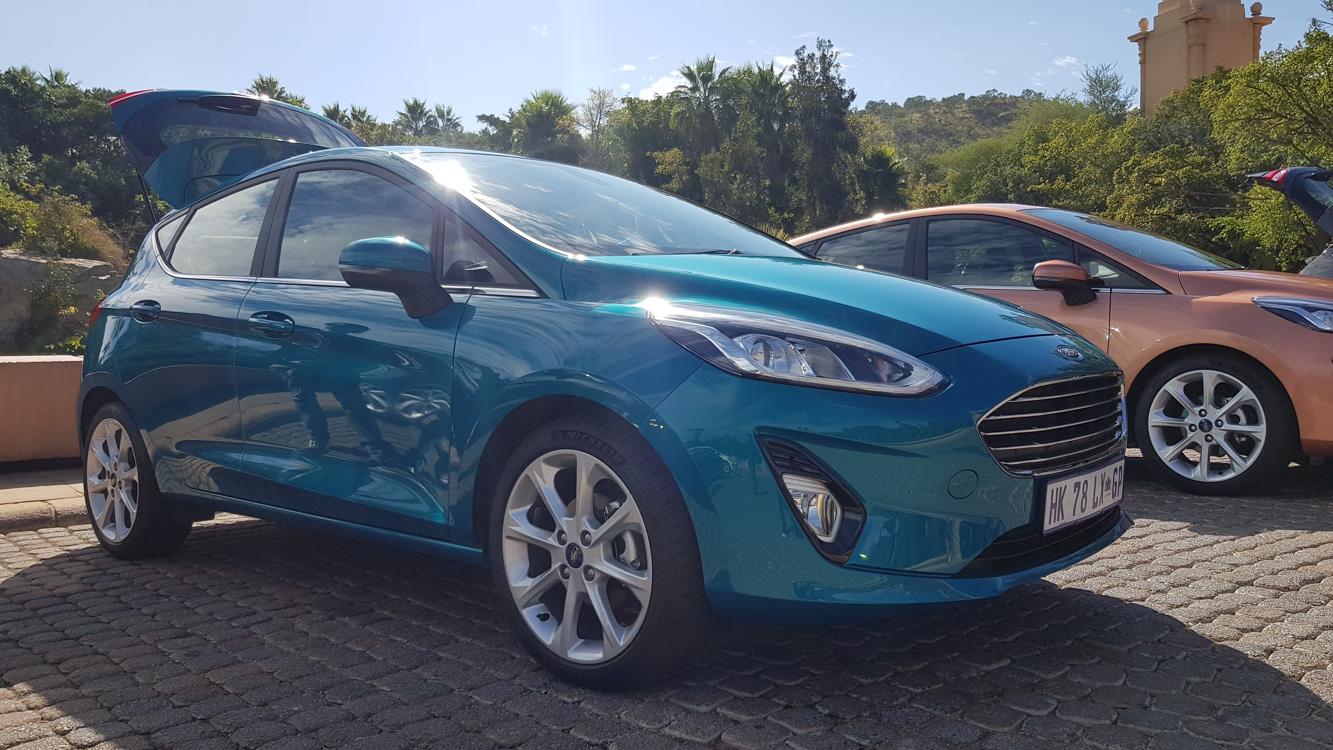
Ford’s all-new Fiesta is set to raise the bar in the compact car segment. The new generation model is not just cosmetically enhanced but changes have also been made to safety, technology, refinement, and drivability.
There’s just so much greatness about this all-new Fiesta, and so much detail in the technicalities of how and why the Fiesta has been changed, that I may need a few pages to run through the list. But I’m going to try and keep it short and sweet, like the all-new Fiesta. However, if you are interested in this vehicle - interact with us online, interact with Ford or speak to someone at a Ford dealership who can go into further details. You’ll notice in the images some information regarding the new dimensions, safety features, and model highlights pertaining to each trim level.
Engine
Getting straight to the power of things, the latest Fiesta retains its six-time International Engine of the Year award-winning engine, the 1.0-litre petrol EcoBoost. This engine is fitted in two variants: Trend and Titanium. Manual cars are equipped with a new six-speed manual gearbox instead of the old five-speed transmission, with an improved gearshift quality.
Both Trend and Titanium variants are also available with a conventional six-speed torque converter automatic transmission, which replaces the old model’s dual clutch transmission. The reason Ford opted for the torque converter was because of the smooth gear changes, and it indeed works exactly as intended. The 1.0-litre EcoBoost puts out 74kW of power and 170Nm of torque in Trend specification (or when mated with the automatic gearbox), while the Fiesta Titanium in manual guise uses a 92kW version of this engine.
On the diesel front, there’s a 1.5-litre TDCi turbodiesel that’s been exclusively paired with a six-speed manual gearbox. I would’ve expected more power on this one, but never the less, it puts out 63kW and 175Nm of torque.
The Cars and the Drive
As I headed for the launch, an early 2000s (or possibly even older) Fiesta appeared on the road in front of me. It couldn’t have been better timing to see an old one right before the all-new one, to witness the major transition from where it began. This evolution has kept it at the top of the sales charts in Britain for decades. Meanwhile, here in SA, Ford has sold more than 145,000 units since the Fiesta first arrived in 1997.
After a hearty lunch at the Culinary Table in Lanseria, we journeyed out to Sun City through Brits. On day 1, we drove the 1.5 TDCi. Day 2 had us travel in the auto 1.0 EcoBoost Titanium for the return journey back to Lanseria. Both cars have extraordinarily smooth gearboxes, and pretty decent acceleration. Cabins take in a bit of road noise, but engines are practically silent: this has to be one of the quietest cars in its class.
Fuel consumption was equally impressive. Our 1.0-litre claims a 3.3L/100km average figure (hard to believe right?), but we managed a 4.1L/100km average on the test route. On the 1.5-litre diesel, claimed fuel consumption was 5.2L/100km, while we managed 6.6L/100km. With the constantly increasing fuel price, which is about to hit over R15 a litre in June, figures like these become even more attractive.
The 1.0 Titanium had a very premium feel inside, with soft touch materials used all around. Our 1.0-litre was equipped with navigation which, once you go over the speed limit for that area, would show your speed in red on the screen. Buttons and knobs all have a good touch-and-hold feeling. Ford have designed a cover to hide screws inside so there aren’t any visible ones, and there is a one-piece main console. Seats are very comfortable, and now feature available heating as well. The steering wheel is height and reach adjustable, and visibility from the driver’s seat is very good.
The only little gripe I can muster up against this car is that legroom in the rear is rather limited, and the boot space is also subpar. However, space in the front is laudable.
What’s new?
Aside from the obvious new bumpers, grille and lights, a rear view camera is now fitted as standard and keyless entry and keyless go is a new feature. On the engineering front, body stiffness has been increased by 16 percent, and in addition to the new bigger tyres, handling and ride comfort has been significantly improved. The design of the car also has better aerodynamics and assembly quality. There are also two new colours available, named Blue Wave and Chrome Copper.
In the cabin there has been a reduction of buttons by 50 percent, which fits nicely with the ergonomic plan of the car. A 2.3-inch cluster display shows driver information right in front between the two dials. You will notice the doors also have a more robust feeling than before.
Ford’s SYNC 3 infotainment interface is available in the all-new Fiesta, and features navigation, voice control, colour graphics, and Apple CarPlay and Android Auto smartphone integration. Waze, with live traffic updates, will soon be available on the system as well. This displays on a touchscreen which measures either 6.5-inch or 8-inch. Power windows and cruise control are also part of the package.
Rivals
The Fiesta’s biggest rival is the Volkswagen Polo. Both models have been replaced by all-new versions this year with dramatic changes done. The Fiesta is leaving behind it’s entry-level status for a more premium one. Is that not the aspiration of every human being? Well, cars have them too, and the Fiesta has made it.
Even though the Fiesta is based on the outgoing model’s platform, significant mechanical changes have been made. These changes include a chassis that offers 10% more cornering grip, a 10kg lighter suspension (benefitting fuel consumption), an 8 percent improvement in the braking distance at 100 km/h (thanks to a new brake system and tyres), the addition of Eco Stop/Start, and better cabin ergonomics.
The all-new Fiesta aims at offering as standard what the Polo offers as optional. Let me break it down between the Fiesta 1.0 EcoBoost Trend and the VW Polo 1.0 TSI BlueMotion Comfortline:
Selling price: R261,000 (Fiesta) vs R281,793 (Polo). In terms of what the Fiesta is offering, the Polo will give you all that, but for an additional R17,093 (included in the aforementioned price). The Fiesta offers 4kW of more power, 16-inch alloys (vs 15-inch on Polo), six-speed manual (over five-speed in Polo), Rear Parking Sensors are standard (Polo PDC +R3,177) and Automatic headlights (+R3,884 in Polo). Furthermore, the Fiesta has SYNC 3 with a 6.5-inch touchscreen and 6 speakers, whereas the Polo’s infotainment system upgrade sells for an additional R5,297. Ford also offers a standard four-year warranty and four-year service plan over VW’s three-year warranty and optional three-year service plan.
Other rivals include the KIA Rio and Hyundai i20/Accent.
Verdict
Trims are fundamentally similar to the outgoing car, but the all-new Fiesta is a very practical car with a great list of standard equipment. It handles very well and has extremely good stability on the road. With an 87 percent score, it even has a 5-star Euro NCAP rating for safety. The 2018 Fiesta would indeed appear to be a fun, stylish and inexpensive car to own.
Pricing:
Fiesta 1.0 EcoBoost Trend 6MT R261 900
Fiesta 1.0 EcoBoost Trend 6AT R277 300
Fiesta 1.5 TDCi Trend 6MT R292 500
Fiesta 1.0 EcoBoost Titanium 6MT R295 900
Fiesta 1.0 EcoBoost Titanium 6AT R310 600
All models come standard with Ford Protect, comprising a four-year/120 000km comprehensive warranty, three-year/unlimited distance roadside assistance and five-year/unlimited km corrosion warranty. A four-year/60 000km service plan is included, with 15 000km service intervals.