
The new Passat the high-tech business class car from Volkswagen
The new Passat the high-tech business class car from Volkswagen


Clarity and power bridge over to the next higher class: Passat shows more presence, exclusivity and dynamism than ever
- Sporty proportions with longer wheelbase but nearly the same length over all
- Innovative interior with new ventilation layout and powerful light staging
Wolfsburg / Potsdam, July 2014. With the debut of the new Passat, Volkswagen is revealing a design that combines stylish clarity with a high level of impressive power. Clarity and power – these two elements merge on the exterior of the eighth-generation Passat to create a design that conveys exclusivity. A design that is not simply fashionable, but is contemporary. A design that is not whimsical, but is expressive. A design in which every line has a purpose. A design that will be influential in its era. While preserving all of its functional virtues, the Passat has gained noticeably in presence, exclusivity and dynamism. In the new Passat, Volkswagen has made a saloon car and an estate car with clarity and power that bridge to a higher class. As the most successful German business car, the Passat represents a new type of business class – a transition car between the mid- and premium classes and between the B and C segments.
Stylistic evolution of a model series
Initial situation. Volkswagen has been perfecting the Passat for over four decades. Internally, the now eight generations carry the designations B1 through B8. At Volkswagen, the B stands for the B- segment to which the Passat belongs (mid-class cars), and the number indicates the car's generation. In retrospect, the car's styling was primarily influenced by the B1, the original model of 1973, and all of the generations from the B5 (1996) onward. Volkswagen introduced a paradigm shift in the Passat B5. While all previous Passat generations were balanced multi-talented cars that offered a high level of comfort, very good everyday features and above- average space, with this generation the quality and design made a leap forward, positioning the Passat in the top league of its class and making it the most successful business car. This path was consistently and successfully followed up by the B6 (from 2005) and the B7 (from 2010). Currently, the Passat – including its derivatives that were individually tailored for the Chinese and American markets – is, as noted, the most successful car of the brand and the Group with over 1.1 million units produced.
Breathtaking proportions. In light of this history of success, Klaus Bischoff, Volkswagen Head of Design, and his team posed the following question as they began to work on the B8: "What do we need to do to make a world's best-selling car even more visually attractive? There was a clear answer: "Breathtaking proportions." The team was able to realize this goal more consistently than ever, because an entirely new design platform was made available for the Passat for the first time in the modular transverse matrix (MQB). Although it is nearly as long as the previous model, the car's wheelbase grew by a considerable 79 mm; the front and rear wheels were made larger and are now positioned further out to the sides, making it possible to shorten the body overhangs significantly. At the same time, the Passat was made lower and wider. Because of the optimised engine orientation, it was possible to significantly lower the bonnet and shift the windscreen towards the rear. This "cab backward design" with mature saloon proportions resulted in a very long bonnet look with the impression of a premium-class model. It was also clear that the new Passat should get dynamic proportions. But that did not define the entire style of the design, the orientation. Klaus Bischoff: "In the new Passat we wanted to make a formal jump to the next higher vehicle class. Our objective was to sculpturally develop the potential of this vehicle into a business saloon. What was important for me was to develop significant design themes that radiate an impressive visual presence and express the powerful sporty character of the new Passat."
Exterior design and details
Dimensions. The Saloon is 4,767 mm long and therefore 2 mm shorter than the previous model. At the same time, its wheelbase was lengthened by the aforementioned 79 mm to 2,791 mm. The front wheels were shifted 29 mm towards the front bumper, and the rear wheels 17 mm towards the rear bumper (the occupant cell was lengthened by 33 mm). The result: shorter body overhangs (67 mm less at front, 13 mm less at rear). At the same time, the Passat was made 14 mm lower (1,456 mm) and 12 mm wider (1,832 mm). These dimensions enabled a ratio of proportions that provided ideal conditions for creating a design that was as powerful as it was exclusive.
Side profile with a distinctive character line. Those encountering the new Passat for the first time will notice that the car is not a typical mid-class car based on its design; the style would also be appropriate for a car in the upper mid-class or premium class. The exclusive image of the new Passat was achieved in part by a wide variety of extremely precisely drawn edges and creases which develop individual light-reflecting surfaces. Especially distinctive in side profile is the area between the window sill (beneath the side windows) and what is known as the character line (at the height of the door handles). Here, the creases and edges in the upper area of the side panels merge to form a horizontal surface from which – viewed from front to back – the distinctive and athletic shoulder section of the Passat develops. The character line starts at the front as a lengthening of the upper headlight border into the wing, and then it is briefly interrupted by the prominent front wheel arch and then rises slightly but continuously as an actual shoulder line toward the rear (the windows and roof pillars slope inwards as on a sports car). Adding tension: Between the window sill and the character line there is an alternation of light surfaces. This modulation is subdivided into two areas. The upper area at the front of the wing forms a wide concave surface which becomes progressively narrower towards the C-pillar of the Saloon or the D-pillar of the Estate like a tapering triangle. Beneath this, there is an area that runs in the opposite direction; it starts wide at the rear as a powerfully arched shoulder section and runs forward, also as a tapering triangle; this makes the side of the car appear more wedge-shaped than it actually is. The shoulder line and the powerful rear wheel arch are emphasised maximally by this intensive interplay of light and shadow surfaces.
High-end precision – also in production. The designers placed the door handles directly on the character line that gets another crease – a highly precise sculpting that requires production methods that are equally precise. And so far this know-how is a unique proposition by Volkswagen. Beneath the character line are the door surfaces that flare outward and the dominant wheel arches. At the very bottom, the side profile is bordered by the shaped side sills. Between the door surfaces and the transition into the side sills there is another crease with an alternation of curvature that once again generates a muscular light surface. This light surface is continued along the sides and into the rear bumper. Elegant: wrap-around chrome trim at the height of the side sill (from the "Highline"). The interplay of lines and light surfaces significantly lowers the height of the new Passat visually; as a result, the Saloon and Estate look much lower than they really are. Last but not least, another crease above the side windows and the wrap-around chrome trim of the long window surface (from the "Comfortline") and a double edge in the roof area all contribute towards this sporty and exclusive overall impression. As a result, when people look at the car they are certain, based on the extended volume of the side section, that the new Passat has been made significantly longer. In fact, however, it is 2 mm shorter than the previous model.
Front end has unmistakable presence. The Passat of 2014 arrives on the market with a completely re-designed generation of front ends. The radiator grille is designed to be significantly larger than the headlights. In all three equipment versions (Trendline, Comfortline, Highline) it is upgraded by four chrome bars. On the sides, these bars bend inward towards the headlights in a trapezoid shape. The lowermost chrome bar of the grille is continued into the headlights. Above the grille and the headlights there is another chrome accent which extends across the entire width of the front end, and it is continued laterally in the character line (from "Highline"). In general, the headlights and the grille follow Volkswagen design DNA with their clear horizontal alignment, and they meld into a horizontal unit more than ever. Nonetheless, the designers did not rely on the width alone, but intentionally worked in parallel with diagonal angles to generate an impressive, prominent and unmistakable front-end image.
A face in the crowd. The "face" itself – the cross-bar made up of the grille and headlights – reinforces the superior image of the Passat with its strong presence. The upper chrome bar of the Passat Highline further reinforces this dynamic effect. Distinctive is the bending edge beneath the grille and the headlights with a light surface that follows the upper course of the radiator and headlights as a line. The contours of the radiator grille and the headlights are reflected in the lower bumper area. The fog lights are each arranged on the outside.
LED headlights from the "Highline". Volkswagen developed an entirely new lighting design for the eighth-generation Passat. The car is being offered with halogen and LED headlights. In particular, the LED headlights that are offered in two versions create an unmistakable look.
LED headlights (level 1). The newly developed all-LED headlights with reflector technology offered by Volkswagen represent the base level of a lighting system that is replacing xenon headlights in the Passat. The daytime running lights also use LED technology. The main areas of the daytime running lights also assume a turn indicator function. Twelve LEDs are used here which can be operated in white or yellow. The signature of the daytime running lights is unmistakable together with the two "eyes" in the reflectors.
LED headlights (level 2). At the next level, Volkswagen offers all- LED headlights with projection technology in the Passat. Arranged next to one another, two exceptionally low-profile lens modules project the light onto the road and generate a type of illumination that is similar to daylight. The centrepiece of these headlights is the outer multi-beam lens module. In addition to the dipped beam and main beam lights (with adaptive country road and motorway lighting), it also generates the dynamic cornering lights. Meanwhile, the inner flat-beam lens module is responsible for what is known as near-field illumination. Another highlight of the projection LED headlights is the daytime running lights with 32 LEDs. Their signature consists of two separate modules; one large "U" (which incorporates both lens modules) and one small "U", which frames the contour of the multi-beam lens module. Beneath each daytime running light, the broad indicator (12 LEDs) emphasises the light design of the headlight. In addition, the LEDs for the static turning light are located on the inside of the headlight.
LED headlights (level 2 plus Dynamic Light Assist). In the top version, the all-LED projection headlight is also controlled via a vehicle camera. For the first time, Volkswagen is combining Dynamic Light Assist (automatic main beam control) and LED technology. The camera detects vehicles ahead and oncoming vehicles, and it compares the data with the headlight electronics; it coordinates the light distribution via the control unit for the cornering light and the swivelling multi-beam lens module.
Rear section. Immediately noticeable at the rear is that the cab has a strong inward sweep, as on a sports car, and at the bottom it transitions into the wide, flared shoulder section. The rear lights have been made considerably wider and leaner. In this area, the Saloon looks like a young sibling of the Phaeton with its large boot lid surface. Especially distinctive is the crease beneath the rear lights that extends across the rear. Under this edge, the rear body draws inward – the upper part of the rear protrudes more above the bumper than below it. Designers used this trick to exploit the greatest possible length in the rear body while still satisfying the guidelines of numerous insurance classifications that prescribe a specific deformation area in the bumper area.
Trapezoidal exhaust tailpipe trim panels. A love for details is a common thread that runs through the new Passat. One example is found at the rear of versions with larger engines: the trapezoidal chrome trim panels that are integrated to be flush with the rear bumper. The rear reflectors – trapezoidal like the tailpipes – were also worked into the bumper in an extremely precise fashion. In turn, they precisely define the termination point of the wrap-around chrome trim strip that is included from the Passat Highline. The Saloon and Estate both have these small yet refined details. The two body versions exhibit differences at the rear – beyond those directly related to the different body types – such as the positioning of the licence plate frame: This frame is in the bumper on the Saloon, while it is on the tailgate on the Estate.
Rear lights (level 1). The new Passat will be launched with all-LED rear lights. In two versions: a standard version and a top version. Both versions of the lights are two-piece and extend from the boot lid or tailgate into the side body panels. In the standard rear lights, the tail light and brake light functions as well as the indicators are performed in the outer part of the light modules. The inner segment (boot lid) integrates the reversing lights along with the tail lights and rear fog lights.
Rear lights (level 2). The lighting design of the top version is extremely distinctive. The functionality of these LED rear lights is visible while braking. In this case, the horizontal light signature switches over to a vertically oriented brake light signature – it is generated by two lines in the outer segment and one vertical line in the inner segment. The visual effect is of a flip-flop from the horizontal tail lights to the vertical brake light signature. The alternation of visual cues makes other drivers more aware of the brake lights, contributing to traffic safety. Along with the tail lights and brake lights, the outer rear light modules also integrate the indicator light. Functions in the inner module (boot lid) are the tail light, brake light, reversing light and high rear fog light.
Interior design and details
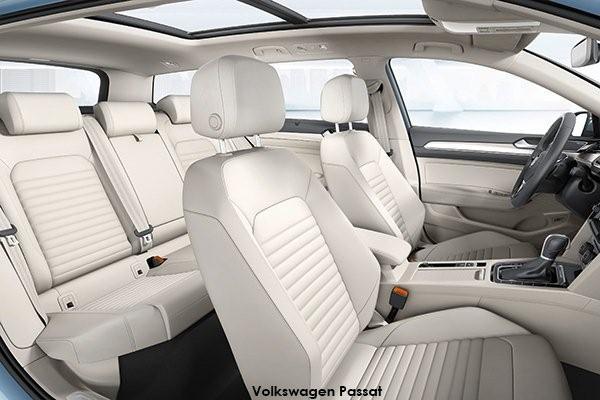
Exclusive atmosphere. Analogous to the elaborately designed exterior, the interior designers developed an interior whose aesthetics, clarity and high value are a match for the sophisticated overall concept of the eighth generation Passat. Due to numerous new design solutions, precisely executed details and innovative technologies such as an Active Info Display and a Head-Up display, the interior is more avant-garde, distinctive and multifaceted than ever. The modular transverse matrix made it possible to further improve interior space as well. Although the new Passat is 2 mm shorter than the previous model, interior length has grown by 33 mm. Cargo capacities have also increased. In the Estate, cargo capacity is increased by 47 to 650 litres; when the bootspace is filled to the roof, cargo capacity grows to 1,780 litres. In the Saloon cargo capacity increased by 21 to 586 litres.
Horizontal ventilation strip. The goal defined when development began of creating a feeling of lightness and generous space in the interior was realised by the designers with a lean dashboard with a consistent horizontal structure, and the front door panels are stylistically incorporated into this design. The central design element of the dashboard is an innovative air vent that extends across the entire width of the interior like a band and is designed as a functional decorative element. So there are no separately placed air nozzles in the new Passat, rather one continuous element that is only interrupted by the instruments and the analogue clock in the middle of the dashboard – it consistently unifies form and function. The clear architectural character is created by the impressive length of the chrome fins integrated in the air vents and a decorative panel integrated beneath it. The dimensions of the air vent not only affect the design of the dashboard; they also have a positive effect on climate control performance and ventilation acoustics.
Stylish ambient lighting. Beneath the air vent and the decorative panel there is an extremely low-profile ambient light strip that continues into the doors. Its wrap-around lighting effect defines the space and creates a pleasant mood. This staging begins when the central locking system is opened by wireless remote control or by Keyless Access. In this case, the central lighting unit in the headlining dims first and immerses the centre console in a warm light; immediately thereafter, the inside door handles are illuminated, and the wrap-around ambient light as a narrow, fine strip in the dashboard and door panels is activated (the three available colours "Cyan", "White" and "Amber" and the intensity can be set from the "CAR" menu in the infotainment system). At nearly the same time, the footwell is also immersed in an orientation light. As soon as the ignition is activated, the wrap-around ambient lighting and the illumination of instruments and switches are dominant; all other light sources are dimmed to an individually preset level. When the ignition is shut off, all light sources are ramped up again to simplify orientation.
Driver-oriented architecture. The designers placed special value on a driver-oriented design and a very spacious feeling of the front interior area. Therefore, starting from the seating position of the driver, the dashboard builds upwards in the space to the two sides of the instruments, inclined slightly towards the windscreen. This creates a spacious feeling as well as an ideal ergonomic landscape. The centre console also has en extremely clean layout, is well organised, and the controls are easy to access. The infotainment system is integrated high on the console and is easy to see; the climate controls are positioned beneath it. Since the console between the driver and front passenger has a sporty incline up towards the infotainment system, the gear shift gate is up high, and the gear shift grip is in an ideal ergonomic position.
Active Info Display. In the Passat, Volkswagen is launching an instrument cluster that has been designed as a full interactive display: the Active Info Display. All instruments are implemented virtually via software. Only the icon lights at the lower border of the display are still implemented in hardware. Navigation information can be shown in 2D or 3D views on a 12.3-inch display. Its resolution of 1,440 x 540 pixels enables extremely precise, high- quality graphics and interactive display of all details. Take the Navigation mode, for instance: Here the speedometer and tachometer are relocated to the sides in order to create more space for the map. Information on driving, navigation and assistance functions can be integrated into the graphic areas of the speedometer and tachometer as needed. Data that is displayed on the centre console via the infotainment system, such as phone contact pages or CD covers, can also be shown in the Active Info Display in the Passat. Volkswagen is offering the Active Info Display as an optional alternative to analogue instruments.
Head-up display. The new Passat will now also be the first Volkswagen to have a Head-Up display. It projects important information, such as vehicle speed or navigation pictograms, directly into the driver's primary visual field. Thanks to the projection of the Head-Up display, the driver's eyes can remain focused on the road while reading data such as vehicle speed. Reaction time can also be significantly reduced by projecting warning messages directly into the driver's visual field. The Head-Up display of the Passat is a "combined solution": the data is projected onto an extending glass panel before the windscreen. Developers succeeded in attaining the same display quality as in much more expensive windscreen systems. When it is not in use, the display can be lowered into the dashboard to protect it, and the opening is closed flush to the dashboard surface. To the driver's eyes, the projected data appears to be displayed around two metres in front of the Passat. The results: because drivers do not have to shift their gaze back and forth between the instruments and the street nearly as often, they do not have to constantly refocus their eyes, and this reduces eye fatigue. The Head-Up display is activated by a separate control next to the rotary light switch. The driver can decide – from the menu of the infotainment system – which information should be displayed: momentary speed, speed limit, navigation instructions, information on assistance systems or warnings.
[ source : Volkswagen ]
Auto Trader News and Reviews brought to you by vehicle information specialists]