
Lamborghini concept shows possible move to less extreme looks
Lamborghini concept shows possible move to less extreme looks


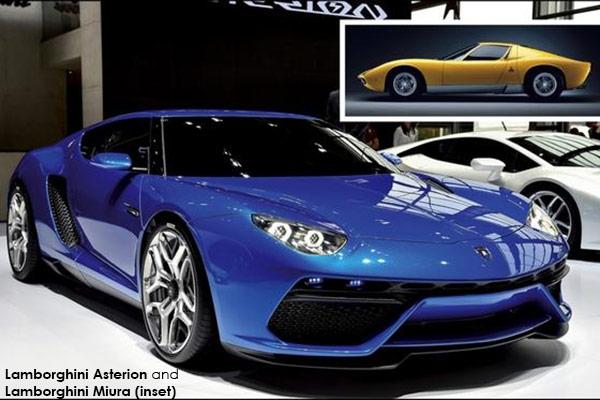
Lamborghini design boss Filippo Perini and his team faced a tough challenge when they started work on the Asterion concept. They wanted the Italian supercar maker’s first plug-in hybrid to have a unique look, one that steps away from the angular and aggressive forms of recent cars by borrowing less extreme features from renowned Lamborghinis of the past such as the Miura.
“We need to understand if we can open another window in our future to be not so extreme but also a little bit more politically correct and elegant,” Perini said. He said that a key reason for the design shift was that the Asterion rides differently from the Volkswagen Group subsidiary’s current models.
In most Lamborghinis occupants have the sensation of being pushed by the car’s power. The feeling in the Asterion is akin to being pulled. “For this reason we decided that this car needed a new dress, a dress that is much more classic, much more GT, and inspired by the Miura.”
Perini points out that Lamborghini started as a maker of Grand Turismo-style cars such as the 350GT. Later founder Ferrucio Lamborghini built cars such as the Espada, Jalpa and Urraco, all of which established the company’s design direction. “We were taking inspiration from our heritage,” says Perini. “You can see flavours of the Miura and flavours of the Espada [in the Asterion], and this is because of the platform.”
Modern & traditional
The Asterion’s more modern design features include front lamps that utilize high-tech materials such as titanium, forged carbon fibre and aluminium. The new look is woven together with typical Lamborghini design features such as exposed screws and hexagonal shapes.
The hexagon treatment is echoed in the composite engine cover and exhaust tips as well as the front grilles and side air intakes, which are double layered to incorporate Lamborghini’s Y-shaped elements, as seen on the rear lamps. The rear of the car also recalls Lamborghini’s history while referencing the supercar maker’s more contemporary vehicles such as Huracan and Veneno, albeit with different proportions.
“The rear end is close to the Miura feeling. You have the same size impression, the same solution of lines,” Perini said. “In every detail we are pushing modernity and luxury but the surrounding is traditional, it’s classic.” Though the Miura also inspired the Asterion’s three-spoke steering wheel, the interior is very close to the recently launched Huracan, with a horizontal, symmetric dashboard and a longitudinal tunnel that, in this case, houses the car’s battery pack. The air vents, door handles and switches also are shared with Lamborghini’s production supercars.
“What we did was to improve the ergonomics to have better roominess,” Perini said. “We reduced the dimension of the rocker to have a better entrance, we have a very comfortable seat and we have a raised H-point, which means you can drive the car in a very different way.” The changed seating height is a big switch for Lamborghini. In the Asterion the driver has the view of the front fender. “You can see the colour of the car,” Perini said. “That is something unknown in our very extreme designs.”
The interior is also a laden with technology such as the TFT screen’s reconfigurable graphics for the car’s different driving modes. There’s also a touchscreen infotainment pad, which can be detached and used by the passenger. “This is something we are looking at,” Perini says. “A different use of the car – a daily use of the car.”
Perini said that while the Asterion’s design language is atypical, it does not signal a radical forthcoming change to the company’s design identity. “We will continue to produce really extreme supercars,” he said, “but our goal is to understand if the [Asterion’s] design language will be appreciated by a different kind of customer.”